

2026-09-15 03:54:29

A few days ago, like everybody else with a modicum of interest in tech, I saw the Apple event Surprise and Shine where they introduced the new iPhone 18 Pro and Pro Max, the new iteration of AirPods, Apple Watch, and then the One More Thing — the iPhone Duo.
[Quick aside before going on: maybe it’s because Steve Jobs’s Apple was better at keeping secrets (except for that unfortunate iPhone 4 situation), but only during Jobs’s tenure these One More Thing moments in keynotes really surprised me.]
As usual during these bland, over-rehearsed, over-produced, pre-recorded, sleep-inducing Apple events, I tend to jump over on Mastodon and let my snark flow while I live-microblog. The iPhone Duo segment got a bit of my attention back. I hadn’t read any rumour nor seen any rendering predicting the shape and look of this device prior to the official event. I looked at the iPhone Duo with fresh eyes.
And I’ll tell you this, without irony: I really like the iPhone Duo. I like the hardware, the form factor, the construction, and how Apple has adapted iOS to work on this specific iPhone.
The pricing is ludicrous, of course. Watching all the YouTube tech influencers I still have a bit of respect left for, all saying It’s less than I expected, made me chuckle. If you didn’t know the price, you would think for a split second that it’s even an affordable device. Nah, fool, it ain’t. And I’ll tell you all the prices of the Duo here in Spain:
| Storage | Price |
|---|---|
| 256 GB | €2,339 |
| 512 GB | €2,589 |
| 1 TB | €3,089 |
| 2 TB | €3,839 |
But, believe it or not, what makes the iPhone Duo unappealing to me is not the price. It’s not my diminished trust towards Apple as a company. It’s not even the fact that I’m slowly but surely abandoning the Apple ecosystem and don’t want another device that’ll pull me back in.
It’s that the iPhone Duo is an empty device, conceptually. It’s just another foldable. It’s a very well-made foldable for sure. But — like all the other foldables preceding it — simply restates the fundamental idea. You carry a smartphone that can unfold and become a small tablet, to give you a bit more screen real estate for unitasking, or the ability to run two apps simultaneously side by side, and interact between the two if needed. That’s mostly it.
For most foldables, this distinctive feature — a display that folds and unfolds — has also been its weakest point. The display doesn’t unfold perfectly. The area is unified in software. You see and interact with a single screen that’s double the size of the device when folded. But the area across the hinge is delicate. The crease, usually visible or at least somewhat perceptible. These past years many of the premium foldables have iterated on this pain point, making better hinges, using more robust materials, inventing new solutions to prevent dust from accessing the most delicate parts. They all did a great job at perfecting this. Apple did an amazing job considering it’s their first foldable.
But that display folding in the middle remains a background process in your mind as you open and close and open and close that expensive foldable smartphone dozens of times every day. How long is it going to last? And if I drop the phone in a certain way? Will the protective case help? What if the phone lands unfolded and face down? Will a scratch or a nick be enough to start an irreversible fate down the road?
The foldable phone category has always left me a bit perplexed. Flip phones, less so. I’m more of a guy who’d like a smartphone that becomes even smaller by flipping close, rather than having to carry an iPad mini that folds into a still-large smartphone. I’m not saying foldables are useless devices — I can see their appeal. But I also see how they appeal to people with very specific needs. Like, tech enthusiasts who already work from their phone when out and about, multitask a lot between a few favourite apps, and who would also like to have some more screen real estate… and who also don’t want to bring too many different devices with them, like a phone and a tablet; or a phone and a laptop; or, goodness me, all three devices together.
Foldables possess this contradictory nature: instrumentally, they appeal as a multi-tool; practically, they present as a very expensive multi-tool. Or, if you still like car analogies: they appeal as an agile economy city car, spacious inside but not big and hideous like an SUV, but then their price make SUVs and luxury sedans appear affordable. Their target audience is bound to be niche, mostly people who really need what foldables offer. The curious customer who would buy a foldable just to have a cool device to watch videos on the go more comfortably, has to be someone with money to burn, or someone willing to undergo the bloodletting that paying in instalments represents. In short, I think very few people buy a €2,300 foldable phone ‘just for kicks’.
Let’s go back to the concept of a foldable phone now.
What if, instead of being a phone that unfolds into a small tablet — or a tablet that folds into a smaller device — a foldable phone were the digital counterpart of a notebook, a journal? What if it maintained the inner duality of having two facing ‘pages’ cleanly separated by a spine? What if this duality was the concept and you built on it, following the metaphor of the book, embracing the hinge and the separation between the two sides of the device? It’s what Microsoft did. First with the Courier project, and then with the Surface Duo.
This might seem limiting to some (or to many), but I very much prefer to handle a device with a clear focus and defined use cases rather than a device that wants to be many things at once and equally good at all of them. Very few multi-purpose devices truly succeed in that.
I’m the typical person who has very little use for a foldable phone. I don’t need an already large smartphone in my pocket that can become an even larger device when I’m sitting in a café. I very much prefer a small phone (say, the size of an iPhone 5) and my perfect laptop because I feel I’m carrying with me the best of both worlds, not a compromise.
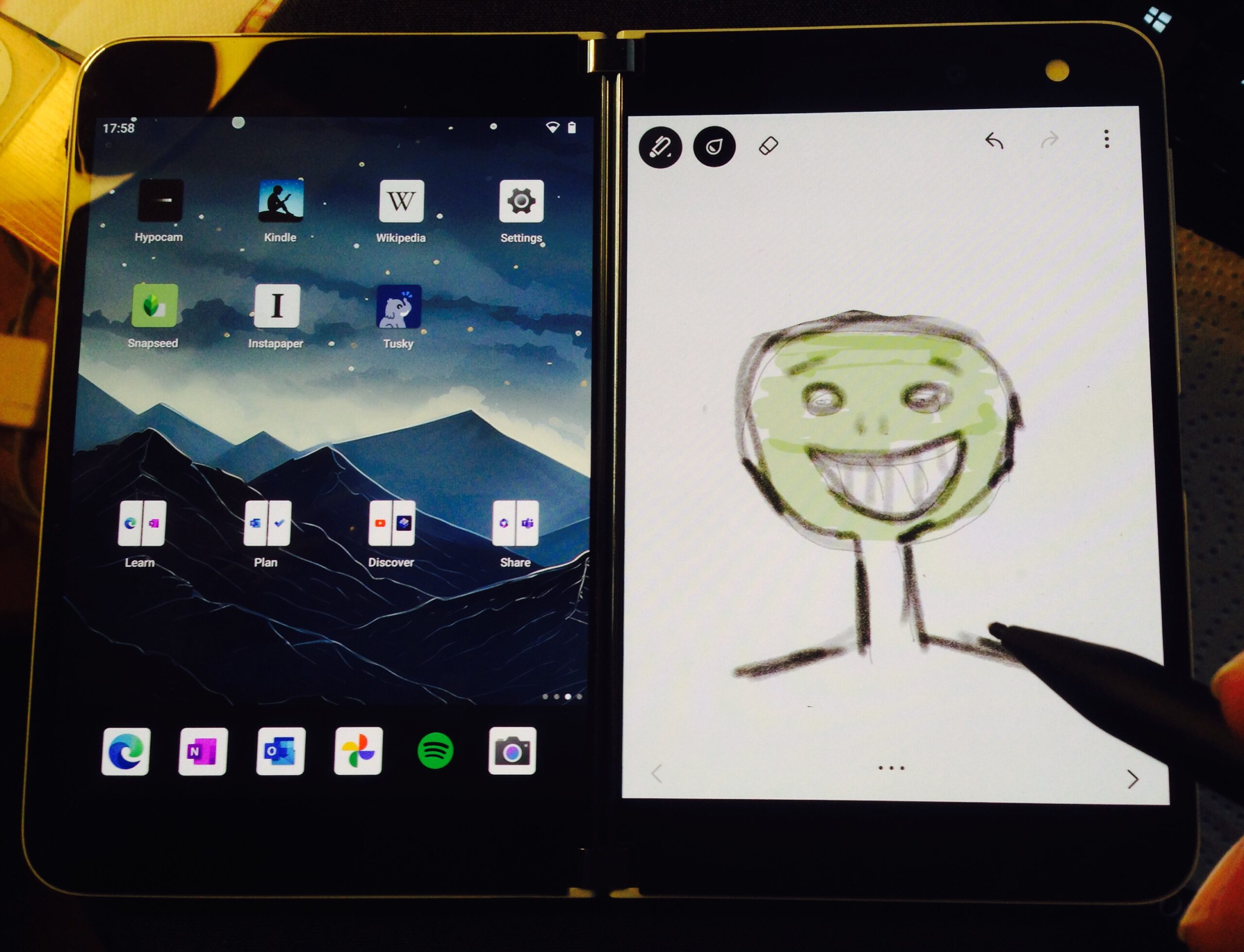
But I’m also a person who has a long history of writing and sketching in pocket notebooks, and using physical planners and agendas. That’s why I found the Microsoft Surface Duo to be extremely appealing from the very start. I had to wait until early 2024 to find a great deal for a second-hand unit, and the Surface Duo has been my digital notebook ever since, warts and all.
Is the execution perfect on the Surface Duo? No, not entirely. When the device was introduced in 2020, Microsoft’s choice to use Android as the Duo’s operating system didn’t sit right with me. I kept hoping they would go back to Windows Phone or Windows Mobile and revive the Metro UI, maybe in some kind of reimagined way and adapted for this new device. I still think it would have been a great marriage of hardware and software.
But we must work with what we have, and while some parts of the user interaction are a bit rough around the edges, they’re not as bad as to interrupt the flow. I wish the original Surface Duo could be updated beyond Android 12 without having to engage in some hacking, and I wish Microsoft would have iterated more with this device. But it’s all still pretty usable — browsing, email, reading ebooks (the Kindle app is particularly satisfying — given the Duo’s ‘book’ form factor, it really looks like you’re reading the digital version of a book), taking notes (even handwritten notes), sketching (the Surface Duo supports the Surface Pen out of the box), reading feeds, consulting maps, etc.; all of these things can still be done seamlessly today. The device remains responsive; nothing feels outdated; you don’t feel you’re having a lesser experience.

One of my preferred ways to use my Surface Duo — two apps opened side by side.
You can have apps take the entire screen (or rather, the two screens together) — you’ll obviously see the clear separation in the middle. Sometimes it feels better to turn the Surface Duo in portrait orientation — so that the hinge separates the two halves horizontally, have an app take the whole real estate, and scroll vertically. Or you can place the Surface duo in such a way that an app takes one screen in landscape orientation, and the virtual keyboard takes up the other screen. This way, it’s like having a mini-laptop.

What I particularly like about the original Surface Duo is that Microsoft put forward a very opinionated device, with a series of purposeful design choices that made that Duo unique.
The original Surface Duo, in this regard, is the most Apple-like device Microsoft has produced. Conceptually, it’s a device that could have been imagined within Jobs’s Apple (again, I’m talking more about the Surface Duo’s personality rather than its literal design, although the Surface Duo feels much closer to Apple’s Knowledge Navigator concept than the iPhone Duo).
And that’s why it’s such a frustrating pity that Microsoft didn’t believe enough in the Surface Duo to push all these opinionated takes and stress the Duo’s uniqueness. They could have doubled down on the ‘book’ form factor in so many ways. They could have optimised so many parts of its user interface to be interacted with a stylus, just like in the original Courier prototype design. The Surface Duo could have become a sort of modern Apple Newton MessagePad. It could have become what many e‑ink tablets released afterwards have actually become — the digital equivalent of paper notebooks.
Instead, Microsoft treated this potential jewel with the most obtuse inertia. The second iteration, the Surface Duo 2, was bland and unimaginative. People wanted better cameras? Microsoft added just that — an unsightly camera array on the back of the device. It didn’t look like an elegant digital notebook anymore. The 360-degree hinge couldn’t fully reach 360 degrees anymore. The Surface Duo 2 may have featured better hardware underneath. But everything that had felt unique, fresh, and original in the first Duo’s concept had practically been killed.
In comparison, Apple’s new iPhone Duo — as good as the hardware and overall design are — doesn’t really introduce anything new. It’s just another foldable, produced following the guidelines of the many Android foldables that have preceded it. It doesn’t pioneer any new interface paradigm that may hint at innovative new ways to use such a device, or use cases never before seen in the category the iPhone Duo belongs to. It’s another ‘me too’ device of today’s Apple, constantly afflicted with this Fear Of Missing Out.
2026-09-03 20:40:29
In the past two months, for no apparent reason, I’ve noticed a surge in emails from Mac OS and iOS developers, offering me the opportunity to test their apps, with no obligations to subsequently write a review; they just ask an honest opinion. Very often their email would mention that they chose to contact me based on a past article I wrote, or for vague things like ‘user interfaces being important to me’.
The pattern I noticed in these emails is that they all seem to follow the same format. There’s briefness, initial pleasantries, a quick description of what the app does, the offer of a redeemable code, and a concluding ‘no strings attached’ statement.
I haven’t responded to any of these — except the first one, which sounded genuine, until I received the exact same email with a different free code two days after my reply. My lack of reaction isn’t out of spite or because I’m busy or because I’m not interested, or whatever. It’s much simpler: I’m currently running Apple devices that do not fulfil the system requirements of your apps.
This situation is unlikely to change in the near future.
My main machine, an M2 Pro Mac mini is currently on Mac OS 13.7.8 Ventura. I plan to upgrade it to Mac OS 14 Sonoma before the end of the year, and that’s it.
Either of the following has to happen for me to update my Mac OS installation to the most current:
To anticipate your question: yes, I’m willing to run an outdated version of Mac OS on my main Mac. It has a better UI, it has better software, it doesn’t have any ‘AI’-related features. It’s a familiar place I have no intention to disrupt to install something I cannot bring myself to even look at.
My main smartphone has not been an iPhone since late 2024. What was my primary iPhone, and the iPhone I still use on occasion to interact with iOS apps I still love (photo apps in particular) is a third-generation iPhone SE running iOS 17.6.1. This iPhone, at the time of writing, can still be updated to the latest version of iOS (26; I don’t know whether it’ll support iOS 27), but I don’t plan to update it past iOS 18, for two main reasons:
As for iPadOS, I still use an eight-generation iPad, currently on iPadOS 18. Again, this iPad could be updated to a newer version of iPadOS, but for now I’m keeping it on iPadOS 18. This is the only device I could maybe update to iPadOS 27 if it’s still supported. I don’t use this iPad that often and I don’t have particular apps I need to preserve, so that’s a possibility.
Feel free to contact me and propose I check your Mac OS/iOS app out, but if your app:
then don’t bother.
2026-08-28 01:52:11
I enjoyed this blog post by Michael Harley, titled My perfect laptop, which I discovered via Mike Rockwell. It was very interesting to discover what Harley and Rockwell consider to be a great laptop and why.
My daily routine has changed in the past years, and I spend much less time working on the go, so I’m not as reliant on having a great or even perfect laptop with me when out and about. I actually think I have found my perfect desktop in the M2 Pro Mac mini I purchased in 2023. While not being as compact as the M4 Mac mini, it still retains a small footprint, which is great given how cramped and crowded my main desk is. It’s also a very reliable and very powerful machine for my, let’s say prosumer needs. Next, it’s equipped with a good mix of modern and legacy ports (2 USB‑A and 4 USB‑C/Thunderbolt ports). Finally — and this is something I can only appreciate with hindsight — I got it at a time where Mac OS was still decent. It came with Mac OS 13 Ventura preinstalled, and three years later I’m still happily running it without encountering any issue or setback. I’m still standing by my intention to upgrade it to Sonoma but not to anything newer.
Anyway, I’m not completely bound to a desk and a desktop machine, so having a perfect laptop is still something that matters to me. Over the years I’ve actually put together a small collection of what I consider very interesting portable machines, and all because I was intrigued by the idea of experiencing different operating systems’ UIs firsthand. So I have a ThinkPad 240X subnotebook from 2000 that’s running Windows 2000 Professional; a Toshiba Satellite from 2001 running Windows XP; a 2007 ThinkPad X61 Tablet running Windows 7 Pro (a very cool and still somewhat compact 2‑in‑1 machine); a 2008 ThinkPad T400 running Windows 8.1 Pro; a 2015 Microsoft Surface Pro 4 running Windows 10; another Windows 10 laptop I’ll talk more about later; another couple of laptops running Windows 11; a 2008 ThinkPad X301 running a Linux distro called CrunchBangPlusPlus; and of course several Apple laptops of different vintages.
The two laptops I want to focus on to give my answer to the question What’s your perfect laptop, and why? are these:

This is the Apple laptop closest to perfection, in my opinion. I purchased mine second-hand in late 2018, and this is how I started talking about it in a piece I wrote in January 2019:
When it arrived by post a couple of weeks ago, I joked on Twitter: Loving my new 11-inch iPad Pro!
It turns out it was only half a joke. This Mac really invites you to treat it as a pro tablet + keyboard. It’s very compact, it’s very light (1.08 kg), it’s still a thin machine by 2018 standards, it has a long-lasting battery. It’s also absolutely quiet (yes, I checked, the fan works) and it’s instant-on.
[…] It’s a mid-2013 model, with a Core i5 CPU at 1.3 GHz (turbo boost to 2.6 GHz), 4 GB of RAM, and a 128 GB SSD. The 2013 vintage means it has two USB 3 ports, a Thunderbolt port, a better graphic chip (Intel HD 5000), and that it can run the latest version of Mac OS [At the time]. I also managed to find a unit that was well taken care of: its battery is at 94% health, has a low charge cycle count, and still lasts more than eight hours on a charge. Not bad for a 5‑year-old Mac.
The first remarkable detail is that its battery has aged incredibly well. Eight years later, doing normal work on it, the battery can still last around six hours! Nothing earth-shattering compared to the performance of current laptops, but still staggering given that it’s a 13-year-old MacBook Air.
Its specs, again, are nothing to write home about nowadays, but despite the 4GB of RAM and the unexceptional CPU or graphics card, this MacBook Air handles ordinary tasks very well, and I’ve never experienced a slowdown. Granted, I’m not doing any video editing or sophisticated photo editing with it, but it can have multiple apps open and several tabs open in a browser, and tackle the load with aplomb.
If this machine had a retina display, it would be absolutely perfect. I quoted Michael Tsai back in 2019, and I’ll reiterate the quote today: Nothing that Apple makes today has close to that combination of price, power, ports, and size. I feel this to be true today as it was true seven years ago. Even software-wise things are ideal, in my opinion: this MacBook Air model can be upgraded up to Mac OS 11 Big Sur, and the last 11-inch MacBook Air (the early-2015 model) can be upgraded to Mac OS 12 Monterey. This means that a max specc’d early-2015 11-inch MacBook Air, with a 2.2GHz Core i7 CPU, 512GB SSD, 8GB of RAM, a new battery, and running Mac OS Monterey could still be a very useful Mac today even if it doesn’t have an Apple Silicon chip.
You’ll probably retort by saying that perhaps the 13-inch 2020 MacBook Air with M1 processor is an even better machine, and for many things it is. It has a retina display and a faster architecture that makes this Air still quite viable today. But — for me — it’s not as compact as the 11-inch models, and it has fewer ports.
And believe me, that compactness is an important factor. As I said in 2019, the 11-inch MacBook Air is the only instance of Apple doing ‘thin & light’ rightly. But having a MacBook this compact, combined with a regular-sized keyboard (except for the row of function keys) and with a usable-sized trackpad means that you can absolutely work in total comfort on a plane or train — the 11-inch MacBook Air is the perfect size for those cramped tray tables. I’ve just returned from a 2‑day trip to Madrid and I brought my Air with me just in case I had to do some work assignments, and turns out I had to. I could work from my train seat and from the tiny desk in my hotel room without struggling to find a comfortable position.

The brochure for this 2016 laptop describes it as The world’s lightest business rugged 12.1” mobile PC and after spending quite some time with it, I’d say it’s hard to argue otherwise.
This was a chance eBay find after reading an article on Panasonic ‘Toughbooks’, rugged laptops that are often fused in bulky-looking briefcases made for use in extreme conditions. But as you can see, though this CF-SZ6 is technically part of the Toughbook family, it looks just like another regular laptop.
The reason this feels like an almost perfect laptop for me is that it possess that combination of price, power, ports and size Michael Tsai was talking about when referring to the 11-inch MacBook Air. This Panasonic has a better display (12.1″ WUXGA with 1920×1200 resolution), which is bright and clear. It comes equipped with a decent 1080p webcam, three USB 3 ports (USB‑A size), Gigabit Ethernet, HDMI and VGA video out, SD memory card slot, Bluetooth 4.1 and 802.11ac Wi-Fi. My model comes with a Intel Core i5-7300U vPro CPU (2.6GHz, turbo boost up to 3.5GHz), 8GB of RAM, 256GB SSD, a battery that still last several hours, and all this in a package that weighs only 850 grams. You read that right. In the hand, it feels even lighter. It feels like you’re handling a dummy made for display in a computer store.
The secret to its weight is of course in the choice of building materials: plastic and magnesium alloy. The outer surface feels like one of those Sony portable CD or MiniDisc players: they look metal in photos, but the chassis is actually mostly plastic. Even flimsy-looking plastic in some cases. And yet, while not looking or feeling like premium building materials, this laptop is rugged and resilient. It’s the perfect “toss it in your backpack without a protective sleeve and go” laptop.
In use, it’s as capable as the brochure promises. It cold-boots to desktop in less than 15 seconds. And when you put it to sleep, it even has a front green light that breathes like Apple PowerBooks and MacBooks used to do! I won’t lie, I had to get accustomed to the circular trackpad at first, especially for scrolling — to scroll down you move your finger clockwise, to scroll up counter-clockwise — but it quickly made sense. It also comes with a dual Japanese/English keyboard layout, and I had to memorise the location of a few specific keys, placed differently from where I usually find them on my ThinkPads. I still have Windows 10 Pro installed, and technically the CF-SZ6 doesn’t support Windows 11, but I’ll cross that bridge when I get there. For now, it’s a very responsive machine I can absolutely work on when needed, and still has a lot of life in it. All in all, the best €100 I spent for a second-hand laptop, and a surprising alternative for a ThinkPad fan such as myself.
2026-07-31 21:34:24
I’m not subscribed to The Atlantic, so I can only refer to this article by Damon Beres — The New iPhone Underclass — Apple’s rental program is a trap — via the parts that John Gruber quoted for his commentary.
In his criticism, Beres points out that:
The Klarna plan — “Apple Upgrade,” which replaces the iPhone Upgrade Program — is truly, legally, a lease. This is confusing! And it’s confusing in part because this is not how Klarna, a well-known buy-now, pay-later service, typically operates: When you use Klarna for clothing from Shein or lip kits at Sephora or an Xbox at GameStop, you’re paying back a loan, exactly as you were in the original iPhone Upgrade Program. Same if you use Klarna to buy a Samsung Galaxy phone. But with Apple Upgrade, you are renting: The Mac or Apple Watch is not yours until the final payment is made.
Gruber remarks:
I don’t think this is confusing at all. Apple Upgrade is the primary brand for this program, not Klarna. Klarna is really only mentioned in the small print. You get into Apple Upgrade through Apple.
And I agree with Gruber here. I don’t think it’s confusing either. But Beres says something worth emphasising here. Probably you’ve already spotted it. I’ll return to it in a moment.
In Beres’ opinion, the Apple Upgrade plan is a trap mainly in the way instalments work:
Consider a student or a young professional, or perhaps an underemployed older one, who needs a new laptop. They decide on a MacBook. Apple Upgrade will appear to be the best deal: In its announcement, Apple offers the example of a 14-inch MacBook Pro that retails for $1,999 but that can be had for a monthly lease. Perhaps this person goes for the two-year term, which has them paying $54 a month. Best Buy, which currently has the same computer on sale for $1,849, offers an 18-month loan repayment with $103 installments. Apple’s deal appears to be cheaper: The 24-month lease adds up to $1,296; Best Buy’s 18-month loan lands at the store’s full retail price of $1,849.
Why does Best Buy’s laptop seem more expensive? It’s because the plan is actually designed for you to fully pay off the device. At the end of the 24-month MacBook Pro lease, meanwhile, the consumer will still owe $703, meaning that the actual total price of the Apple arrangement is $1,999 — higher than Best Buy’s offer.
And again, I have to agree with Gruber when he retorts:
This has nothing to do with the differences between Apple Upgrade’s leasing terms and Best Buy’s 18-month loan. It’s the difference between Apple’s retail price of $1,999 and Best Buy’s $1,849. Guess what? $1,849 is less than $1,999.
Unfortunately, Beres gets lost talking about money and instalments, and things like “Apple’s deal seems to be cheaper”. Meanwhile, perhaps without realising it, he was already en route to a good argument. Let’s go back to the first quote, when at the very end he wrote:
But with Apple Upgrade, you are renting: The Mac or Apple Watch is not yours until the final payment is made.
That’s the point, in my opinion. The ‘trap’ in Apple Upgrade (and in similarly-conceived plans by other companies) is more subtly psychological. Gruber gets it more than Beres:
That’s surely the appeal of this whole thing from Apple’s perspective — that leasing entices people to keep starting new leases every two years rather than just sit back and enjoy a fully-paid-for device for a few additional years. I think it’s a stretch to call that a “trap”, though.
But while getting it more than Beres, Gruber is still coy about the crux of the matter — ownership. And that’s why I think we should still call this a ‘trap’, at least in quotes.
I can’t stress the point enough: the Apple device you’re leasing isn’t yours until you fully pay for it. Contractually, there’s a big difference between owning something and renting it. I’m not a lawyer, but when you own a product, you have certain assurances, warranties, and rights you probably don’t have when the same product isn’t technically yours. And until the product isn’t yours, a tech company can potentially find ways to screw you. (If you don’t like my cynical language, I’ll rephrase that with “a tech company can potentially use that to their advantage in various subtle ways”).
If you haven’t noticed, one important current trend in tech is to nudge people away from owning products while normalising subscriptions (paying for access) and product licensing. See for example the recent Sony situation, where the company announced that they’re phasing out physical media for PlayStation games, turning everything to digital by 2028. Tech companies want us to own nothing and rent everything, so they can have the upper hand in this arrangement.
I’m not arguing that the new Apple Upgrade plan can’t be advantageous for customers, especially if your budget is tight, you need to buy a new Mac, and you can’t pay for it upfront. And the fact that, if you choose to keep paying until you own that $1,999 Mac, at the end of the lease period you won’t have paid a dollar more, is without doubt another good thing. But don’t let this distract you from the main issue: you only truly own that Mac when you pay for it in full. And what Apple ideally wants here is that people stop thinking about owning devices and start leasing them indefinitely. The proposition can seem very enticing — you can theoretically keep staying up-to-date by returning your leased Mac before fully paying for it, and just lease a newer Mac; rinse, repeat. This is the behaviour Apple wants to normalise.
I’m sure that this never-ending lease cycle will appeal to specific customer segments (professionals that need to have the most performant Mac at all times — frankly a niche — and those fanboys who are obsessed with always having the ‘latest and greatest’ stuff), but I urge everyone to never lose sight of the matter of ownership. Owning your computers and devices is important — that gives you more rights and more freedom, and I’ll add it’s the best choice from an ethical standpoint.
Also, if you’re a regular Mac user who doesn’t use the Mac for performance-critical tasks, you really don’t need to upgrade it every 1–2 years. Apple Silicon Macs are so brutally performant today that in the sheer majority of cases you will not notice the bump in performance between, e.g., an M4 and M5 Mac. My M2 Pro Mac mini from 2023 is still a very capable machine. Basic tasks are still carried out without lag, I constantly have 10–12 apps simultaneously open for the better part of the day, and I haven’t noticed a glitch or slowdown in more than 3 years of ownership. And this mini still tackles the occasional resource-intensive task (a demanding game, a video-editing session) with aplomb.
Tech companies are quietly and patiently eroding our agency in this increasingly toxic and abusive relationship. In an ideal scenario the two parts should be peers, instead these companies increasingly want us to be a part of their processes. We must think of ourselves and for ourselves first. We must keep establishing boundaries and refuse to play games whose rules are out of our control.
2026-07-01 02:11:19
In a short novel I wrote about 20 years ago, there’s a scene where Eric K. (the protagonist, a private detective) and his best friend Patrick Z. (a hacker), are approaching the investigation from different angles. There’s a bit of banter between them, then Patrick ends the conversation dismissively, hinting that there’s work to do and they’re just wasting time. “Off you go,” he says to Eric, “As they say, You’re a detective, go detect. I’ll stay here with my machines. [a beat] They’re computers, they’ll compute.”
I was reminded of this exchange when thinking about the current phenomenon of so-called ‘AI psychosis’, where people, believing the many lies of the ‘AI’ industry, think that now computers and other computing devices are capable of thinking, reasoning, understanding, remembering and learning from our ‘conversations’ and their training, and so on and so forth. They aren’t.
There is no intelligence involved behind the blanket term that ‘AI’ has become today. Large Language Models are a useful tool within specific applications, but that’s all there is to it. It involves statistical analysis, it involves prediction. But outside those applications where it can produce useful results, it’s a gimmick, it’s a magic trick. The ‘AI’ industry is doing exactly this — selling you a tool that can be used to perform a magic trick while telling you that what you’re getting is real magic. That magic exists.
Nothing has changed in the nature of computers since their invention. The difference between the first mechanical computers (e.g. Charles Babbage’s machines) and what we have today on our desks is computing power. Nothing else. Computers have become increasingly fast at performing calculations, their hardware has become increasingly refined and sophisticated, their use cases have multiplied, but nothing in their fundamental structure has changed. Today’s computers do not think. Despite what the ‘AI’ industry and ‘AI’ fanatics may tell you, there is nothing ‘neural’ about ‘artificial intelligence’ or computers today. It’s snake-oil salesman marketing terminology designed to misdirect people. It’s like telling you that that mug with Homer Simpson’s face on it is alive and has feelings, while actually it has a thermo-sensitive coating that makes Homer Simpson change expression when you pour hot liquids into the mug.
The ‘AI’ industry has essentially capitalised on that famous Arthur C. Clarke’s quote, which is the third of his three laws: Any sufficiently advanced technology is indistinguishable from magic.
I’ll say that the computing speed of today’s devices is fast enough to trick some people into thinking that such devices are doing more than just performing calculations. But this ‘understanding’ and ‘learning’ and ‘communicating’ are just a faster and sometimes more efficient autocorrect. Yes, the autocorrect you have on your phones and tablets and personal computers.
When you’re typing a message and you see your phone’s OS correctly suggesting the next word after the one you’re typing, that’s not intelligence. The phone doesn’t ‘get’ you. The phone doesn’t ‘know’ you. The system is making a prediction by calculating probabilities. The data sample it’s using for this prediction is everything you’ve typed on the phone since you bought it. Fun anecdote: one of the vintage iPhones in my collection is a second-hand model I purchased from an Austrian seller on eBay. Throughout its previous life, this iPhone was set up in German by a user who only spoke German. I switched the language to English, and the first times I was typing messages and other things, the predictive text engine was essentially shooting random stuff, and ‘guessed right’ only in obvious scenarios, like suggesting ‘the’ after I typed ‘into’.
Now, some will say, But as you kept typing stuff in English, the iPhone got better at understanding you and at suggesting the right words. But that is not learning in the same way a human learns. That is ‘learning’ in the sense that pieces of information have been progressively stored in the device’s memory. When I type “Hey, do you want to meet for lunch…” and the iPhone autocorrect proposes ‘today’, ‘later’, and ‘now’, these are guesses that are calculated every time, from scratch, by going through all the similar sentences I may have written in the past. It’s not knowledge. In fact, the iPhone doesn’t even know what ‘lunch’ — or any other word in that sentence — means. It has only registered that, up to now, 349 previous sentences I wrote ending with ‘meet for lunch’ had the word ‘today’ after ‘lunch’, 188 sentences had the word ‘later’ after ‘lunch’, and 70 sentences had the word ‘now’ after ‘lunch’.
By the way, Large Language Models don’t even see those as words, but numbers, tokens.
When you ask ChatGPT or Claude or your fave chatbot something — whether a simple query or what sounds like a more sophisticated one — these tools are not sentient, they’re not ‘built different’. They process the data you passed to them, which is analysed, computed, and spat out in a friendly, anthropomorphised language. These tools are designed to sound like real, responsive, agreeable, trustworthy assistants. But the emphasis should not be placed on trustworthy — it must be placed on sound like. Because they’re far from infallible, and their output should always be fact-checked. This is the main reason I don’t waste one second of my time with this stuff and insist on doing my searches and research myself. I want to look at the sources, I want to cross-check and do my due diligence. I don’t need shortcuts — I’m not in a hurry. And if you’re doing important and meaningful work, you ought not to be in a hurry, either.
In a conversation with friends on this subject, one put this in a way that looks pretty straightforward to me: ‘AI’ isn’t a surgeon (or any other professional); it’s an actor pretending to be one. If you’re rushed to the emergency room, you don’t want to be checked out by George Clooney or Noah Wyle, no matter the amount of medical terms they have memorised and they’re able to assemble on the spot — you want a real doctor.
Going past the trick of using anthropomorphised terms to describe LLMs’ modus operandi (like ‘thinking’, ‘reasoning’, ‘understanding’, ‘remembering’, ‘learning’, ‘hallucinating’, and so on), another unfortunate approach of ‘AI’ advocates and apologists is that to demonstrate how ‘AI’ behaves in a human way, they reduce every complexity of human processes and every complex facet of human identity to the cartoonish and vague approximation provided by these ‘AI’ tools. They will tell you that no, an LLM really learns because what is human learning if not an accumulation of data and a probabilistic extraction of such data whenever necessary. (Hint: it doesn’t work that way). What is a human brain if not a very large neural network, they say. (Hint: it’s not. It’s so, so, so much more. Just because you put the term ‘neural’ doesn’t mean that every node has the same functional ability of a human neuron. In fact, you could say that it takes a very deep neural network to barely do something a single biological neuron can do. As Brooks Brown says in this video, “That thing we named neuron [in a neural network] is to an actual neuron what a stick figure is to the human body”).
Another approach I profoundly dislike is the sheer abuse of the term ‘AI’ even when it’s really unwarranted. ‘AI’ advocates will tell you that there have been several advancements in medical research (or other fields) thanks to ‘AI’, so ‘AI’ is good and it’s the future and similar bullshit. It wasn’t ‘AI’. There wasn’t a machine that woke up one day and autonomously decided to absorb the most pertinent and up-to-date cancer research and made a discovery based on deduction and intelligence. All the data was fed to computers that made calculations also utilising LLMs and analysed the data in a relational manner and made educated (i.e. by processing an absurd amount of information) projections. It wasn’t artificial intelligence, it was computers that computed. It’s always been computers computing. We have more refined tools today, but that’s it. The ‘AI’ industry likes this kind of misdirection because it puts their tools in a far better light. It builds trust in the snake oil they’re selling. And by the way, I’m not saying that LLMs aren’t useful per se. But they’re just a tool, not the Second Coming of Computer Intelligence, and certainly not the Prelude to the Singularity that will produce, one day, out of nothing, a sentient machine. This is the snake-oil part. Use the tool, if you like, but think critically and don’t fall for the narrative. And for the love of all that’s good, don’t outsource your thinking to the tool. Do your fact-checking, do your due diligence.
And that’s really it. Computers perform calculations using potentially immense amounts of data, at exceedingly high speeds. They compute. Any other verb is basically an illusion. Or manipulation, however we want to call it.
The number of YouTube creators I have chosen to support can be counted on one hand. Brooks Brown is one of them. On his channel (mainly about philosophy, but also technology, with entertaining ‘After Hours’ streams) he has started a new series of 15 videos called The Lies of AI, where he demystifies ‘AI’ much more articulately than yours truly. At the time of writing he has published seven of these videos, roughly 10–12 minutes long each. This is very good stuff, and I strongly suggest you subscribe to his channel and watch these. Here’s a link to the first video of this series.
2026-06-11 05:19:00
Apple’s WWDC26 keynote last Monday felt… weird.
There are many flavours of weird, some with positive connotations. Quirky, for example. Quirky can be charming. It can be interesting. The flavour of weird I felt as I watched the keynote unfold, was inching more towards gross — sometimes subtly, sometimes not so subtly. Let me try to explain.
Especially in Cook’s era, and especially since Apple stopped presenting events live before an audience, with live demos of products and product functionalities, we’ve had to watch videos with either pre-recorded demos or with simulated ‘slice of life’ situations where you could see a certain feature or set of features in action. Such videos have always felt particularly artificial to me, always leaving me with the impression that people at Apple — both due to their social status and the Apple Park ‘ivory tower’ creative environment — don’t really have a clue as to how regular people go on about their lives.
During the WWDC keynote, this kind of detachment was (to me) painfully obvious both in the initial segment about children safety, and especially throughout the excruciatingly long segment about Apple Intelligence and Siri AI.
I’m not an educator. I’m not a parent. I’m not in a position to tell people how they should properly educate their children or protect them from today’s dangers. However, based on observed behaviours, and having a certain knowledge and expertise when it comes to technology, I am of the opinion that children should not be given a smartphone in the first place. Of course, big tech companies such as Apple will present the smartphone as an inevitability to then offer you ‘solutions’ to mitigate the impact of this inevitability and develop ‘healthy digital habits’.
Just because we’ve all become obsessed with our smartphones doesn’t mean the next generations have to develop the same kind of behaviours. The smartphone isn’t an inevitability in a child’s life — its physical presence can be delayed and introduced when it’s necessary and safe to do so. This of course doesn’t mean keeping Internet and the online world a secret until your son or daughter turns 13, or 15, or 18, or whatever age you consider safe. But using a smartphone or tablet as a tool to keep your child entertained and pacified and as a shortcut to a lot of parental work is just as misguided.
But Apple prefers the inevitability scenario because it involves — you know — buying an extra iPhone or iPad for your household.
Apple guy, during the keynote:
On one hand, there’s so many benefits to your child having their own device. You rest easier, since you can stay in touch, know where they are, and provide them with great apps that help them learn and grow.
Note that, as the guy says “great apps that help them learn and grow”, the icons appearing on screen are for the apps Books, Notes, and Freeform. If you really want to put devices in the hands of your young children, you can stay in touch by giving them a dumbphone. And for reading, regular books or a simple ebook reader is enough and even provides fewer distractions. Deep focus is essential from a young age, and you can’t do that by shoving the digital equivalent of an amusement park in children’s faces.
To be clear, I’m not saying that these new ‘trust and safety’ features Apple touted are bad. But the whole discourse rings a bit hollow to me. It all sounds like a sales pitch to parents, as in, Feel free to get an iPhone and leave it in the hands of your children: we have put a lot of safeguards in place, so you don’t have to worry. And I’m sitting here, shaking my head, thinking about all the children I see when out and about, literally left to their own devices while their parents are doing other stuff, arguing among themselves, or doomscrolling on their own smartphones. I’ll reiterate: The first step to children’s safety is not giving a smartphone to a child. They won’t miss out on anything. You don’t need special skills to master the use of a smartphone that is essential you start using such device from a very young age. But it’s much better if a child starts learning another language or how to play an instrument if they’re musically inclined. Both these activities are highly beneficial the sooner you start them. Countless studies demonstrate this.
This is how the segment on Apple Intelligence begins, with Craig Federighi saying:
AI is incredibly powerful technology, with the potential to shape society in profound ways and, with proper care, unlock meaningful benefits for people everywhere. Still, some appear to be racing forward, seemingly pursuing AI for the sake of AI, without clear regard for the people, all of us, that it’s ultimately meant to serve.
Keep these words in mind. He continues:
At Apple, our mission has always been to turn the potential of advanced technology into helpful and intuitive products for everyone. […] We believe that truly helpful AI must be centred around you and your needs. This means integrating AI deep into the products you use every day, grounding it in your personal context and the apps you rely on…
Isn’t this just another flavour of “pursuing AI for the sake of AI”, though? Why not take this opportunity to do something radically different in your approach to ‘AI’, instead of basically saying, Other actors are doing AI in a bad and untrustworthy way, putting it everywhere, not caring about people. We’re still putting AI everywhere in our ecosystem, but TRUST US BROS, we’re going to do it the right way. We know what’s best for you.
This We know what’s best for you attitude — which has always struck me as being a bit patronising — used to work, ultimately and in most cases, when Steve Jobs was still alive. Why? Because Jobs was User Zero. Because despite being a very affluent person, he was still grounded in reality in a way that fewer and fewer ultra-rich people in tech display today. With Jobs, Apple knew what was best for you because he demanded that his people do their damn homework and presented that homework to him, the ultimate user/tester: testing ideas, variants, iterations, until a new feature was perfected, until a user interaction was polished and flowing naturally, until something was implemented in a meaningful way, or scrapped altogether because it wasn’t going anywhere.
So, that We know what’s best for you wasn’t just arrogance on display. It was something Apple was indeed ready to prove. Today’s Apple, though? Eh, not with their recent track record. You can’t show up and tell me We know what’s best for you with a straight face after coming up with something like Liquid Glass, and after demonstrating you have been straying badly from even the most basic and most established UI principles.
These were my thoughts as the segment on Apple Intelligence and Siri was being introduced at the WWDC keynote. And my scepticism was confirmed later, by certain examples and demos they showcased.
Other Apple guy:
Siri is the personal assistant that helps you get things done just by asking. […] Siri AI uses our new Apple Intelligence capabilities, and you can tap into them in the same ways you access Siri today. […] This includes personal context understanding, app actions, on-screen awareness, image understanding, and access to broad world knowledge. So Siri is now a profoundly more capable assistant that helps you find what you need and gets more done. It’s also more conversational, so you can go back and forth like never before and get detailed, engaging answers. As you have these rich conversations, you can refer back to them with a new dedicated Siri app. And not only that, now Siri offers helpful Visual Intelligence across platforms. Along with integrated tools, so you can write and edit with Siri virtually anywhere you type.
Translation: we have turned the old, ever-unreliable Siri, into a modern ‘AI’ chatbot (which is probably as reliable as any other ‘AI’ chatbot out there).
Other Apple guy now shows a few examples of how Siri is now a more capable assistant. He asks Siri information about an upcoming concert in the city, and how to get tickets. Siri’s answers are not questioned. And while the query is simple enough, and the answers very probably trustworthy, this is simply not the way I’d choose to get information about a local concert. It’s still less cumbersome for me to just type something like “Esperanza Spalding Valencia summer 2026” in my browser (whether on my computer or my phone), and see the information I need appear right there, in the form of results from different sources I can quickly cross reference to confirm that Esperanza Spalding will play in Valencia the next July 7. The whole operation took little time, I didn’t have to talk to my phone, I didn’t have to talk clearly to my phone, I didn’t have to check whether the assistant actually understood my query, nor did I have to take the assistant’s word for it.
The on-screen awareness demo makes for a cool, polished demo, no doubt, and while I realise it’s just an example to show you how Siri is able to make contextual connections and provide an articulated response, I wonder if this is the kind of friction we actually need to remove. If I remember a friend mentioning a change of address, I’ll probably just look for their message in Mail or whatever chat app I typically use when talking to them (e.g. Signal). I can find that information just as quickly and in a way that makes me feel less passive and dependent on a digital assistant for every little thing.
In the next example, Other Apple guy tells Siri to show him photos from a specific occasion, isolate only those where his family members appear, and put those photos in a Shared Photo Album. Convenient? Sure. But also lazy and thoughtless. It really feels like an example taken from the everyday life of a rich, busy guy who can’t even bother looking at photos taken during an excursion with his family, and personally share those that he feels relevant and important to other family members. It feels a bit like having a friend who’s very fond of cats, and just ask Siri, Hey Siri, take all photos of cats in my Camera Roll and put them in the Shared Photo Album I have with Emma. Are these the super-boring activities we desperately need ‘AI’ to do for us?
Then, Other Apple guy show us the new Siri voices, which according to him now sound “incredible and a lot more expressive”, while to me these still sound artificial, but now with an added inflection that makes them also sound strange, like… well, like a machine that’s really trying to mimic how a human talks, and ending up in Uncanny Valley.
Then, better dictation. And this is objectively a good thing, as Apple always seemed to lag behind the competition in this department.
Now, Other Other Apple guy talks about how Siri is now “more conversational [and again, I can’t contain my laughter because I don’t want my computers and devices to be conversational. I don’t want to engage with them this way. I want the reliability of the written word, of the intentional interaction mediated through the UI], so it gives you richer answers and gets more done for you. This goes well beyond quick questions or one-shot tasks. With Siri AI, you can ask for an in-depth plan, go back and forth during a creative brainstorm, get feedback on a document, and so much more”.
If you ask me, ‘quick questions and one-shot tasks’ should be the only way to use ‘AI’ that isn’t ultimately detrimental to our ability to think, organise, create, compose, write. I want technology that helps me sift through 316GB worth of PDF files to locate a specific sentence or word pattern, or that helps me sort a record with 1,730 authors’ names in alphabetical order by surname but also chronologically by birth date. I don’t want technology I can just outsource my thinking to.
Other Other Apple guy proceeds with an example where he asks Siri to display the opening matches for the World Cup, and when he sees Brazil vs Morocco he asks Siri to show him typical dishes from both countries because he wants to organise a watch party, and also wants to include in the menu some creation his daughter mentioned recently, and of course he needs Siri to remind him about it, because he — a young guy probably in his late thirties — can’t even remember that his daughter wanted to make coconut cookies. Then he asks Siri to create a menu based on all the information gathered so far. And finally, he asks Siri to send a prepared message to all the people in his chat who may be interested in this watch party.
On the one hand, if Siri has indeed become this reliable at understanding queries like those demoed so far, it’s indeed impressive. On the other hand, I can’t help but ask myself, once again, whether people at Apple even know how regular people actually use their phones and devices. (Some people will probably be interested in the ‘compose and send the message for me’ part because they’re lazy. And part of me hates that this behaviour is now even more facilitated thanks to ‘AI’ tools).
The first example of Siri on the Mac Other Other Apple guy makes is just baffling to me. He says his son is “super into 3D printing” and that his son’s school has a setup and he (Other Other Apple guy) wants to help them expand into a dedicated space. Now, instead of actually sitting and thinking about how to do that, he just asks Siri: How should I think about building a maker space in a shed?
And yeah, having Siri analyse three different files with estimates from different companies makes for a neat demo trick, but really, in the real world, are you telling me you need a computer to perform some basic comparison like this? I know that if you’re a busy manager at Apple, stuff like this is boring and all you think about is delegating it to someone or something else. But this kind of task is one of dozens of everyday tasks that typically keep our brains nimble. In this Apple-made fantasy (a fantasy that is shared by other AI companies), you just ask everything to the ‘AI’ and accept whatever response you receive — uncritically.
Siri, think of this maker space problem for me. Pick the best contractor of the three, Siri. Write a friendly email to them. What’s next? Which jacket should I wear tomorrow at work, Siri? I know they’re ‘just making examples’ to illustrate a process, but this is all very telling of the way they think people should be helped. It’s very telling of the kind of assistance Apple (and other AI companies) think people need. It’s hard not to sound a bit conspiratorial here, but it’s almost like they want us to be more dumbed down and dependent on this type of technology. Wink, nudge.
Next, after a little wrap-up, the word goes to Other Other Other Apple guy, who talks about Siri’s ‘powerful Visual Intelligence’ across Apple’s platforms. On iPhone, it’s going to be integrated into the Camera app with a brand new ‘Siri mode’. You take a photo of something and Siri can tell you what it is (because asking people or doing an image search on the Web with results you can collate yourself is too outdated and not frictionless enough).
Again, some of the examples are hilarious. Select a portion of a photo of a slice of focaccia, wait for the Siri prompt to appear, then ask if this can be made gluten-free. Wow, so useful! So intuitive! So much better than opening a new browser tab and typing “can focaccia be made gluten free” in the default search engine field. Right? Right!? Oh goodness, all this innovation is killing me!
The following Siri AI examples in Vision OS also kill me. Asking Siri if a certain backpack can work as carry-on for an upcoming flight, with Siri answering yes and reporting the backpack’s measurements that are clearly visible on the backpack’s website, or asking if a pair of boots you own will fit in such backpack when you can clearly assess it yourself — the boots are right there, and you have the backpack’s measurements already!
Next, Other Other Other Apple guy talks about the integrated writing tools, ‘Write with Siri’: “Suppose you’re kicking off a document at work. Just describe what you need in natural language, and Siri can generate a draft from scratch to get the ball rolling”. In this technological vision, we’re all 12-year-olds who are too dumb or too lazy to do the homework ourselves, and so we do the equivalent of the old-school ‘copying stuff from books’ and patch together an essay.
“You can also get feedback on your writing”, Other Other Other Apple guy punctuates triumphantly. No. No, no, no. I don’t want ‘helpful tips and suggestions to improve my work’ from a language model. This is what teachers do. This is what editors do. And in an informal capacity and in a casual scenario, even a family member, or partner, or even that friend whose writing you always loved can tell you whether something you wrote sounds okay or needs a bit more work. A machine should not tell you how to write better. It’s gross.
And Apple Intelligence is going to wriggle its way into so many apps. I won’t keep listing other dumb examples introduced by more Other Apple guys and gals with contrived smiles on their faces. How can you suspend your disbelief when some Apple gal introduces Safari like this — and I quote: Safari was designed to help you move fast and stay focused on what matters.
Are. You. Kidding. Me. It’s a damn Web browser! It’s a tool to search, view, and organise stuff from the Web. But wait, now Apple Intelligence in Safari is going to make it easier to find what I’m looking for because — wait for it — it’s going to organise my browser tabs in topics, analysing Web pages and rearranging everything by relation. I don’t know about you, but in my case, no one, nothing organises my browser tabs except me. As for topics, that’s what Bookmarks are for since this feature was added in browsers decades ago.
Once again, that minimum of friction required to organise your stuff yourself isn’t unnecessary mental payload to get rid of. It’s one of the little things that, together, help you become better at organising yourself and your stuff because you are doing them and learn in the process. Remember when your mother tidied up your room for you, putting away your belongings and storing them according to her criteria, and then you searched for something and you couldn’t find it? Wasn’t it maddening? Sure, you asked your mother where she put that book or that pen you love using, and she would tell you. Just like you can ask Siri where’s that website or document you let Siri arrange and store for you. Is this lack of agency ultimately appealing for you? Because for me it’s just unsettling.
I’ll end my discussion of this segment by making one last passing observation. Looking back at all the atrocious examples the various Apple presenters have made to extol the virtues of Siri AI during the keynote, I’m starting to suspect that most of these examples were actually drafted by Siri itself.
The segment on Apple Intelligence took the lion’s share of the WWDC26 keynote. I found it rather patronising and infantilising towards us users and customers. These people think we’re all just a bunch of idiots who are completely dependent on technology for every little stupid thing — or want to become completely dependent. (This is American Big Tech’s dream of course. This is what they would love us to become).
Notice how with Apple Intelligence everything, everything is a mission to reduce, pulverise, annihilate friction. In this worldview, Apple is this close to telling us, Just stop thinking, just touch here and there, and everything will be done for you. You will all sound a bit more like Siri in your emails and messages. Your peculiarities and ways to organise your stuff and your life will be a bit more levelled and similar to one another’s. Even with little creative things like taking a photo, you’ll have the chance to feed them to Siri AI to ‘make them better’ and make them look more like one of those glossy, ultra-processed hero images you see on Apple’s website. Please, do not think for a moment about the creative process of taking the photo, just tap the shutter button and then let ‘AI’ do the ‘heavy lifting’ (in quotes because come on, LOL, what heavy lifting!?)
Remember at the beginning of this piece, when I quoted what Craig Federighi said about Apple Intelligence? Let’s revisit that quote:
AI is incredibly powerful technology, with the potential to shape society in profound ways and, with proper care, unlock meaningful benefits for people everywhere. Still, some appear to be racing forward, seemingly pursuing AI for the sake of AI, without clear regard for the people, all of us, that it’s ultimately meant to serve.
Yes, after watching the WWDC26 keynote I have no doubt whatsoever that Apple, too, is seemingly pursuing AI for the sake of AI, without clear regard for the people, all of us, that it’s ultimately meant to serve.
Oh, I almost forgot. It appears that at least Apple is actually trying to un-fuck Liquid Glass. So that’s something, I guess. I didn’t expect my personal ‘one more thing’ moment would come at about 6 minutes into the keynote.