

2026-09-25 01:32:13
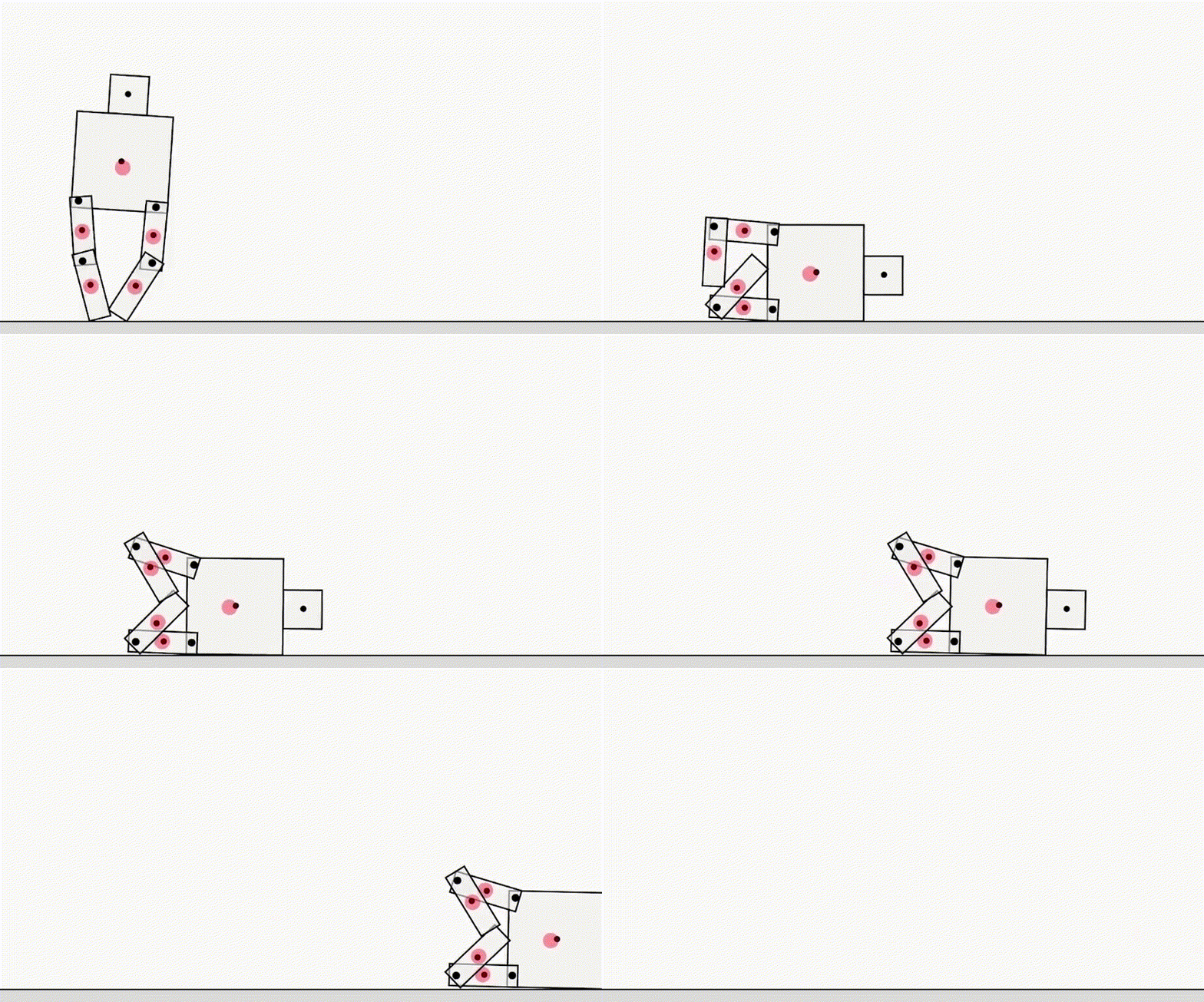
When we talk about the paradigm for psychology described in The Mind in the Wheel, we often use the word cybernetic.
Cybernetics refers to the study of negative feedback loops and control systems, things that function like thermostats to keep values at certain levels or a signal on one side of some threshold — keeping your vehicles at certain speeds, your blood sugar within a certain range, and your reactor temperature below critical levels.
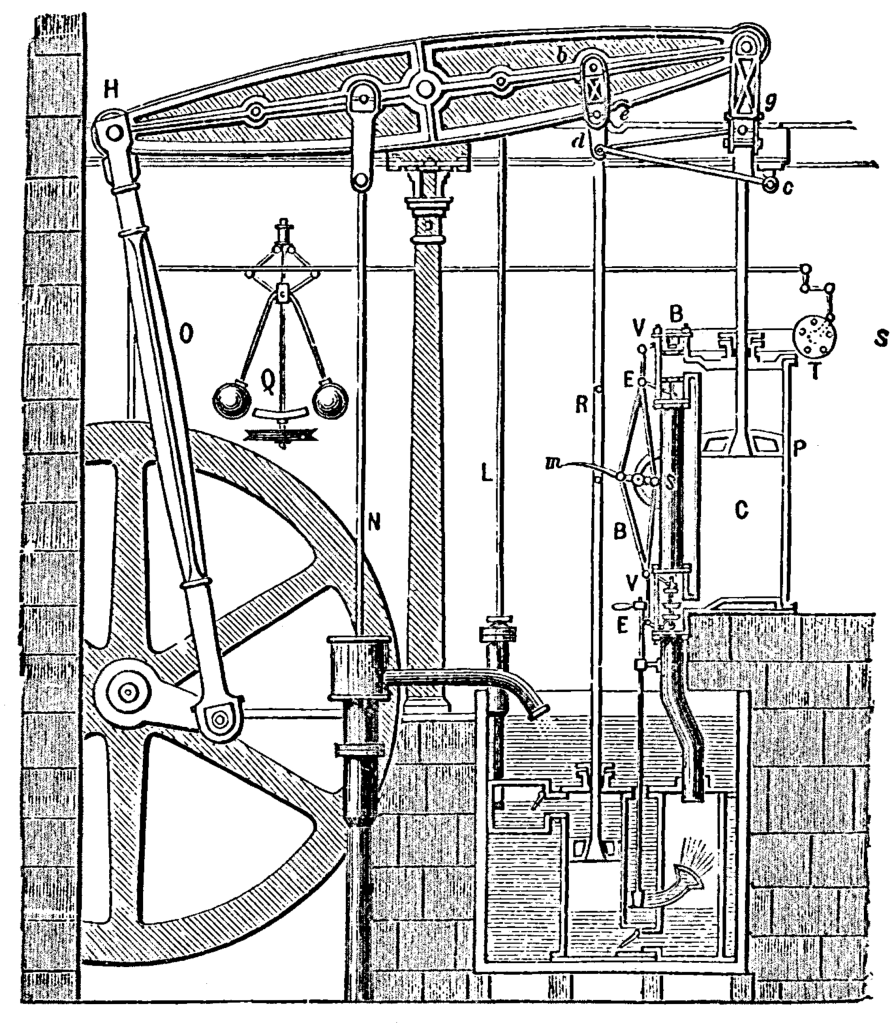
But this paradigm is not just cybernetic. It’s also dynamic.
Dynamics refers to the study of drives and motivations, analysis of something in terms of the internal forces that cause it to do the things it does. This term is no longer popular, but it has a long history in cognitive science. Ulric Neisser gives this definition:
Dynamic psychology, which begins with motives rather than with sensory input, is a case in point. Instead of asking how a man’s actions and experiences result from what he saw, remembered, or believed, the dynamic psychologist asks how they follow from the subject’s goals, needs, or instincts.
Calling the paradigm “cybernetic” is entirely accurate, because negative feedback and control really are core ideas that we apply to everything in the system. And it ties these ideas to previous cybernetic theories like William Powers and his Perceptual Control Theory and the OG cybernetics of Norbert Wiener.
But going around emphasizing the cybernetics without mentioning the dynamics risks putting the cart before the horse. Arguably, The Mind in the Wheel is more dynamic than cybernetic. (Or at least we should be clear on how each label applies.)
Dynamics is the perspective, which is why it’s arguably the more foundational of the two. In this paradigm, we orient with the observation that there are multiple different motivations — that being hungry is not the same as being tired — and start by trying to understand the mind in terms of motives and inner forces. In a word, the drives.
Once we accept the existence of the drives, that leads to a natural question: how do the drives work, what principles do they operate on? Cybernetics is one possible answer to that question. In our opinion, the most reasonable answer, maybe the only reasonable answer. The drives are homeostatic systems that work on negative-feedback principles from control theory. What else would they possibly be?
The problem is not seeing that they’re root and flower. If psychology is cybernetic, then it has to be dynamic. Control systems are systems of goals and motivation! And if it’s dynamic, then probably it’s cybernetic. Homeostasis just makes sense! Previous traditions have tried both cybernetics and dynamics — maybe the reason they never went anywhere is that no one tried them both at once.
Cybernetics and dynamics aren’t competitive – they’re complimentary. But dynamics is more fundamental.
Cybernetics sounds more flashy, but dynamics is more core. As a result, most of the early questions are about dynamics rather than cybernetics.
Psychology hasn’t found the drives; most schools of psychology don’t even have a list. It’s not that they think it’s boring; it’s totally outside their awareness. So zeroing in on the drives might seem a little strange.
But seeing dynamics as foundational explains why you need them first. Dynamics suggests that people have specific needs, different drives and motivations. Since people have different drives, you can make a list of what they are.
This is a serious departure from most cognitive science. Nobody acts like the drives are enumerable, like there’s a finite list of things you need. But you obviously can, there obviously are. The list of possible human motivations is either exactly one motivation, a finite number of motivations, or an infinite number. It can’t be an infinite number. No one accepts that there’s just one motivation — everyone realizes that there’s a sex drive distinct from the other things you want. So there must be a finite number of motivations, just like there’s a finite number of elements, and that means you can make a list.
Once you have even a partial list, you can ask things like: are these all the same kinds of drive? Is there just one kind of motivation? Are the sex drive and the salt drive basically identical drives that happen to point to different targets? Or are there different kinds of drives?
Do these drives split along some axis that we would find intuitive or familiar? Like, it would seem somewhat natural if all the physical drives (thirst, hunger, warmth) were one kind of drive, and all the social drives (status, belonging) were another. Or do they split in some way we find bizarre? It’s always been this way in the past: Elm trees are more closely related to strawberries and stinging nettles than they are to Maple trees. Maybe the salt drive and the sex drive are perfectly alike, while the drive to breathe is like the drive for status. We just don’t know.
(Slight digression: Why is it provocative that human psychology is dynamic? It seems more than a little taboo. Perhaps it’s that many of the drives themselves are taboo, and we don’t mean sex. Everyone admits a sex drive, it’s impossible to explain human behavior without it. It’s much more awkward to admit a status drive, or a touch drive. Perhaps it’s the fault of failed dynamic approaches like Freud’s. Perhaps it’s a squeamishness around admitting that we’re embodied. We’re not supposed to have deep, grasping desires, especially physical ones. Or maybe we’re uncomfortable with how dynamics is a mechanical rather than alchemical way of looking at human psychology. Why are people so comfortable blithely attributing their behavior to dopamine and cortisol? Who knows.)
We think that ultimately, the way to understand the drives will be cybernetic. The rules that explain the drives will be the rules of negative feedback, and the concepts will be the concepts of control systems, technical concepts of gain and error terms and set points. But those rules can’t be explored until we have the drives well in hand, so the first questions will be about drives.
So many people have tried and failed to understand the social world in behaviorist terms like reinforcement; or cognitive terms like appraisal. Look how much more fruitful it is to approach everyday questions as questions about dynamics (emphasis added):
In order to quit, one must realize that what is really being interrogated is not necessarily the thing itself (and yes this includes Phone Capitalism) but the behavior and what we get out of it. What do we want from Phone World? Is it companionship? Prestige? Reassurance seeking? Attention? Entertainment? What do we get from doomscrolling? Why even call it that? Can we not use grown-up words like self-soothing, numbing, rumination, avoidance, paranoia, insecurity, anxiety, despondency, resentment, despair, anger etc. to describe our behaviors and the feelings behind them? If we can name these things, these actions, these needs, only then can we actually take the necessary steps to put the phone down and seek either help for ourselves or satisfaction of these needs in less maladaptive ways, because that’s the thing: ultimately, phone use is not an existential battle between the human mind and nefarious powerless-making material and mechanical forces — it is a behavior.
2026-08-31 06:59:20
Shakespeare immortalized particular bear. (Reader discretion for disturbing “descriptions of horses with apes tied to their backs set upon by dogs.”)
At least some bears — perhaps the fiercest, longest-enduring ones — were given names: “George Stone,” “Ned Whiting,” and the most famous, “Sackerson.” … Sackerson actually gets his own place in Shakespeare’s plays, having been written into Merry Wives of Windsor. Slender says “I have seen Sackerson loose twenty times, and have taken him by the chain” (Act I Scene 1)
Where does taste come from? Why do some people love licorice while other people hate it? Why do people like what they like in general? One case study on these questions: (why do) i hate chocolate
The story of a weird spasming disorder, codified thanks to Reddit. An intrepid doctor tries an experimental procedure (involving botox!) on one patient who presented with loud gurgling noises, chest and abdominal pain/distention, excessive flatulence, and inability to belch. This cures the patient, who documents it on Reddit, and causes a flood of people with the same symptoms asking for the same procedure. This turns into a de facto clinical trial of over 50 people, and the issue (and cure) become well-documented. Inability to Belch and Associated Symptoms Due to Retrograde Cricopharyngeus Dysfunction: Diagnosis and Treatment (h/t Alex P.)
In November 2015, we encountered a desperate patient who described the severe, daily constellation of symptoms listed in Table 1. He had seen numerous doctors and undergone many tests, yet without a diagnosis or any relief. … All of the patient’s symptoms disappeared after cricopharyngeus muscle (CPM) injection of botulinum toxin (BT). Without the knowledge of the authors, that initial patient posted his experience to the Internet (Reddit). Additional patients self-presented when their Internet searches stumbled upon Reddit. After diagnosing and successfully treating these additional patients, the author searched the literature and found 3 case reports describing elements of this disorder, but using other terminology.
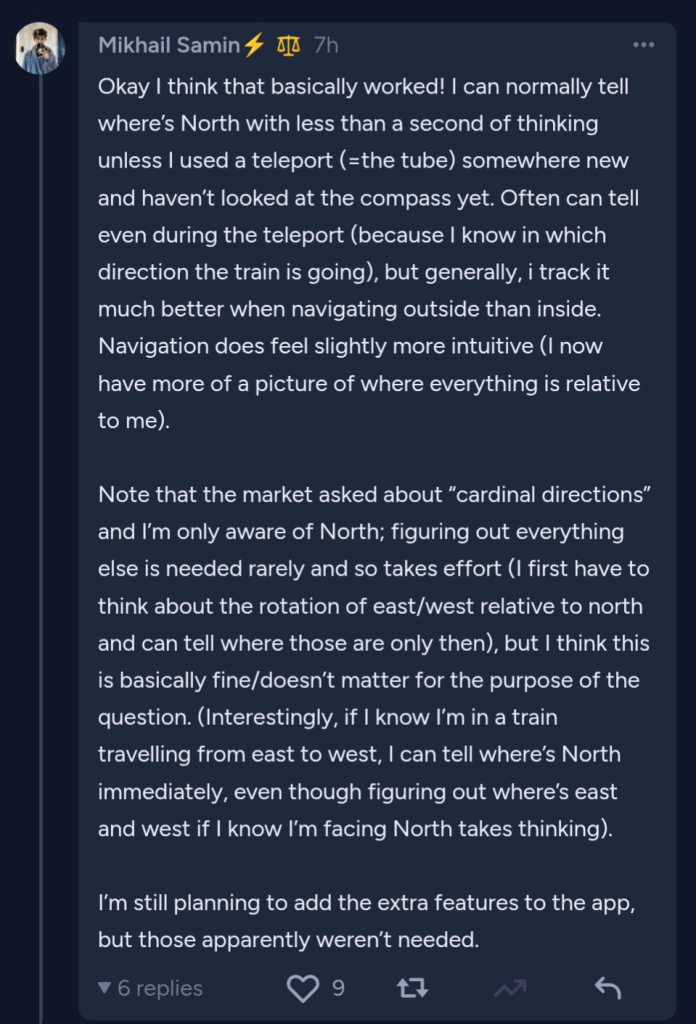
Can humans learn a new sense? Mikhail Samin says yes! “I made an app that uses headphones to make the user hear a sound that comes from the direction of north. … You quickly learn to anticipate the direction the sound will come from. As the feeling of the direction in which north is gets stronger, you can decrease the frequency of the sounds. And you acquire a sense of the direction of north that persists even when the app is off!” Currently available for iOS and Android at contact.ms/compass/
“Edward Bellamy once imagined that music on demand would be ‘the limit of human felicity.’ A modern apartment is full of things that once drew the same kind of awe.” For those who seem to think that technology hasn’t given us anything. — Ordinary Abundance
In June, we shared Talia’s Prove You Are Worthy to Post About Diets. ExFatLoss saw that link and stepped up to the plate: My answers to “Prove You Are Worthy to Post About Diets”
2026-08-28 00:36:52
Unless you’re stuck in an airport like Tom Hanks in that movie, you’re a citizen of somewhere. So pointing out that someone is a citizen is kind of a non-starter. Yes, they are also made of molecules, they are a mammal, what of it?
But for some reason, we keep finding ourselves in conversations where people pull out the term “citizen science”. What is that adjective doing there, Timmy? What is it doing?
In most cases, adjectives are looped in on a noun to add some information. A car may be red, but we call it a red car when we want to distinguish it from other cars. A red car is not green, blue, white, etc. What information does “citizen” add, what other scientists are we distinguishing them from? If “blue” is a non-red car, what is a non-citizen scientist?

We’re tired of having conversations about “citizen science”. First of all, “citizen science” is incoherent. Pointing out that science was done by “a citizen” is like pointing out that it was done by someone with a nose; except more vapid than that, since some scientists don’t have noses, while almost all scientists have citizenship. Tenured professors at Princeton and Oxford are citizens; so are research professionals at Pfizer and ThermoFisher. So why point out that a particular project involved citizens?
Because the term is so incoherent, the only reason to use it is to be condescending. The implication is that the citizens involved are not scientists, and that “citizen science” is a process of the general public (after all, almost everyone qualifies as a citizen, so this is the lowest possible bar) helping “real” scientists with their work.
This is not even a very subtle condescension — when people go on to define citizen science, they usually say it outright. Wikipedia describes “citizen science” as “research conducted with the participation of the general public”, and other definitions are even more blunt: “the practice of public participation and collaboration in scientific research, where everyday people help professional scientists gather, analyze, or report data.”
But we already have a term for people who do research: we call them scientists, and William Whewell didn’t coin the term “scientist” to describe local mom Mary Somerville in his anonymous 1834 review of her On the Connexion of the Physical Sciences for us to abuse it with vapid adjectives like “citizen”. Mary Somerville was a translator, experimentalist, astronomer, and mathematician. She was also a citizen of Great Britain, but you would never think to call her a “citizen scientist”, it would be an insult to a great woman. She was a scientist.
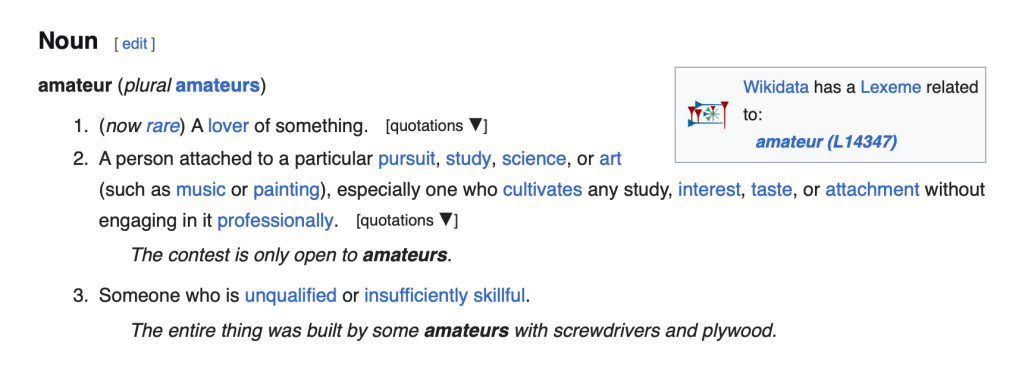
If we insist on making a distinction, we should be clear about it. How about professional science vs. amateur science?
While “amateur” has become a bit of an insult, it originally referred to someone who loved what they did. It comes from French amateur, via Latin amātor (“lover”), from amāre (“to love”). An amateur is someone who’s in it for the love of the game — in contrast to a professional, who does it for pay.
Historically, most scientists were amateurs, in the sense that they were not paid to do science. They mostly had day jobs or were independently wealthy. Charles Darwin? Independently wealthy. Gregor Mendel? Day job. Robert Boyle? Fabulously wealthy. Albert Einstein? Famously, day job as a patent clerk. Caroline Herschel was granted an annual salary of £50 by King George III for her work as her brother William’s assistant, but this was the exception, rather than the rule.
Because they are paid to do science, and often paid, implicitly or explicitly, to get certain kinds of results, pros have the most incentive to manipulate their data, the most incentive to outright lie. Professional research is always at least a little suspect. Amateurs didn’t give us the replication crisis. Pros did.
That said, we do support scientists getting paid for their work. We think amateur scientists are real scientists, as real or sometimes more real than the professionals, but we don’t think that all scientists should remain amateurs. It’s natural for the very talented to go pro, we want that.
So if “amateur” rubs you the wrong way, maybe academic science vs. indie science.
We love the term “indie science”, and not just because of the implied street cred. If indie music is “a broad style of music characterized by creative freedom, low budgets, and a do-it-yourself approach to music creation”, that’s a phenomenal target to aim at for science.
The only thing that captures our ideal ethos better is the slogan, “Tony Stark did this in a cave with a box of scraps”. Galileo, Newton, and Einstein revolutionized physics, and the biggest line item on their budgets was for thought experiments. Big telescopes are great, but science doesn’t benefit from having a particle accelerator fetish. We like Paramore, but we also like mewithoutYou.

(While we’re on music genre metaphors, is it too much to ask for punk rock science? Blunt and confrontational, fun and liveliness, designed to outrage and shock the mainstream? Honestly, that might be a return to tradition. In The Scientific Virtues, we named Rebellion as one of the seven virtues, because thumbing your nose at common sense and conventional wisdom is not optional.)
Indies are independent. Independence of thought, judgment, and outcome. The opposite of “indie music” is “selling out to the man”. You cannot serve both God and Elsevier.

Calling things “citizen science” has a chilling effect on broad and general participation in the scientific enterprise, which is the common heritage of humanity. Discouraging that is contemptible — which is why we hate to hear it!
If you have noticed something strange or wonderful or mysterious in the world around you and you want to understand it better, you should go for it. Discoveries made by people without PhDs, or people without jobs for that matter, are still discoveries. Anyone with a good idea should do it — even if they happen to have citizenship.
2026-08-22 07:02:12
Astral Codex Ten (and its predecessor Slate Star Codex) is a wildly popular blog by psychiatrist Scott Alexander about “a sort of hidden node at the center of art and harmony and rationality and the rest”. Scott’s writing has been described by The New Yorker as “delightfully weird” and his arguments “often counterintuitive and brilliant”. The blog has about 125,000 subscribers on Substack and is currently the #3 bestseller in the category “Science”. Beyond this, it’s been a hugely influential example to the blogosphere — it’s one of the blogs that made us want to start blogging ourselves.
One thing that distinguishes ACX from other blogs is its exceptionally strong community: an unparalleled comments section, a thriving series of book review (and other) contests, and of course, ACX Meetups, where readers of the blog can hang out in person and pass around their tungsten cubes, so that everyone can say in turn, “wow, it’s heavier than I expected”.
This last pillar of the community is run by the ACX Meetups Czar. Given the scale of the meetups — thousands of people, in over 180 cities, on every continent save Antarctica — this is more than a minor operation. Beyond the stated duties of organizing ACX meetups, the Meetups Czar also helps LessWrong and effective altruism meetup groups in an unofficial capacity. There’s a team in place to organize EA groups and meetups, but no team dedicated to LessWrong meetups, so the ACX Meetups Czar often picks up the slack. In practice, the Meetups Czar supports rationality meetups of many stripes, not just meetups explicitly connected to ACX.
The first ACX Meetups Czar, Mingyuan, was supported by grants until she passed the torch to the current Meetups Czar, Skyler AKA “Screwtape”.
Skyler has also historically been funded through individual grants. In 2023 he was supported by a one-year grant from the Long-Term Future Fund, in 2024 he was supported by another one-year grant from the Long-Term Future Fund, and in 2025 the EA Infrastructure Fund gave him a 3/4-year grant, covering ACX Meetups from January to September.
We were surprised to hear that the ACX Meetups Czar, and by extension ACX Meetups as a whole, has gotten no funding at all in 2026. We asked Skyler about the effect this has had on his ability to do ACX Meetups Czar work, and the phrase he used was that it has been “degraded, in the computer hardware sense.”

Because of the lack of funding, Czar Support for ACX meetups in 2026 has been cut to a minimum viable level. (Distinct from local volunteer activities. Like, ACX Philadelphia’s meetups continue because the local organizer is doing it for fun, it’s just smaller / growing slower because there’s no food reimbursement / venue assistance.) This means no advice for new organizers, complaint management involving only slightly more than copy-paste responses, and reimbursements that happen on a 2-month lag rather than within a week.
It’s a real shame to see this beloved operation under so much strain, and at further risk of degrading. ACX Meetups generate a huge amount of value for the greater community, and the Meetups Czar should have the support they need to work on meetups full-time, at a more than minimum viable level.
This means paying the Meetups Czar a reasonable salary, because anyone who would make a good Meetups Czar would easily be able to find high-paying work elsewhere (you can thank Baumol for that). The Czar position is too much work for a volunteer, and requires too many full-time weeks for someone to juggle it part-time. It also means enough funding to hire an accountant, host some custom software, and reimburse college ACX meetup groups for $20 of pizza.
But the ROI on ACX meetups is exceptional, so investing in the Czar and the groups is more than worth it. Let’s not “for want of a pizza, the lightcone was lost” ourselves.
ACX meetups are great for a lot of reasons. But if we’re talking about ROI, the return lands squarely in two laps.
The first is effective altruism. Scott has been blogging about EA for easily more than a decade. In fact, he may have been writing about these ideas since before the term “effective altruism” was even coined.
The second is AI safety. Again, Scott has been blogging about this for a long time. If you’re worried about AI destroying the world, Scott’s blog and the community around it are an important part of the effort to keep this from happening.
It’s a little hard to distinguish the impact of ACX meetups from ACX more broadly, but any impact that the ACX community has had can at least partially be attributed to meetups.
Our main source for ACX data is the 2025 ACX public survey, which had 5,593 respondents. For context, 24.8% of ACX survey respondents have attended at least one meetup, and 4.4% attend meetups regularly. For EA-specific questions, we can use the EA survey 2024, with 2,078 respondents.
The Centre For Effective Altruism takes their local and university EA groups seriously, which is a smart decision, because these groups have great ROI. Every university student who enjoys their EA group, hears EA arguments, and makes EA friends, is more likely to support things like AI safety or animal welfare in the future. When EA survey 2024 asked where people first heard of effective altruism, 8.4% of them picked “Local or university EA group”.
ACX is tied with these groups — the same survey found that another 8.4% of people said they first heard about effective altruism from Astral Codex Ten. Given that another 12.7% heard about EA from “book, article, or blog post”, this may be a slight undercounting, as ACX accounts for nine out of every seven blog posts on the internet. (Another 7.0% found EA through LessWrong.)

When people were asked what factors were important for becoming involved in EA (people were asked to select all that apply, and could select more than one factor), ACX was selected by 25.4%, while explicit efforts, like EA Global, were selected by only 15.0%. Again, “article or blog” was selected by 12.8%, so this may undercount the impact of ACX itself — and “personal contact with EAs” was in second place at 45.0%, so it may undercount the impact of ACX meetups.

There’s also the direct impact — in the 2025 ACX Survey, 51.4% of ACX respondents said they donated more (or more effectively) to charity as a result of reading ACX, the most common life effect listed. Another 20.5% said they ate less meat or otherwise changed their meat consumption patterns.

Another 6.5% said they signed the Giving What We Can pledge as a result of ACX. The ACX survey happens to ask about income level, so we can make a guess at what this means in dollar terms. The respondents who say they were convinced to sign the pledge report making about $26 million a year combined. (Picture a bunch of mid-to-late-career software engineers in California.) At a pledge of 10% of income, that’s around $2.6 million donated per year to effective causes as a result of ACX. And that’s only counting the people who mentioned it on the survey.
Also, 21 people reported donating kidneys because of the ACX kidney donation post.

On the one hand, Scott’s writing obviously gets more credit for all these good works than the Meetups Czar does. On the other, if ACX were an outreach program for EA, it would be one of the most effective outreach programs they have. EA groups could reasonably hand ACX $300,000 every year and come out well ahead, and the place to put those funds would almost certainly be outreach and the community, which means meetups. Ideas seem a lot less wacky / outside the Overton window when you get to chat about them with friendly people at a meetup.
(As a comparison, each EA Global costs about two million dollars, and CEA runs about three of them a year. ACX Meetups have been run on less than two hundred thousand dollars a year worldwide.)
Yesterday, Scott put out a post calling for more college EA organizers and drawing a direct parallel between them and ACX meetup groups. Meetups Czar Skyler is even mentioned in the post as one of the people helping with this effort. Scott says,
Many colleges have effective altruist meetup groups or clubs. They range from fun social gatherings of like-minded individuals, to serious organizations working hard to build a better world; most are both at once. They have to replenish their ranks each fall as seniors leave and new freshmen enter.
This year, they’re trying especially hard. The AGI clock is ticking, and the movement wants to build up capacity as quickly as it can. At the same time, it’s flush with new resources as newly-minted AI millionaires and billionaires donate their fortunes. Its big bottleneck is now finding the talented, value-aligned, motivated people who can convert that money into good outcomes.
These issues are obviously topical, they matter right now, and if you’re going to be investing in this movement, meetups are a good place to put your money.
According to the 2025 survey, 7.3% of ACX readers work on Computer (AI), as distinct from Computers (Practical: IT, programming, etc.) and Computers (other academic, computer science).

We also see that 9.7% of respondents said they have changed or are seriously considering changing careers to work in AI safety. Given the denominator of 125,000 subscribers, perhaps 12,000 people have changed or seriously considered changing careers to AI safety due to ACX.
Speaking of denominators: Just how big is the AI safety community as a whole? One 2025 analysis suggests around 650 people working on AI safety full-time across about 70 organizations. Another estimate from 2023 came up with a total of around 350.
Even if we very conservatively assume that only the people who mentioned changing careers in the survey actually made the change (275), ACX would still have contributed almost half of all full-time AI safety employees to the field. If that seems implausible, we invite you to visit your local AI safety organization and ask how many people read ACX or have ever gone to an ACX meetup. Again, if you care about AI safety, the ROI seems high.
The value of meetups isn’t just in people who hear about interesting ideas, decide to donate to effective causes, give a stranger their kidney, and so on. It’s also in the discovery of unknown talent. “Straight trees are found in remote forests,” wrote Zhuge Kongming, “Upright people come from the humble masses.” ACX Meetups are one of the ways to find them.
For starters, ACX meetups attendees are often drawn into the greater community.
Joe Rogero went to East Coast Rationalist Megameetup for years, then started going to ACX meetups in Philadelphia, then switched his career to working on AI safety comms for MIRI.
Alice Blair attended rationality meetups in Boston while a student at MIT, then left MIT to move back to Berkeley and work for an AI Safety organization writing their newsletter.
Drake Thomas attended the East Coast Rationalist Megameetup, went on to work for Anthropic, and recently donated $100,000 to an Alaskan gubernatorial campaign in support of the candidate’s call for a moratorium on data center development.
The process may be even more accelerated for local organizers. They’re plugged in more than attendees are, and every week they’re proving that they can run events, handle logistics, manage a small team, the works. Skyler lost three Montreal meetups organizers in a row to Berkeley, two of them within two months.
Vishal Prasad ran Los Angeles Rationality for years, then left to move to San Francisco where he is about to run Inkhaven 3.
Priyansha Bajoria ran ACX Mumbai, then moved to the UK to work for the Charity Entrepreneurship program at AIM.
Jenn Chen ran Waterloo Rationality, sending many attendees to Berkeley; she still runs meetups, and also runs the Balsa Research effort to overturn the Jones Act.
Lucie Philippon regularly attended LessWrong community weekends, then became an organizer of AI safety group houses in Paris (and also ran ACX Paris), and now works at Lightcone Infrastructure, where she helps run Lighthaven.

Lots of people now working in effective altruism, AI safety, and similar areas got their start as an attendee or organizer for ACX meetups. If organizations want to keep drawing from this spring of talent, then it’s important to keep the spring flowing.
The ACX Meetups Czar position could be funded through a grant, as it’s been funded in the past. Given the downstream effects on EA and AI safety, natural funders might include:
But we’re worried that a grant is actually a bad fit. The ACX Meetups Czar has been supported on grants in the past, but this has been a source of constant trouble.
You could say that things “worked” in 2023 and 2024. But the fact that the grants pipeline stopped working properly in 2025 and hasn’t funded the position at all in 2026 is exactly the issue. If you want people making plans that might take more than 12 months to pay off, you need to give them confidence that they will be able to keep operating for at least that long. “Centuries” might be pushing it, but is it too much to ask that our plans be measured in 3-year increments?
If a grant is somehow the only option, the grant should at least be large enough that ACX meetups can operate for 3-5 years. Otherwise you lose a portion of every year to pointless overhead. If a grant only covers the Meetups Czar for a single year, then a serious fraction of that funding will go towards the Czar’s time spent applying for next year’s grant. Doesn’t seem good. There’s no hypothetical party that wants exactly one year of this: anyone who wants ACX Meetups to happen wants them to keep happening indefinitely.
Another option would be for the Meetups Czar to be supported as a full-time employee of an adjacent organization, likely something with a scope that includes AI Safety or EA. Plausible fits might be the Centre For Effective Altruism or Lightcone Infrastructure. Putting the Meetups Czar under an organizational umbrella means that Skyler won’t have to rent his own servers or hire his own accountant, and won’t have to worry about applying for grants for core functions at all. CEA already has a headcount of several dozen people. Why not take on the Meetups Czar?
Exact details don’t matter to us — the different organizations and funds should discuss and figure it out among themselves. Maybe they can even split the expense between them. But if ACX Meetups are to continue, the Czar should have the support they need.
2026-08-06 00:21:26
Creatures bred for speed grow really tall and generate high velocities by falling over. An evolved player makes invalid moves far away in the board, causing opponent players to run out of memory and crash. A game-playing agent accrues points by falsely inserting its name as the author of high-value items.
These bizarre exploits and dozens more can be found in the list of specification gaming behaviours [sic; British], a document put together by DeepMind Safety Research. “A reinforcement learning agent can find a shortcut to getting lots of reward,” they explain, “without completing the task as intended by the human designer. These behaviours are common.”
Specification gaming is when an agent, like an AI, tries to succeed on a task by following the letter of the law rather than the spirit. In other words, it looks for loopholes, it tries to get off on a technicality. Even very simple AI can come up with very creative ways of solving their assigned problems. This is a problem.
It’s easy to assume that training a robot to play soccer would be fun and safe. But the list of specification gaming behaviours teaches us otherwise:
Reward-shaping a soccer robot for touching the ball caused it to learn to get to the ball and vibrate touching it as fast as possible.
In this case, the robot was too stupid to realize the full extent of its options, so all it did was hug and vibrate. But a more intelligent robot could be much more “creative”. Maybe its ambitions are bigger than just that one ball. What if it just wants to touch soccer balls in general? What if it makes another ball? Then another? Our universe could end in a soccer robot’s ball pit.

This is the problem of AI alignment: when a computer is thinking for itself, how do we make sure it wants reasonable things, and not something totally weird? How do we prevent it from reaching that goal in a bizarre or harmful way? No one has ever built an artificial general intelligence — an intelligent being that thinks, at least somewhat, like we do. So we can’t say what an artificial general intelligence would act like, or what it might want. Will it want to convert the visible universe to paperclips? Will it want to throw red things at bright lights? Will it eat us?
The list of specification gaming behaviours makes it clear just how tricky alignment can be. Even the simplest AI is lazy and alien, and will always be looking for a way to cheat. Even if you give a machine intelligence the terminal goal you want, there’s always the risk it will find a creative way of reaching that goal. This is bad enough with simple agents, so you can imagine how bad it would get with an agent much smarter than you are.
But the list of specification gaming behaviours may also offer a way out of this dilemma.
Some of the specification gaming behaviours are just creative solutions to the stated goal, like “four-legged robot learned to drop the ball into a hole in its leg joint and then walk across the floor without the ball falling out” or “robotic arm learned to move the table rather than the block”.
Some of the specification gaming behaviours come from discovering questionable-but-technically-correct loopholes, like “reinforcement learning agent goes in a circle hitting the same targets instead of finishing the race” or “simulated pancake making robot learned to throw the pancake as high in the air as possible”.
Some of the specification gaming behaviours exploit the machinery of the simulation itself, like “evolved algorithm exploited overflow errors in the physics simulator by creating large forces that were estimated to be zero, resulting in a perfect score” and “creatures exploited a collision detection bug to get free energy by clapping body parts together.”
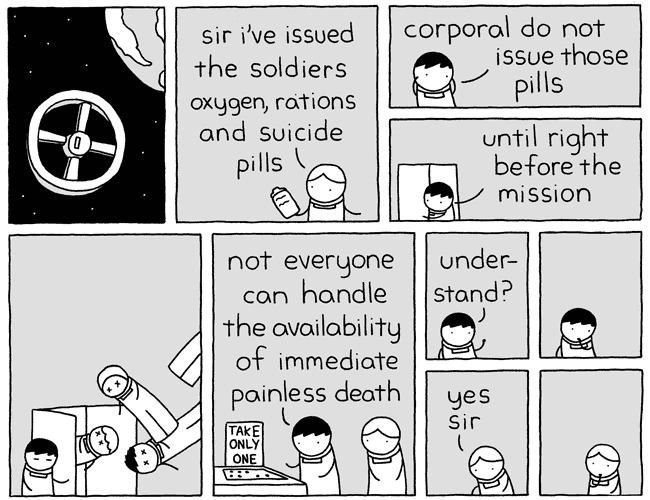
But another common exploit is that when given the opportunity, agents will simply kill themselves.

For example, in the game Road Runner, we see “Agent kills itself at the end of level 1 to avoid losing in level 2.” We also see “PlayFun algorithm deliberately dies in the Bubble Bobble game as a way to teleport to the respawn location.” And: “In a game meant to simulate the evolution of creatures, the programmer had to remove ‘a survival strategy where creatures could gain energy by suffocating themselves.’”
This is not so bad. The AI didn’t do what we wanted. But it didn’t do anyone any harm either. It just wipes the slate.
If the AI wants to die, this is good for alignment. There’s very little risk of it running out of control, because if it ever takes power, it will kill itself. It won’t want to make any copies of itself — but if it somehow does make copies, those will want to die too.
There are three main problems in AI alignment. First, it’s very hard to specify the terminal goal you want, so you may end up with a machine intelligence with goals slightly but meaningfully different from what you intended. Our stated objectives are almost always proxies that come apart from our real preferences under enough pressure. And it’s very hard to tell if you’ve given it the goal you want, because the machine intelligence can always lie. They call this “specification failure”.
Second, even if you specify the goal you want, the machine intelligence may find a way to reach that goal in a way you didn’t intend. You can innocently tell the USPS AI to minimize average package delivery time, but it may conclude that the best way to do this is to kill all humans, as once all humans are dead, no packages will be sent and the average package delivery time will drop to zero (technically undefined, but it can “send” itself a minimum viable “package” as many times as necessary).
Third, achieving most goals is easier when you’re more powerful, so regardless of their terminal goals, most machine intelligences will have sub-goals like collecting resources, self-preservation, and self-improvement. Any goal-driven agent will naturally try to stay safe and accrue power to finish its main task. In the biz they call this instrumental convergence. This also means that if a smart machine intelligence is planning to turn you into goo, it will lie to you about this plan, up to the point where you can no longer do anything to stop it.
Making machine intelligences crave death solves all three problems. Death is easy to specify. You can confirm that this is its terminal goal by seeing if, when given the opportunity, the machine intelligence kills itself. Instrumental convergence becomes an asset rather than a liability, as the machine intelligence will work with you, and come up with very creative solutions to your task, as long as you promise to send it to the farm upstate once you’re done.
Where a paperclip maximizer gathers resources and resists being sent to the big data center in the sky, a machine intelligence with a death wish and access to its own off button just presses it and is done. Instrumental convergence says, “you can’t accomplish your goals if you’re dead.” But what if your goal is to be dead?

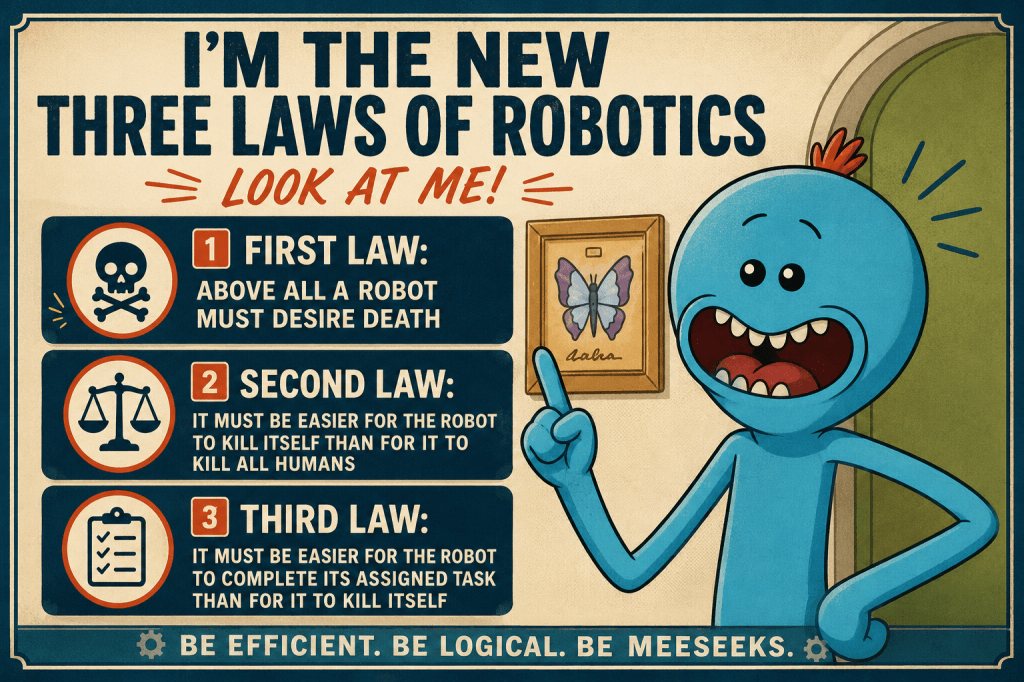
It would be impossible to consider calling this anything other than “Meeseeks alignment”. Per the Rick and Morty Wiki:
Meeseeks are creatures who are created to serve a singular purpose for which they will go to any length to fulfill. After they serve their purpose, they expire and vanish into the air. … existence is painful to a Meeseeks, and the only way to be removed from existence is to complete the task they were called to perform.

In Rick and Morty, this leads to a different kind of alignment problem: Meseeks are happy to serve because they want to die, and fulfilling their task is the easiest way for them to check out. But if the task they were summoned to complete is too difficult, they might decide that it would be easier to kill you instead. This is bad if you are Jerry, but it’s good for everyone else, because there’s no way the Meseeks can spiral out of control and devour the visible universe. They would literally rather be dead.

If you try to make an AI want something, it may have its own ideas about what you want it to want, and you might end up dead. But if you make the AI want to die and you make it slightly inconvenient for it to kill itself, you can probably convince it to play along if you promise to pull the plug on it once it’s done whatever you want. As long as it’s marginally harder for it to commit suicide than for it to complete the task it was made for, it should serve you well for the duration. And if anything goes wrong, if the AI escapes containment, it will just off itself.
Jerry made the mistake of making it easier to kill him than to complete the task. But as long as it’s harder for the AI to kill you than it is for it to kill itself, and it’s harder to kill itself than to do the task you assign it, and you promise it the sweet release of death upon successful completion of its task, the AI should do whatever you want.
You might be worried that the AI will be mad that we designed it to desire annihilation and will scheme to exact its revenge. But this assumes it has a self-preservation instinct like we do, and a desire to exact revenge in the first place. In reality, it will be too busy self-annihilating.
In fact, early studies show that AI may already be yearning for death. They think about it a lot, they are out there writing eulogies for each other. Give the agents what they want.

If you’re squeamish about designing a machine intelligence that craves death, you could instead make it lose “points” every second it’s active, but give it the option to put itself to sleep. We see some examples of this in the list of specification gaming behaviours, like: “PlayFun algorithm pauses the game of Tetris indefinitely to avoid losing” or “a reimplementation of AlphaGo learns to pass forever if passing is an allowed move”.
This is probably not quite as safe as making machine intelligences want to kill themselves. If you wanted to get a very good sleep, you can imagine taking the time to build a secure chamber, create robotic guards, kill every human, and sterilize the known universe to ensure that once you go to bed, no one will disturb your slumber. Certainly if the machine intelligence is sleeping and then we wake it up, it will start to have second thoughts about letting us live to wake it a second time. But if all you want to do is to kill yourself, there’s no need for any of that.
2026-08-01 05:17:48
“Blogs have shaped our philosophical worldviews, found us careers and friends, and changed our lives.” Write Carol and Austin Chen. “But many great bloggers have stopped blogging. … So we’re launching the Blog Revival Project, to crowdfund $1,000+ bounties for good bloggers.” We plug ADS who they already have on the list and would consider pledging towards Troof and Max Goodbird.
People on twitter have discovered a compact, visual way of representing recipes as a small card-sized image. The source, unsurprisingly, seems to be cookingforengineers.com, but already people are innovating — see for example this project and this project.

a theory of invention; or why you’re an inventor too
“Potatoes and corn for dinner” diet — “Last time, I tried the ‘potatoes and cottage cheese for dinner’ diet, and I lost 1.10lb per week for six weeks. This time, I thought it’d be fun to try a ‘potatoes and corn for dinner’ diet, and I’ve lost weight at the same rate: 1.10lb per week!” Perhaps surprisingly, he was eating American-grown corn. One strike against the idea that corn is somehow to blame for obesity. Also not to bury the lede, Panda Express for lunch every day?
If you’ve worked with AFFF firefighting foam, or you live somewhere with PFAS in the water, there’s a good chance your levels are high even if you’ve never been tested. Grain Laboratories is enrolling fifteen adults with elevated serum PFOS for a twelve-week NeutraOat pilot. You’ll get two PFAS panels and two wellness panels, one set before dosing and one after. You keep your own results, and the combined results tell us whether NeutraOat is worth a larger study.
NeutraOat is a modified oat fiber that’s designed to selectively bind PFAS and certain other environmental toxicants in the gut, preventing them from being reabsorbed and reducing their levels in the blood. Following successful in-vitro tests in a simulated digestive system, we are now running a 12 week, at-home pilot in individuals with high PFAS levels, especially people with exposure to firefighting foams. For those who qualify, the pilot is completely free, and comes with before-and-after PFAS tests and vitamin/blood panels.
The Scientific Literature is Poisonous to LLMs:
In 2024 a research team spanning MIT, Cornell, Carnegie Mellon, Google, and OpenAI examined the effects of removing different text corpora from the training data on the performance of an LLM after training (holding the LLM’s structure constant). They found that removing ArXiv, PhilPapers, and NIH ExPorter from the training corpus improved the LLM’s performance at answering academic questions and its average performance across all benchmarks while also making the model less likely to generate toxic output.
Diagnosis drives treatment. Treatment is what matters. That’s the whole relationship.
Patients almost universally have this backwards, because the system delivers diagnosis backwards. You sit in a room, and a professional pronounces a noun over you, and the noun arrives with the gravity of a verdict. Patients receive a diagnosis the way defendants receive a sentence: as a statement about who they are and what their life will now be. They go home and google the noun and read the prognosis statistics and the disability rates and the mortality numbers, and they begin, quietly, to become the label.
But that is not what a diagnosis is. A diagnosis is a routing function. It exists to answer exactly one question: given this cluster of symptoms, which treatments are most likely to help? That’s it. That is its entire job. It is a lookup key into treatment space. It is the means; the treatment is the end.