

2026-09-27 20:15:52
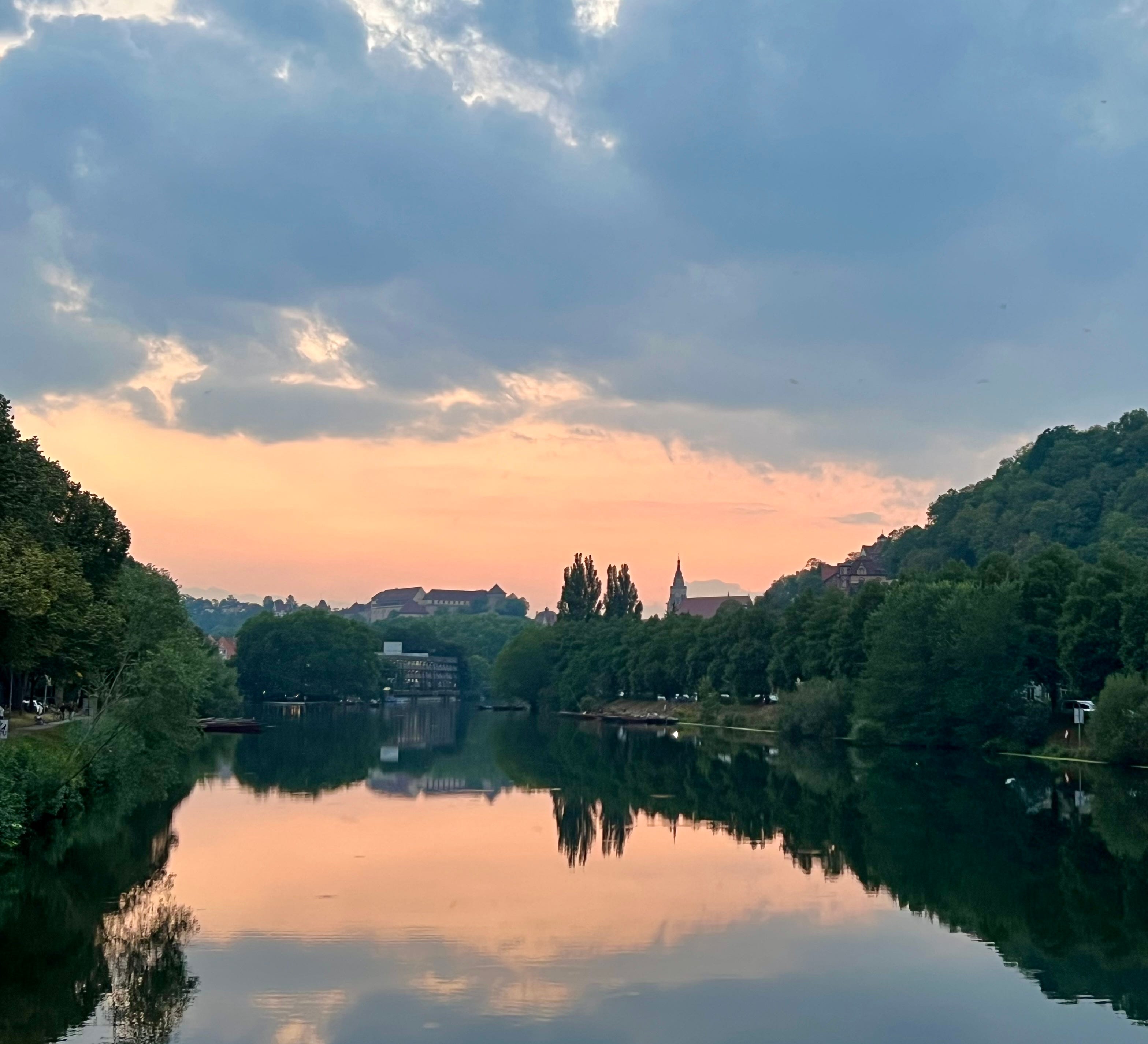
My heart jumps at the advent of fall. I love the moment when the heat breaks and crisp air invites me to walk and ponder. On a recent morning stroll, the ground wet after early rain, I watched a first brown leaf spiral down lazily.
And yet I am leaving again. I am flying to Istanbul, then Bali. I don’t know what awaits me in this next chapter, only that it is time to go.1
Until COVID my life seemed to have direction. I had a rough model of the world and how to get ahead: much of it revolved around money and what I hoped it would do for me. My life felt flat and colorless, and I kept drifting into depression, but I guess I accepted that as the price to be paid.
I don’t write this with regret. I believe I had to have that experience. “Nobody changes unless they’re challenged,” as Joe Dispenza put it. I had to back myself into a corner, find myself suffocated by my conditioning, before I could look for a better way. And of course, I needed the money.
The questions that now haunt my life, like what do I really want in life, seemed inaccessible then, like a distant island shrouded in fog. I feared the dark waters that surrounded it. Instead, I built shrines to lifeless idols. When I was offered a first glimpse of that secret place, deep in a psychedelic journey, the sight was frighteningly strange and beautiful. I woke up in a world infinitely weirder than I could have imagined. And I felt a hook in my heart. There was no going back.
Suddenly I wanted more, wanted to be more, or least be more of myself. But I no longer knew who I was. I held in my hands the pieces of my shattered mask. Like a blind man I had to discover the shape of my face by touch, slowly feeling its edges and texture with my fingertips.
Since then, the churning of change has been relentless. Last year, I left New York to explore the glorious expanse of the American West. This spring I sold my beloved Subaru in Salt Lake City and returned to Germany. After a lonely year on the road, I thirsted for company and new input. So, I signed up for a lot of events.
This summer I stomped and shouted at Sacred Ecstatics, sang overtones into people’s bodies at The Healing Voice, explored shamanic trance dance, and moved through old shapes during 5 Rhythms. I began to free my spine with Simon Borg-Olivier and let myself be shaken by life force during Seiki. I wiggled with Jacob Collier at his Tuscany Hideaway and jumped to the ceiling during AWARË’s set at Heal Play Love. Finally, I felt the doors to my heart blown open during a weekend with Joe Dispenza.
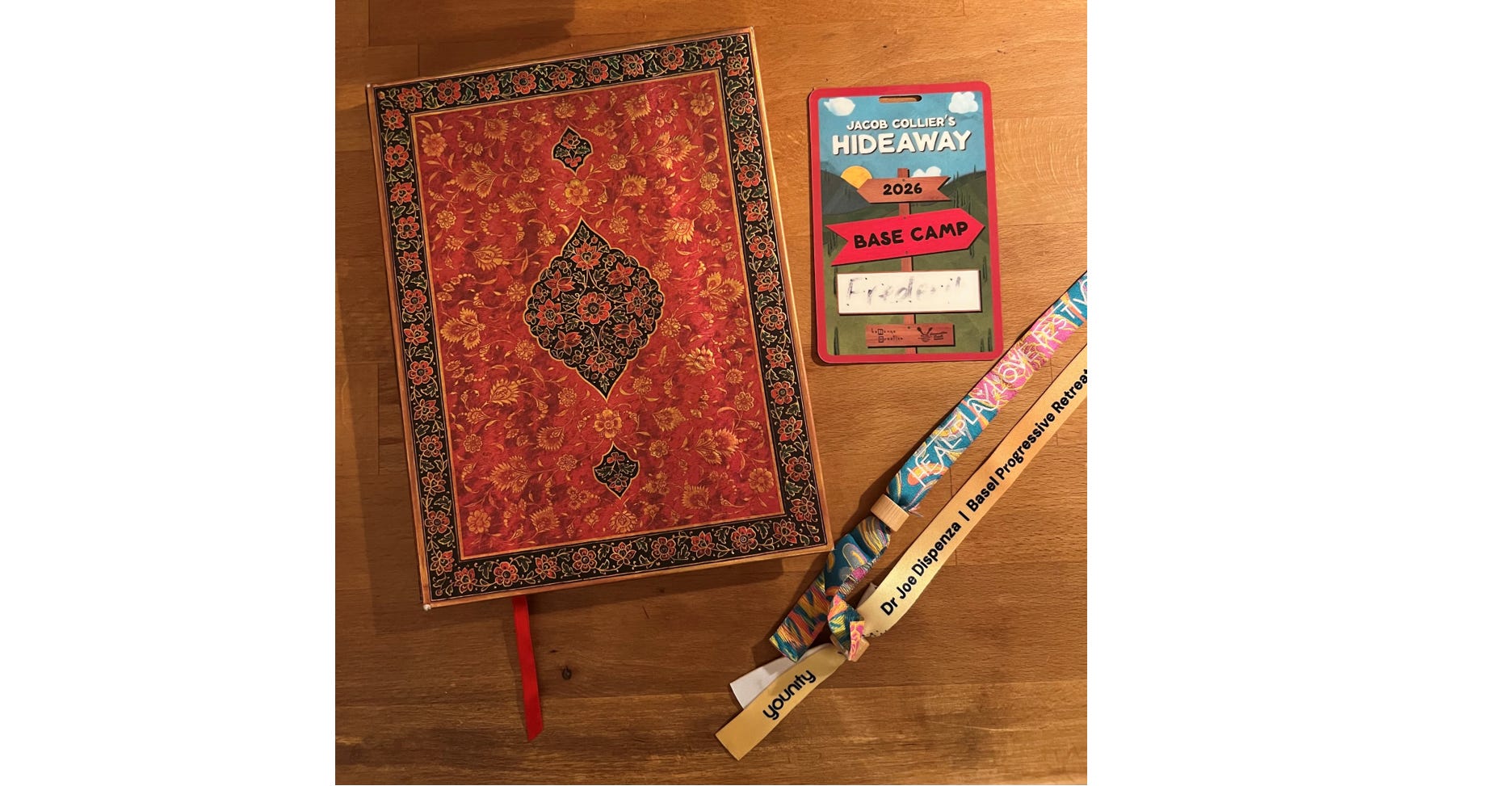
I hoped to be wildly productive. Write a quick piece after each event. Bam, easy win! Pretty much the opposite happened. I didn’t know what an experience meant while immersed in it and by the time I had a first draft, another adventure was around the corner. Not a pace I want to repeat, yet I am grateful I could fill my cup.2
Case in point, I wanted to send this note before leaving Germany. Obviously. Instead, I finished up on the morning of my departure from Istanbul, working in the back of the hotel’s little breakfast room. Except it still wasn’t right. Suddenly I was not feeling alright either, my body overcome with travel fatigue, sinus infection, migraine.
So, I am finally wrapping it up in Canggu, Bali, in a sleek and overpriced co-working space surrounded by influencers and digital nomads.
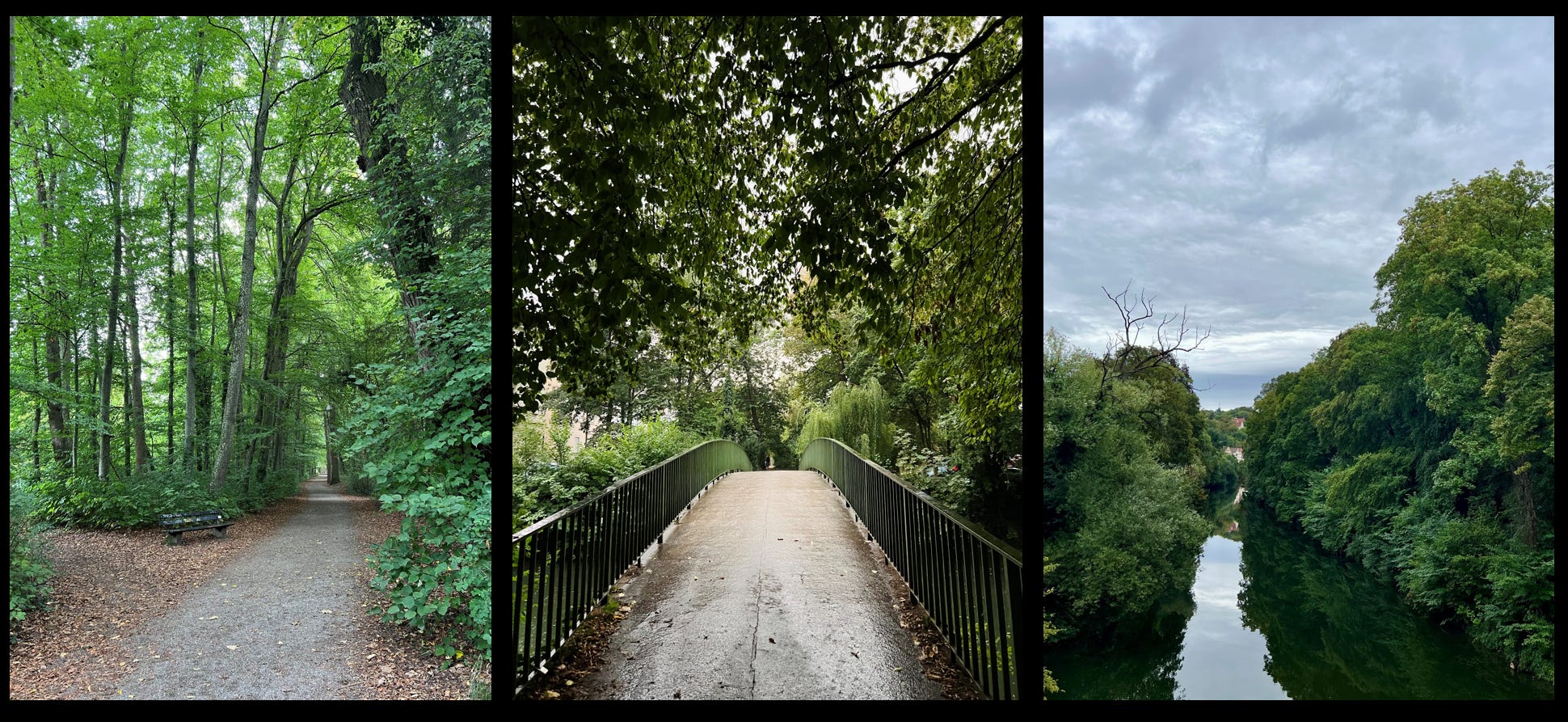
It was hard to get my mind into writing mode this summer when my rhythm was re-shuffled every week or two. I anchored my days in little rituals: movement, prayer and offering, meditation, a walk, picking up the pen. Every morning I crossed a little bridge to the nearby park and shared a song or two with the trees. With my feet in the grass, I contemplated my restlessness. Was this a movement toward or away from something?
Was I really healing, growing, following my curiosity? Or was I traveling in buses and on benches, in planes and on piazzas, in domes and dormitories because it was easier to chase a fantasy than sit with reality? Were these retreats my banana-nut muffin? This much I knew: writing had become stupidly fucking difficult. Like squeezing tears from a stone.
And of course it feels like madness to write anything at all, now that we can summon a language demon and let a data center pipe the words to us. But I can’t seem to help myself. “Technique accumulates around what you like doing naturally,” Jacob Collier told us. Well, he now conducts orchestras and I have a new notebook for the quotes of my teachers.
“Nothing is more unbearable, once one has it, than freedom,” James Baldwin wrote. Was I perhaps breaking under the weight of newfound liberation? Had I turned into another New Age dropout, a spiritual hedonist proclaiming Eat, Pray, Love until the money runs out? The nomadic life can be taxing. Cutting a path out of the tracks of convention is disorienting and the constantly looming question of ‘what next’ takes up a lot of mental bandwidth. But this disquiet runs deeper.
Home remains a fleeting experience for me, as if my destiny was not to belong but to be in longing. It often feels as if I carry some foreign object within me, something angular or spikey whose edges strain against my skin. It has been impossible to rest comfortably against anyone or anything. Perhaps I stay on the path of becoming in the secret hope that constant motion will soften this sharp sense of not belonging, the way time in a stream smoothes a pebble.
And while I long to be more than a writer, writing has helped me come to terms with the sharp turns in my life. I get frustrated with the slow process of translating my experience into language, yet this effort grounds me. It is a sobering contrast to the aftertaste of the infinite. And sharing the journey maintains an enduring connection to the world.
Moving the pen across the page helps me find hidden patterns and open passageways to the unconscious. Sometimes it feels no less sacred than the body in the depths of dance. Unable to tame my inner world, I let it emerge on the page until the ink births a living sentence, a shadow of my face, something I will recognize as part of myself no matter how much my life changes.
So long and safe travels,
Frederik
If I was trying to discover myself—on the whole, when examined, a somewhat dubious notion, since I was also trying to avoid myself—there was, certainly, between that self and me, the accumulated rock of ages. This rock scarred the hand, and all tools broke against it. Yet, there was a me, somewhere: I could feel it, stirring within and against captivity. The hope of salvation—identity—depended on whether or not one would be able to decipher and describe the rock. — James Baldwin, Notes of a Native Son
Suppose you are on a train and a little boy asks what you’re reading. But the book on your Kindle is in English. Instead of trying to translate random words, you offer the boy and his sister your notepad to doodle and write their names. They might happily draw houses and hearts and snakes with a thousand wild coils while their mother gets some time off.
As usual, you won’t know what the encounter means, only that it is impressed into your memory, that it carries an energetic signature of significance. You sense that one day you will try to translate it into words. You might even try to share them with the world, simply because you can’t help yourself, because it is part of your way of being in the world.
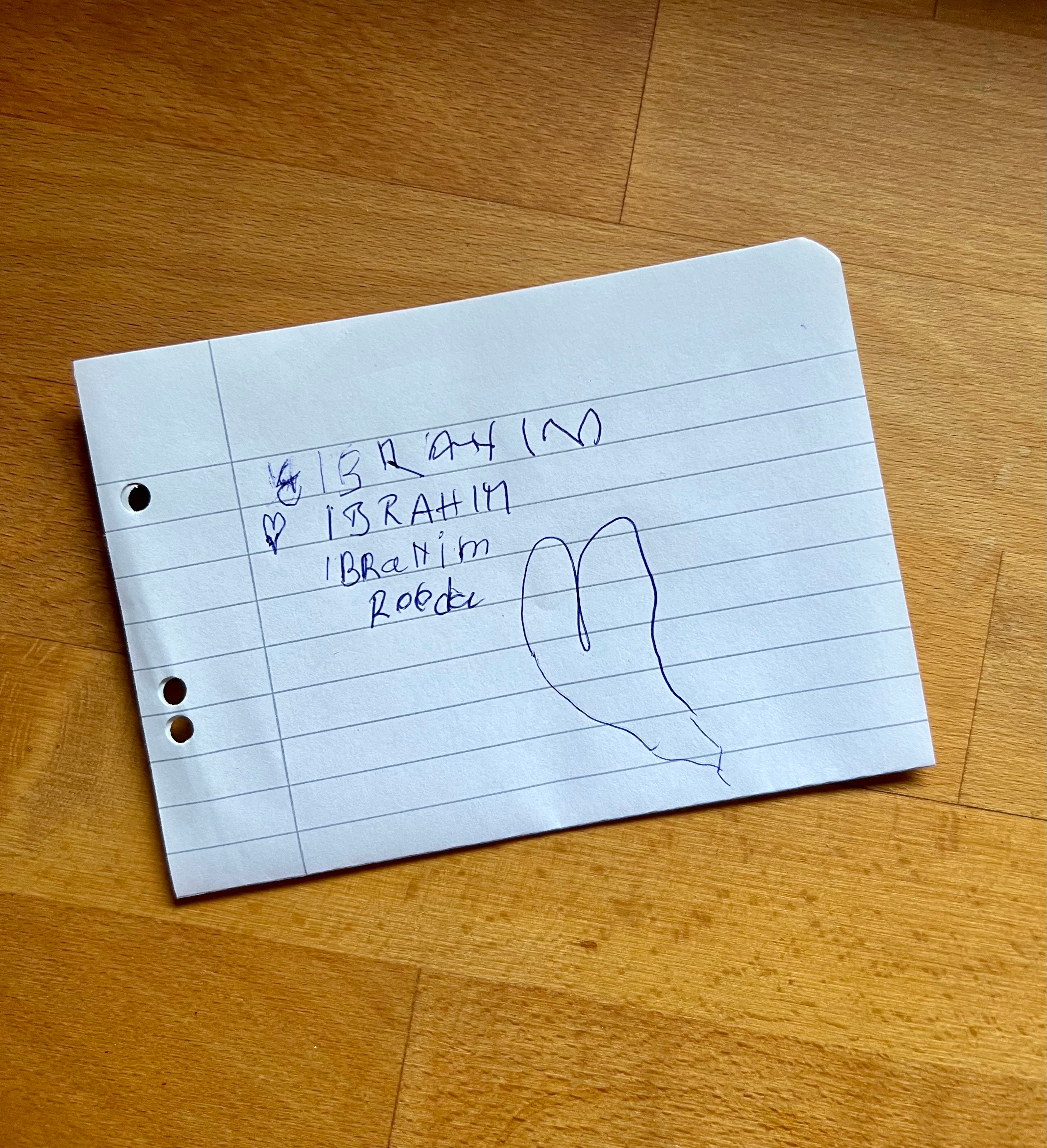
Abschied: farewell, goodbye
You could say I’ve heard the Herald of the Change. Still one of my favorite movie scenes and soundtrack pieces.
In a similar vein, I tend to recognize my future teachers quickly but never know what I will learn. Sometimes it is a practice or skill, but often my encounters seem to be about a way of thinking, perceiving, or being. This leads to a delicate dance around note taking.
Of course I don’t want to scatter my attention. But I know that afterwards, in the sanctity of an airport cafe with a steaming cup of Cappuccino, the experience will come alive again, through the magic of words that tickled my brain. “Put the notebooks away. Just be present,” Jacob Collier advised us. Well, if you could stop being so damn quotable.
2026-07-19 18:28:41
I am finally, belatedly, accepting movement as just as foundational as my morning meditation.
I’ve never been much of an athlete. I have no interest in sports and as a teenager I could barely catch the ball before it hit my face. Then I spent two decades at desks. I went through phases of lifting weights and occasionally tried yoga. I did it the way a monkey would: imitating without understanding. Of course, I was not flexible enough for many poses and with little to show for my straining I always stopped again.
Free form dance has shown me my body’s limitations. One reason I fall into the same patterns is that a lot of moves feel inaccessible. Seems like my lower back does not want to bend much? I guess these hips don’t like to rotate? Wait, am I getting ‘tech neck’? It’s frustrating to notice these signs of bodily neglect, and yet I did very little. A bit of stretching here and there. Of course, the longer this goes on, the harder it feels to change course. A few weeks ago, I had my wake-up call.
I was visiting my 89-year-old grandfather, my last living grandparent. The summer’s first heatwave had ended and I pushed his wheelchair through the drizzling rain under a heavy grey sky. Opa has dementia and I’m used to not being recognized or having a conversation. What shocked me was his wheelchair-bound body.
I had been away for a year and a half. During that time muscles vanished, the torso curved, the legs retreated into the unnatural bend in which they spend most of the day. Opa used to run a farm and ride his bicycle around the village. Now he can barely get up and get into bed. It dawned on me that this was simply an extreme case of what prolonged sitting can do to any body — what it subtly has been doing to me, too.
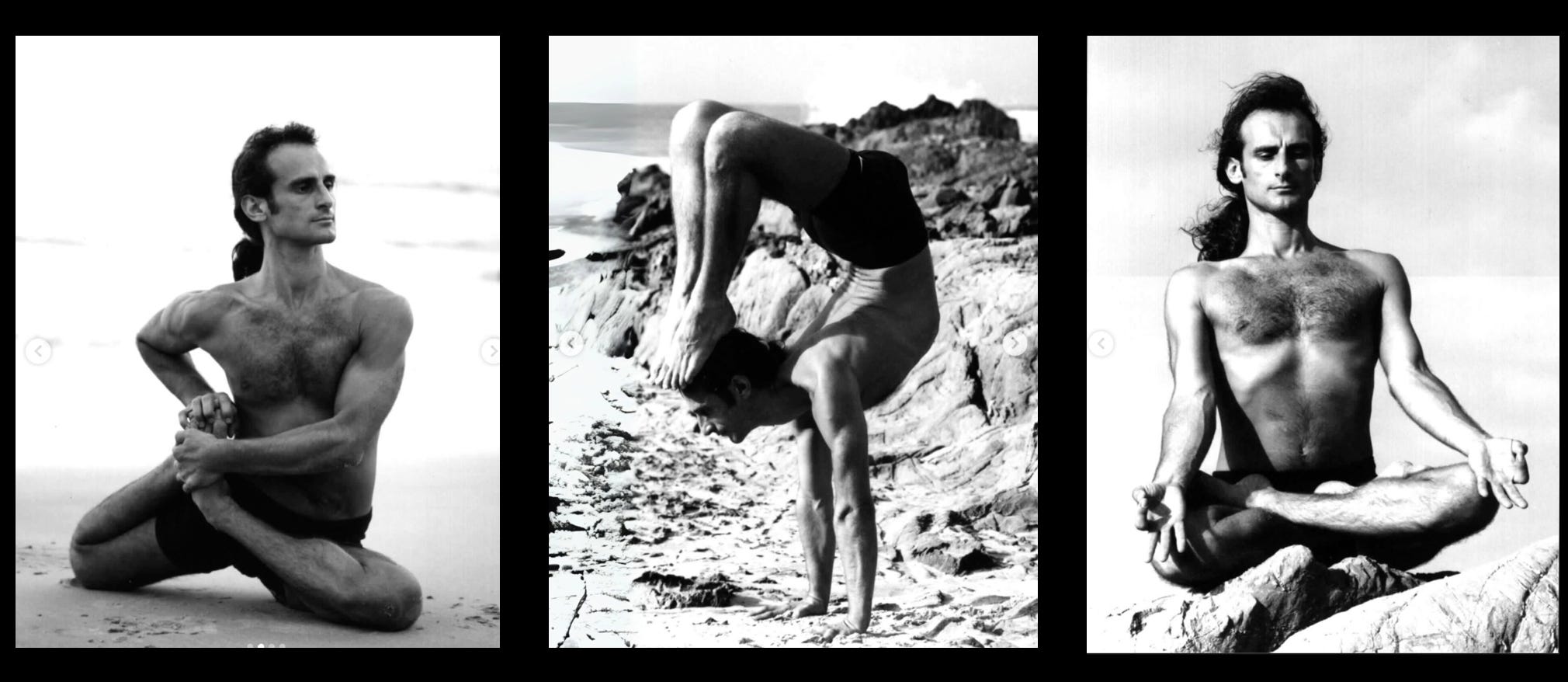
A week earlier I had attended a weeklong workshop with Simon Borg-Olivier in Berlin (all quotes based on my notes). I had seen him do his trademark abdominal roll, a degree of muscle relaxation and control that blew my mind. I knew I had to learn from him.
The goal, Simon explained, is to live in “a functional, pain-free body” and feel good across “five temporal dimensions”: while doing the movement, immediately afterwards, the following days, weeks, and years, as well as into old age. Simon learned this the hard way.
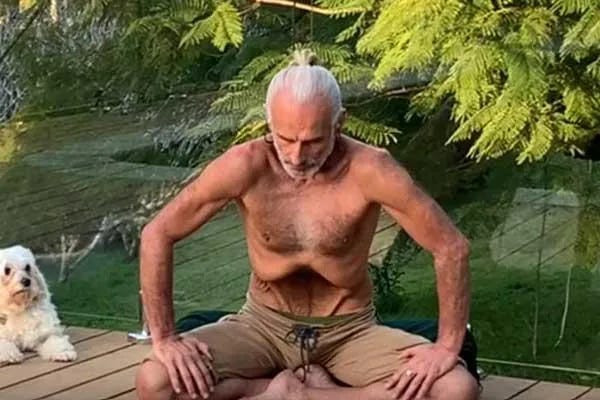
His background is unusual: at six years old his free-diving father taught him long breath-holds. Then he learned how to massage his organs by moving his abdomen. As a teenager he met a Tibetan Lama who could control his body temperature and would sit in the snow nearly naked. Simon studied yoga, human and molecular biology, massage, physiotherapy, and martial arts. Now he is a walking yoga and anatomy textbook whose wisdom I can’t do justice. Still, I feel called to share a few highlights that deeply affected me (or hear from him directly: My philosophy of how to practice posture, movement breathing & mental control).
“The Indian yogis didn’t understand,” he reflected on the pioneers who introduced Hatha Yoga to the West. “The Indian system was not appropriate” for the Western body and mind. We sit all day and rarely squat. We are conditioned to be competitive, ambitious, and tough on ourselves. We turned yoga postures into another workout routine and Instagram-worthy performances. Simon mastered and taught the challenging Ashtanga Yoga.
“The ones who go hard,” he reflected, “10-15 years later, they get problems.” Injuries, joint issues. “I’ve broken every bone,” he quipped, “messed up my body.” He needed something more sustainable.
“Learn to make it effortless,” he instructed us. “What I’m teaching is effectively movement meditation.” The practice must be sustainable, engaging and invigorating, yet also calming and effortless. Move gently and push yourself only 1-10% of the time. Let the nervous system remain in parasympathetic state: practice without heart racing, panting, or much sweat. On the last day of the workshop, we practiced for three hours in the morning and two more in the afternoon (and without air conditioning because Germany. . .). I expected to stand in my own sweat, ‘hot yoga’ style. Far from it.
For Simon, “yoga ends where stress starts.” This was a surprising experience for me as I’m used to feeling wiped out after weights, cardio, dance, and even yoga. Simon calls his sequences a “work in”: if after a workout you feel hungry, tired, and sore, his practice should leave you energized and with less need for food and rest.1 He is looking for the benefits of exercise and sleep. “Make the aim of your practice connecting with yourself. Let strength and flexibility be a byproduct.”
I see his story as an example of how our setbacks are necessary to catalyze our growth. Obstacles are a prompt for us to rise to our unique potential.
The foundation of this flowy meeting of Yoga and QiGong is what he calls the “movement at the base of all movement”: a sequence of spinal movements originating from the core (lower Dantian). One moves the spine or trunk in five dimensions: lengthening and shortening, forward and backward, bending to each side, twisting, and expanding and contracting. His YouTube channel has many demonstrations, like this one or this short one (his website also has a detailed introduction — edit: my favorite introduction is this Basic 5D Synergy Flow Fundamentals Yoga Class with the 5D flow starting at minute ~19).
A favorite of mine is the spinal sequence with its one-legged postures that challenge me and my flat feet (full sequence with verbal and visual instructions). Other sequences focus on the joints (full practice) and yoga-style postures (again more on his website).
I am still learning these basic movements. Often I find that body parts snap back into old patterns as soon as my awareness moves on. A predictable result, I suppose, of a lifetime spent sitting.
Another one of his techniques is to “relax what you don’t need,” a kind of body scan he calls the “bridges to the unconscious” (pelvic floor, abdomen, fingers, shoulders, neck, and face). He uses this during movement, meditation, and pranayama and I like to start my seated meditation with it. (How to Reset to Nervous System and Easy Relaxation Hack — “If you took away just one thing, let it be this one.”). Learning to relax the body in a controlled environment is very valuable when life gets stressful: “when you can’t control what’s happening outside, you have to shift on the inside.” “If a situation is stressful,” he joked, “I think, ‘ok I’ll relax my anus in that case.’”
I don’t think it matters much whether one practices Simon’s flows or a similar practice. But I am convinced that something like this is absolutely necessary when our lifestyle and environment — sitting, screens, chronic stress, etc. — actively conspire against our health. “I don’t want to be a supernatural being,” Simon quipped about the yogic pursuit of special powers, Siddhis. “I’m quite happy to be natural in an unnatural world.”
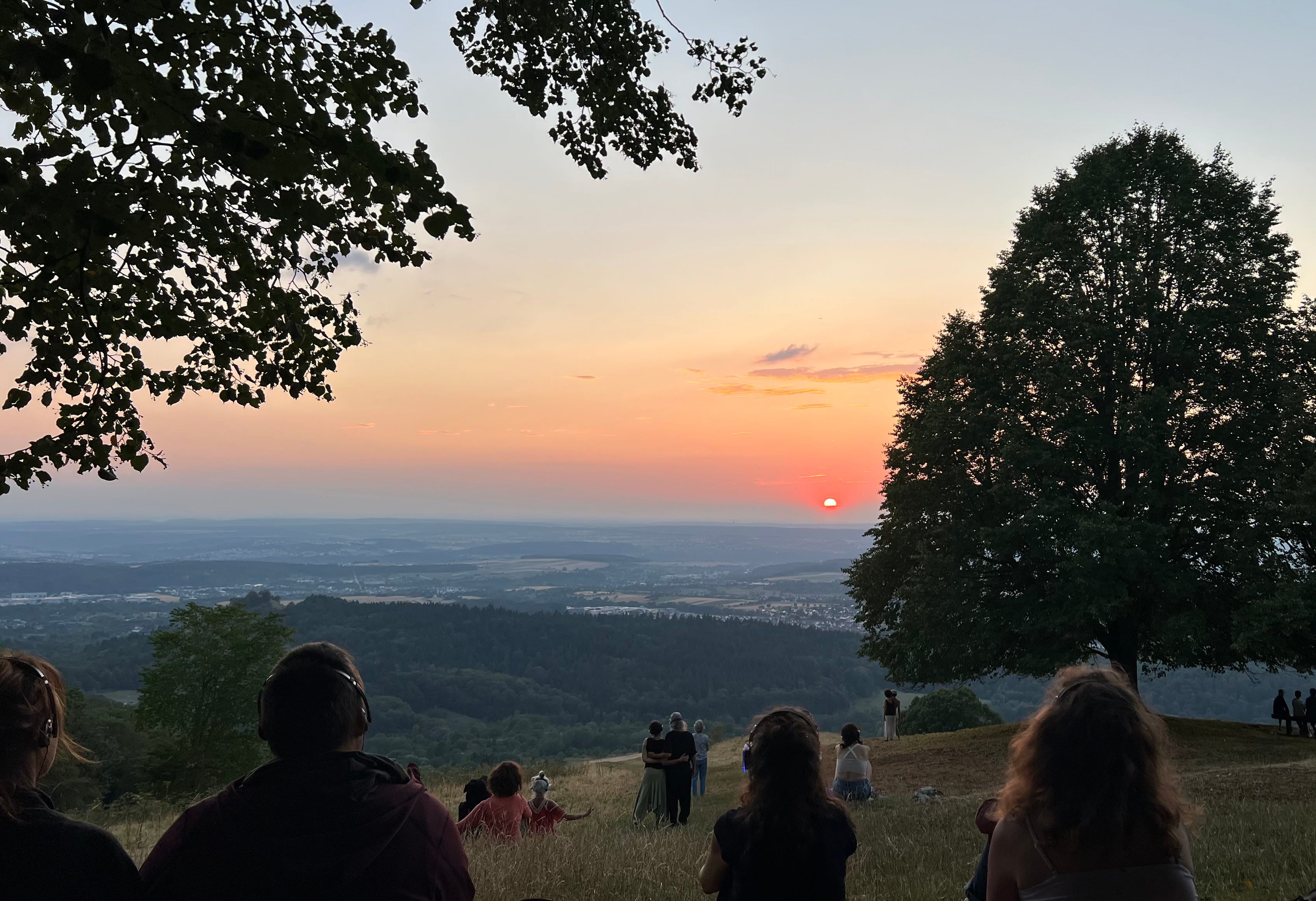
Long gone are the days when I could go for a walk with grandpa. But yesterday I joined my mother for a silent dance event on a mountain near my hometown. The grass was soft and wet under the bare feet, the evening air pristine. The crowd moved silently with their headphones. I felt a little more at home in my body, yet also noticed every creak and pop in my spine. Not quite there yet. . .
By the end of the perfectly timed set, the sun disappeared into a shimmering red pocket of clouds. On the drive home I pitched Mum on the value of Simon’s movements. Old age is inevitable, how we meet it is a choice.
“Enjoy your life, have a healthy body, use it to help others,” Simon summed up his take on life. That’s what I want, as long as possible.
May you be healthy and blessed.
Frederik
While on tour he does 6-days of workshop plus a travel day back-to-back. Thanks to his practice (movement and pranayama) Simon claims to get by on 4.5 hours of sleep and one meal, dinner, of mostly fruit and salad (plus a cacao-Macca-pepper-coconut oil-dates energy drink). After a short night he believes two hours of his practice are better for his body than trying to catch up on sleep.
2026-07-03 15:00:07
A couple of months ago I left the US. Having reduced my life to a couple of suitcases and without an obvious place to settle, I have been feeling restless.
I crashed at my mother’s for a few days (God bless her for putting up with me), then went on a spree of workshops and retreats: Sacred Ecstatics in Hungary, The Healing Voice in Spain, shamanic trance dance and 5 Rhythms in England, and finally yoga-meets-Qigong-ish movement with Simon Borg-Olivier in Berlin.
I was eager to regain a sense of direction. Standing still felt uncomfortable. Surely these experiences would lead to moments of clarity? Years ago, I might have used psychedelics as a shortcut to guidance, but my intuition has been discouraging their use for a while. That’s not what you need to learn right now.
But what do I need to learn? I think it has to do with dreaming.
Individual dreams affect the courses of our lives; collective dreams determine the futures of civilizations. — John Perkins, The World Is As You Dream It

2026-05-09 16:25:32
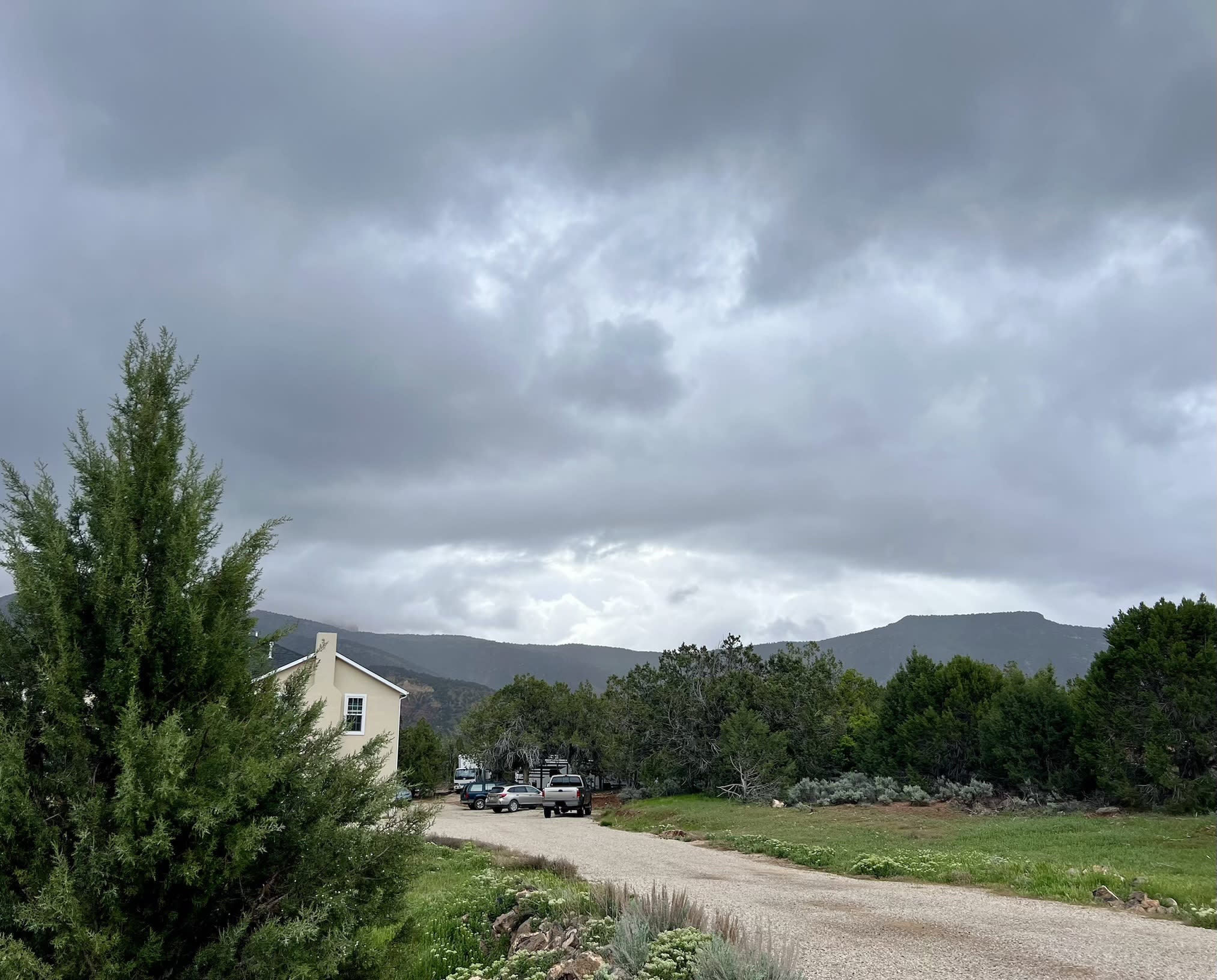
A storm is passing through Southern Utah. I walk in the drizzle, watch the juniper trees sway. Back inside I listen as the storm tears at the windows. Smoke curls above a stick of incense. As I fall on the sofa, for the blink of an eye, it occurs to me that I live inside the heart of God.
I don’t mean Me, Here, Now but All of us, Everywhere, All the time. And yet, most of the time it does not feel that way, does it?
“All of our life, everything we do, think, and feel is surrounded by nothingness,” John O’Donohue writes in Anam Cara. This “cosmic loneliness is the root of all inner loneliness.” Can one come to terms with that emptiness, and with the violence, inside the cosmic heart? Can one resist the urge to escape, to retreat into spaces gated and clean, protected, pristine, whether digital or spiritual?
Can one feel at home in messy, holy, bloody mud?
Can one fall in love with creation regardless?
I pack my bags. Time to drive to Salt Lake City. Time to sell the car, to release all that won’t fit into two suitcases. Time to close a chapter.
If contemplation is taking on the heart of God in the heart of the world, then the contemplative, perhaps more than any other, weeps over the obliteration of the will of God in the heart of the universe. — Illuminated Life, Joan Chittister. (Thank you to James Bailey for the book!)
“We cannot fill our emptiness with objects, possessions, or people,” O’Donohue writes. We cannot. Oh, but we try. “We have to go deeper into that emptiness; then we will find beneath nothingness the flame of love waiting to warm us.”
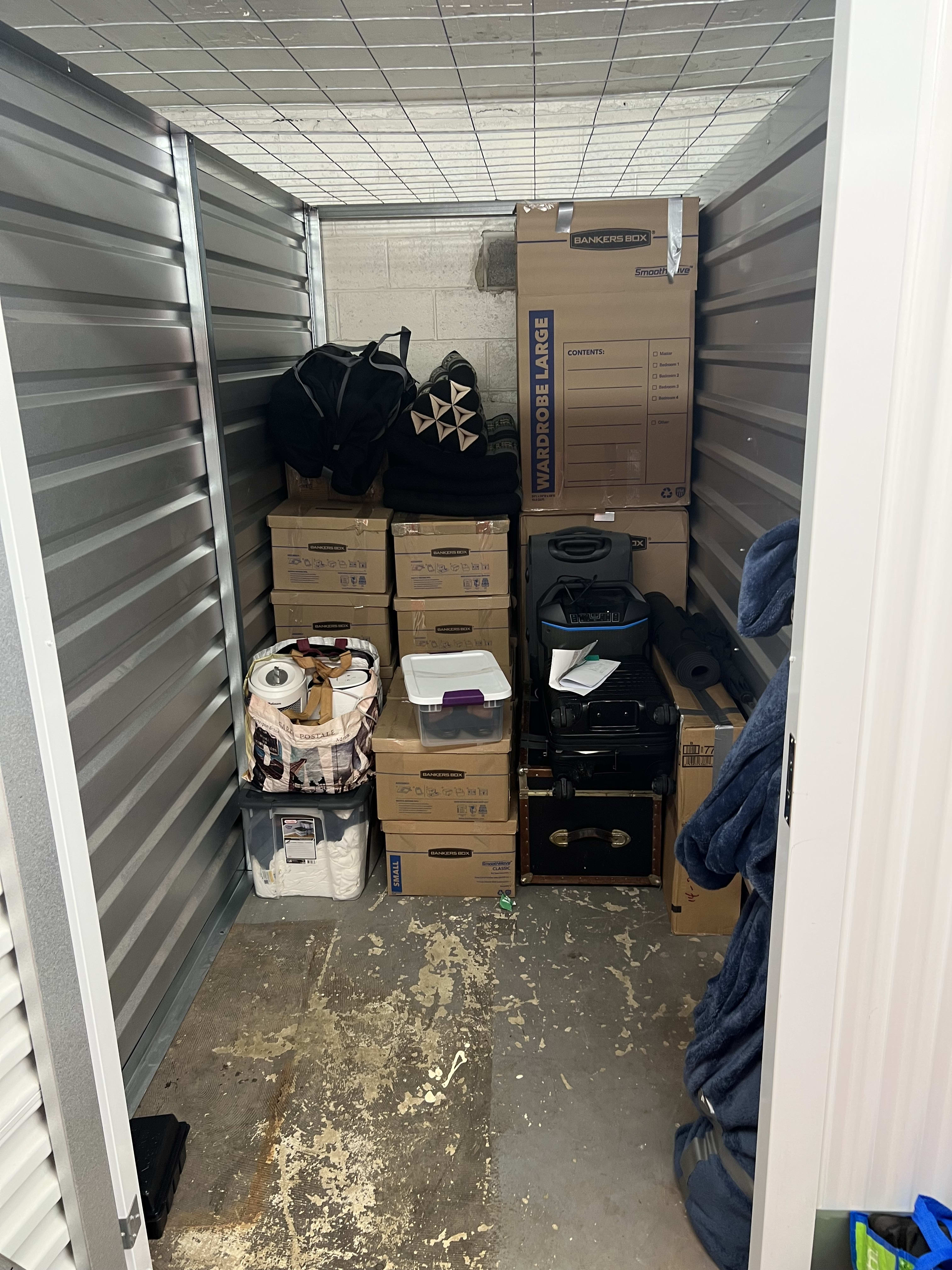
I arrive in Newark, New Jersey, to face what I used to camouflage the fear of nothingness. All of it went into storage when I left New York City nearly a year ago. For this I pay a hundred dollars a month, a reminder of a postponed painful encounter.
I brought a friend for support. When we open the door a jarring alarm rings through the hallway. The air in the storage unit is musty, thick with heavy memories. The devils of my American life wait among the boxes of this warehouse tomb.
We begin to fill large garbage bags. I want it all gone. Donate it, throw it out, I don’t care. I move quickly. I don’t want to feel what the room is holding. I retreat into silliness, into repetitive jokes, into comforting verbal loops. My friend informs me that I am “stimming,” self-regulating through sounds. When we break for lunch the universe throws a flag.
Lights flash in the rearview mirror. A cop pulls us over somewhere in New Jersey’s manicured soccer-mom-suburbia.
“You ran a red light.”
Did we? Maybe?! I have no idea. I am floating in a cloud of my own chatter. His voice hits me like a splash of cold water. I have never been pulled over, ever. And I don’t believe in coincidences, especially not on this trip. When the cop steps away, I pray. I ask for support, for harmony, for guidance. Can we bathe this whole situation in light, please?
The officer returns in a better mood. There are fines and summons, but the tension has vanished. As we munch on bento boxes, my friend and I try to make sense of what happened. We ran a red light. We were unaware. We rushed. We failed to stop.
Instead of pausing to honor the excavation and burial of my old life, I had closed my eyes and hit the accelerator. I refused to make the unconscious conscious. So, the universe forced me to hit the brakes.
We clear the air with smoke and sound, with prayer and invocation. My friend is an expert in these matters, I am a committed novice at best. After an exhausting two days, it is time to cross this threshold.
To be holy is to be home, to be able to rest in the house of belonging that we call the soul. — John O’Donohue, Anam Cara
Home remains a fleeting experience for me, as if my destiny was not to belong but to be in longing.
When I grew up, home seemed simple and tangible: family, the house, friends, culture, Deutschland. Familiarity and bonds of blood felt constricting, suffocating, too small. I could not wait to leave.
New York became home through relationships: marriage, work and, later, healing and spiritual community. But my roots never broke the concrete. I was a renter, a guest, straining against walls, always reaching for sunlight and more space. I never fully arrived.
Before I head to the airport, I meet a friend for breakfast in Midtown. Manhattan is chilly this morning. People rush past me with clenched faces. The place feels overcaffeinated, dysregulated, an assault on the nervous system. My friend’s mind seems to be running at ten times the speed of my own. I consider the consequences of opting out of this cultural hotbed. I like who I have become, but my writing has slowed down drastically. Maybe I think like a tree now, forming thoughts like leaves, one season at a time?
I’ve experienced home downward, in roots and soil, in history and ancestry. I’ve also felt it in the lateral branches of relationships. But home also occasionally reveals itself inward and upward, in the refuge of a full heart, in moments of transcendence. Is home wherever we glimpse our wholeness?
Purifying my physical circumstances repeatedly has created an invitation to revisit the inner room. What attitudes and beliefs make up its walls and tapestry? Can I feel its outline, its texture? Is it inviting? Have I bolted the door and shuttered the windows? How did I ever let it become so cluttered?
The day of departure is filled with Doppelgänger encounters, with faces reminiscent of old acquaintances. Everything seems familiar yet distant. I can’t stay. Every ending implies a beginning and, as I board the plane, I wonder where my wandering heart will lead me.
I maintain that Truth is a pathless land, and you cannot approach it by any path whatsoever, by any religion, by any sect. . . . Truth cannot be brought down, rather the individual must make the effort to ascend to it. — J. Krishnamurti
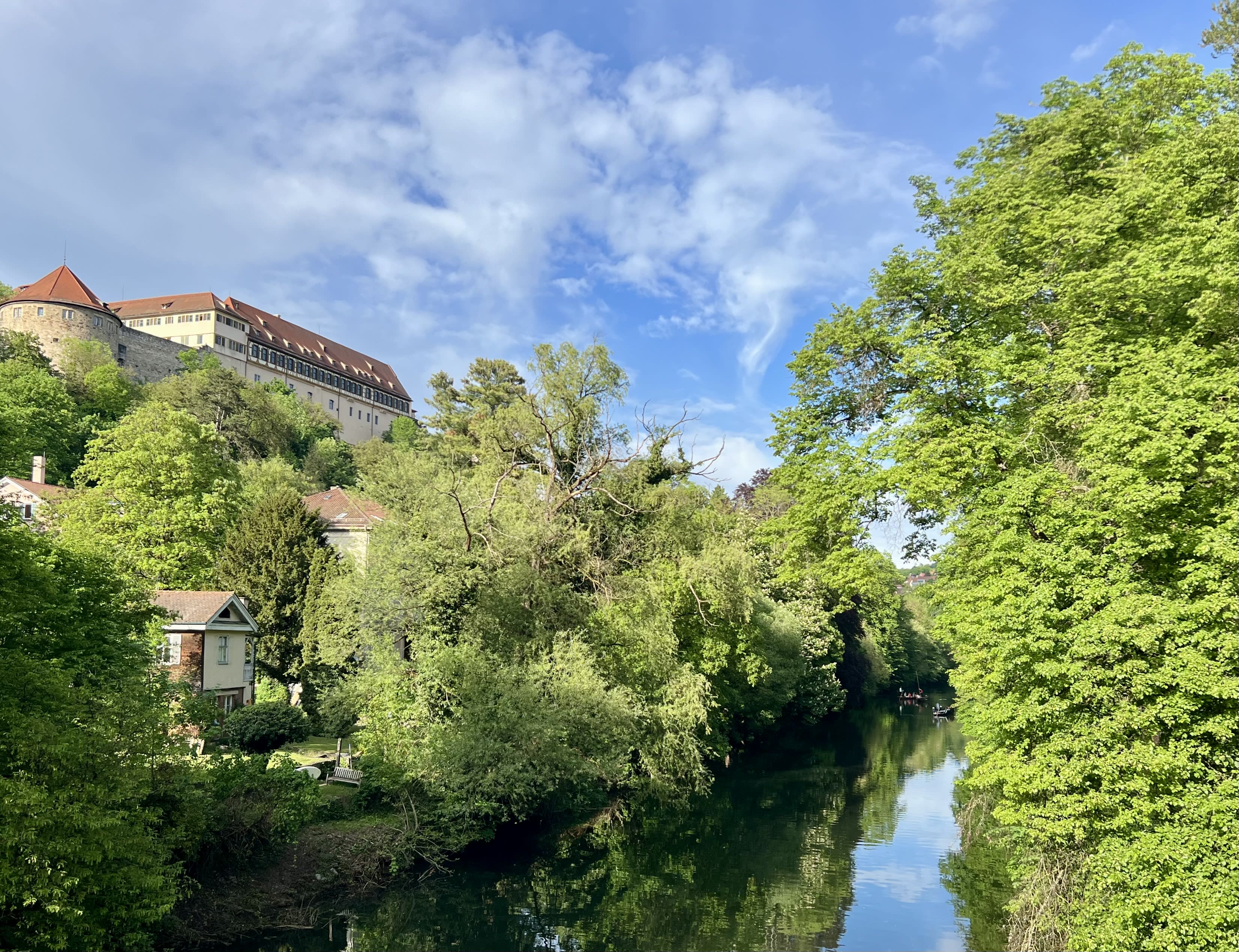
How to find that inner home? I used to think stillness was the “correct” path. Meditation appealed to me. Prayer arose more spontaneously. After some recreational experimentation, I was taught psychedelic ceremony as an inward journey supported by sacred instruments and music.
And yet, some of my most freeing experiences have been in movement. I know the energy of dance can lift the ceiling and open a portal. I had to learn how to dissolve and let myself be moved. Once I did, there was no turning back.
“What we are ready to learn is that heightened arousal, whether through wild dancing, spontaneous jumping up and down, or body shaking, is as valuable a healing and transformational practice as sitting quietly in a lotus position,” Bradford Keeney writes in Shaking Medicine. This guy gets it, I thought.
Brad spent a lifetime following visionary dreams and immersing himself in ecstatic, shamanic, and healing traditions including the Kalahari Bushmen (San) of southern Africa and the healers of Bali, Mexico, Brazil, St. Vincent, and Japan. He and his wife Hillary now facilitate, teach, and write under the name Sacred Ecstatics. When I saw that they offered a weekend workshop in Budapest, I changed all my flights.
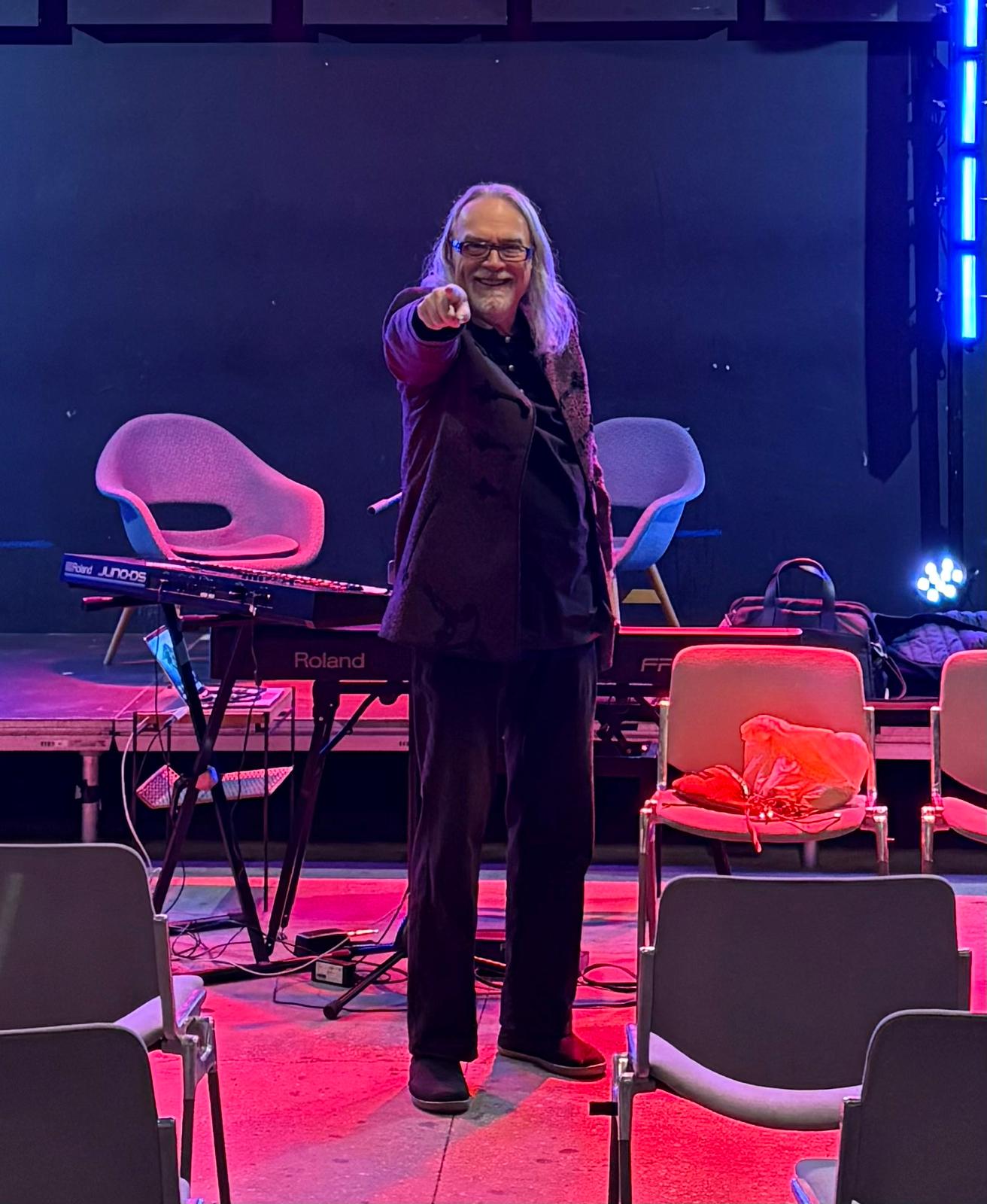
Brad is an Unikat, a genius musical shaman, truly one of a kind. He is posted in front of two Roland synthesizers and plays sequences of rapidly changing rhythms (“all of my music lessons came from the other side,” he explains; a few examples are on Soundcloud). The audience rocks and sways, back and forth, waiting to catch a “stray,” a jolt of energy, a spontaneous shaking movement.
Brad calls it the “spiritual engineering of sacred ecstasy.” His formula is ESM: (sacred) emotion, sound, and (spontaneous) movement. These feed on each other and raise the “spiritual temperature.” The goal is to prepare a “big room” for the divine and “get cooked.” The intention is to climb upward on one’s “rope to God.” It’s very different from anything I’ve done before.
While one of my new friends has an instant kundalini awakening, I spend my days rocking and swaying, listening intently, and occasionally falling into shakes and spasms that remind me of TRE. On the last afternoon, I find a deep space of sadness and yearning. Why won’t You let me draw closer? Why do I have to return to this tiresome world? Tears stream across my cheek.
It feels like I’ve stumbled across something profound, yet I barely managed to touch the rope, let alone climb. The jewel of jewels remains remote. It hangs over my life like the full moon over Budapest.
“The secret of life is to move from observing to serving.” — Hillary Keeney
How odd to think about ancient medicine when everyone is talking about AI. But I don’t know what the world needs or where it is going. I barely know what I yearn for: wholeness and presence, surrender and devotion. Stillness and ecstasy. To feel deeply alive, to return home, if only for a moment. And to become a True Participant, as Hillary put it, a co-creator with the divine.
Brad seems to believe there is a near-universal answer to life’s problems. Diagnosis? Analysis? Convoluted questions about the ineffable? “Trickster territory” of the mind. Too many words. Spiritually cold. He answers with a shriek or a channeled song. If you find yourself in a funk, it’s the “ancestors reminding you there’s not enough dancing!” “Wake up,” he shouts from behind the keyboard.
Is what I’m looking for as simple as gathering around a fire with a drum and a deep longing to reconnect with the infinite? I don’t know. And that’s okay. I let go of the books and the need to know. My intellect used to have unquestioned dominion over my life. Instead, I want to make room for play.
Language and knowledge seemed like the master key to life. But always my intellect felt the need to define and to draw distinctions: it’s this not that. Brad would call this “ground talk.” My heart on the other hand knows the unity behind all contradictions. The heart can embrace paradox because it does not need to be explicit. The heart does not explain. It simply breaks or is lifted in a lifelong dance.
2026-04-06 07:44:26
I have been radio silent and I apologize for that. To be honest, I feel ashamed.
First, ashamed to not have published more often. I expected this trip to be inspirational, a boost of my creative juices. Instead, it feels like my writing brain has gone on strike. But why?
From one angle, the writing feels disconnected from my heart. Writing about travel and money, spirituality and consciousness, all such drafts felt stillborn, like silent piles of lifeless words. I don’t care to write about what does not deeply move me. But what would that be?
It’s hard to put into words. This feels like a time of endings. Endings in my life but also in the culture at large (micro mirrors macro). It feels like the myths woven into my life are dying.
For one, I feel ashamed to be an American.
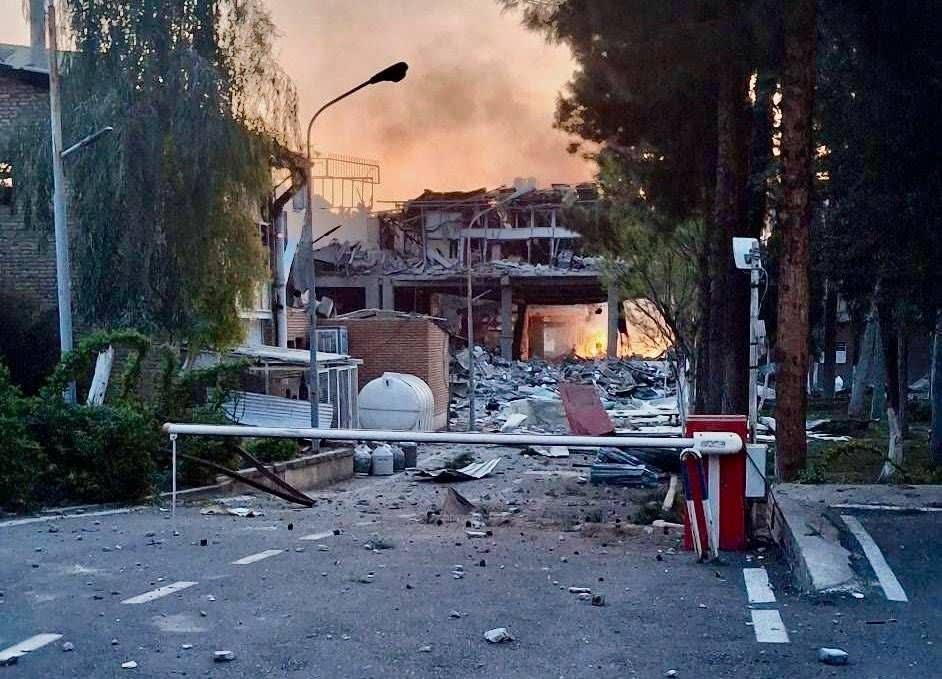
Ashamed to witness what this nation is turning into, what it now stands for, how it is run, and who it is run by. I feel ashamed to be part of a system that embodies hubris, exports violence, and allies itself with an ideology of mass killings, displacement, and starvation.
We bomb schools, hospitals, universities? We conduct double tap strikes? We assassinate politicians and their families? How is any of that okay? It’s not, of course. It is what a ‘Great Satan’ would do.
I feel ashamed also to be safe and comfortable, to bite my tongue, while watching one vile revelation after another. Gaza. ICE. Epstein. Already yesterday’s news thanks to Iran and Lebanon.
Behold a nation carrying its shadow like a barrel full of toxic PFAS. Behold as we project it unto others in the form of organized violence. Behold as our house is ruled by greed, grift, and cruelty.
How do you come to terms with that?
In the past, I would have retreated into denial and distraction. I would have shut it all down, pretended I was not political. Politics? A sure way to ‘kill the vibes.’ Working in finance reinforced this attitude for the market rewards mercenaries. Convictions appear as a costly handicap. “Greg, this is not fucking Charles Dickens World, okay? You don’t go around talking about principles,” as opportunist archetype Tom Wambsgans puts it in Succession. Keep your head down and your eyes on the ball of money.
That’s over, thank God. I no longer want to bypass reality, however nauseating it may be. How could I not let myself be shattered? How could I not let the acid of revelation disintegrate my worldview? How could I not stand in shock as the masks came off?
But what is a healthy response when the atmosphere turns septic, when the discourse is a fever dream, when rot is being exposed but not treated?
What does one do with the anger, the grief, the shame, the feeling of impotence?
Writing feels like an escape into the comfortable space of my head, away from the tension of truth held in my body. And even on the page I find no solace. I have no answers. Writing does not answer that heavy question dangling around my neck: now what?
What does this age ask of me?
What can I contribute but outrage and tears?
I don’t want to join a battle where each side inevitably believes it represents the light and fights darkness. I don’t want to join the dance of fear and greed. I don’t want to walk the ancient path of resentment and violence.
I want to be part of the healing. I want to create and empower, inspire and awaken. I want to be truthful, loving, and kind. I want to find what lies beyond the hunger, beyond the injustice, beyond the catastrophe.
“Loneliness does not come from having no people about one, but from being unable to communicate [what] seems important, or from holding views which others find inadmissible.” — Carl Jung
Charles Eisenstein called this a “time between stories.” What do we do when the fabric of our reality is torn? If the old stories are dead, how do we release them? And how do we bring new ones to life?
The only thing I am confident about is that the answers are not waiting on the screen. We won’t find them on Substack or YouTube. ChatGPT doesn’t know. These can help us discover, share and connect, but they cannot animate a new living myth. If we are stuck, we will have to move.
I am reminded of the book Black Elk Speaks about Oglala Lakota medicine man and visionary Black Elk. “Everything an Indian does is in a circle,” he explained, “because the Power of the World always works in circles.” But his nation’s “sacred hoop” was broken and his people forced into the reservation’s “square boxes.” A catastrophic end to a way of life, “for there can be no power in a square.” How does one respond to such trauma?
One day, “word came to us that the Indians were beginning to dance everywhere.” A Paiute shaman/prophet had shared a vision of multi-day ceremonial trance dances, the Ghost Dance. These were supposed to re-connect the tribes with their ancestors and restore the world to harmony. Buffalo would re-appear, white settlers would return east. “The people were hungry and in despair, and many believed in the good new world that was coming.”
But the US government believed it saw preparations for an insurrection and banned the movement. Hundreds were gunned down at Wounded Knee. The ‘good new world’ did not manifest, yet there is much to learn.
First, it is a sobering reminder not to lean too much on others’ visions. Clarity about the present beats seeing possible future paths. A crisis asks us to re-connect with our deepest inner knowing, with the truths we carry in our souls.
And notice how intuitively the Ghost Dance seemed to answer the situation:
Are people fragmented, divided? Gather. Get in sync.
Weighed down by the trauma of defeat? Rise, move, release.
Lost your spirit? Enter altered states of consciousness. Re-connect with the world beyond for support.
Imprisoned in a lifeless square? Form a living circle.
I’m not saying trance dance is the answer to what ails our culture, but it feels directionally more relevant than reading another book or listening to another podcast.
We are conditioned to watch our visionaries, founders, bring ideas to life with the power of capital, technology, and persuasion. The marketplace votes on how our culture changes. But the answer to a crisis mirrors its nature. Our spiritual crisis will not be healed by the archetypes that created it.
Should it surprise us if we had to humble ourselves and learn from the people whose cultures were steamrolled by the machine of conquest and progress?
“I think it’s just going to get weirder and weirder and weirder and finally it’s going to be so weird that people are going to have to talk about how weird it is. People are gonna say what the hell is going on. It’s just too nuts.” — Terence McKenna
“In traditional cultures, when someone returns from a vision quest, the first thing they do is share their vision with the elders of their community,” Chris Bache writes in LSD and the Mind of the Universe. “They do this, first, to receive their counsel on what the vision means and, second, because their vision does not belong to them alone. Deep visions are not private matters.”
Read it again: deep visions are not private matters. What if during our individual journeys of healing and growth we receive bits and pieces of the answer? These would not be for our entertainment. And yet even creating spaces to share them would not be enough.
Black Elk’s private big vision was turned into a public ritual. Painted riders and horses enacted his encounter with Spirit. To impact the community, energy had to move from behind the veil to the visionary, from the individual to the collective, and from the mind into the body. The story had to be enacted and witnessed to be held.
What is our way of gathering around the sacred tent? The doomer take would be that we don’t have anything similar. We can enact the current myth, say on national or religious holidays like Easter and Christmas, July 4th, or the Super Bowl. We can passively receive new stories through art and entertainment. Are public demonstrations and marches the closest we get to enacting new visions together?
I believe we still yearn for active participation. Removed from noise and narrative we know our ways with absolute clarity.
If we are atomized, we gather.
If we are stuck, we get in motion.
If oppressed by silence, we make noise.
If the world darkens, we share our inner light.
When the collective is wounded, healing happens in community.
Ritual binds the individual to the community and the cosmos. — Joseph Campbell

Black Elk was depressed. The tide of history had not turned and he believed he had failed his people. “It was the story of a mighty vision given to a man too weak to use it,” he said, “of a holy tree that should have flourished in a people’s heart with flowers and singing birds, and now is withered; and of a people’s dream that died in bloody snow.”
It is a warning not to be complacent when the questions are thorny and the stakes are high. But it also reminded me to be compassionate with myself, to accept my human limitations. What can we do but show up, do our best, share our light, and surrender our expectations of how and when a better world will come to be?
My writer’s mind would like to answer the big questions to great applause. That’s the trap, the distraction from the question that demands to be lived every day: how do I help create the world I love with all my heart?
The state of the world is the question. Our lives, how we live, every moment of our Being and doing, is the answer.
After a solitary year on the road, my mind is gravitating to spaces of community, of devotion and healing. I yearn for honest conversations and gatherings that lead us to our truth, that brighten our inner light, that lift the weight by sharing with each other and connecting with the divine.
I find myself disinterested in thought-leaders and founders. I am looking for emergence and co-creation, for spaces that catalyze energy and ideas. Where do we get inspired and tap into our power? Where do we move and let ourselves be moved? Where does the air feel alive and sacred?
It is maddening to love this world, yet that is what we are called to do, in spite of it all. Happy Easter.
Praise be to all names and faces of God.
May Peace be upon the world.
— Frederik
Pause for beauty; it is food. — Robert Falconer, Spirit
2026-03-28 23:51:38
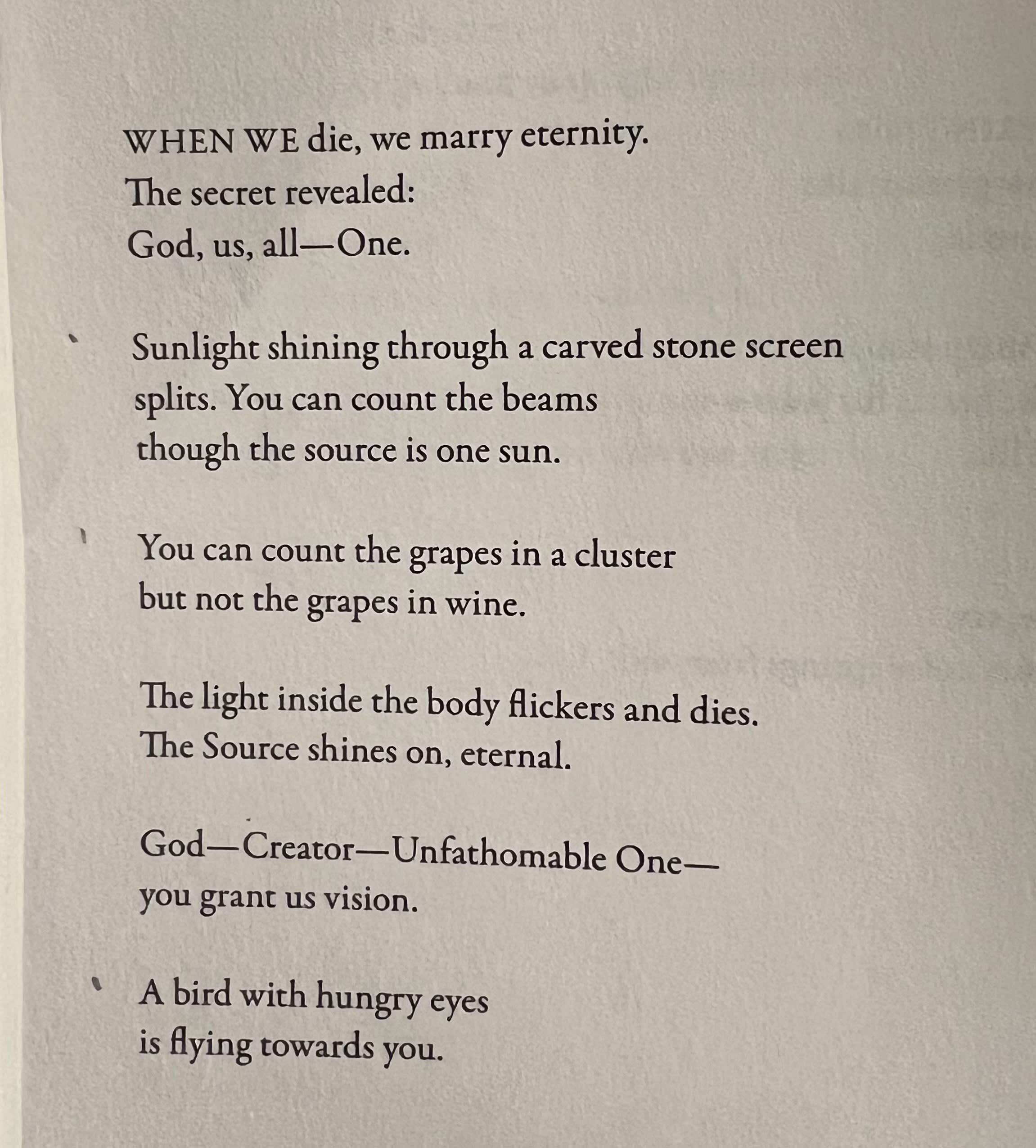
Our job is to look inward, toward the one source of light and thus reconnect with our source of being.
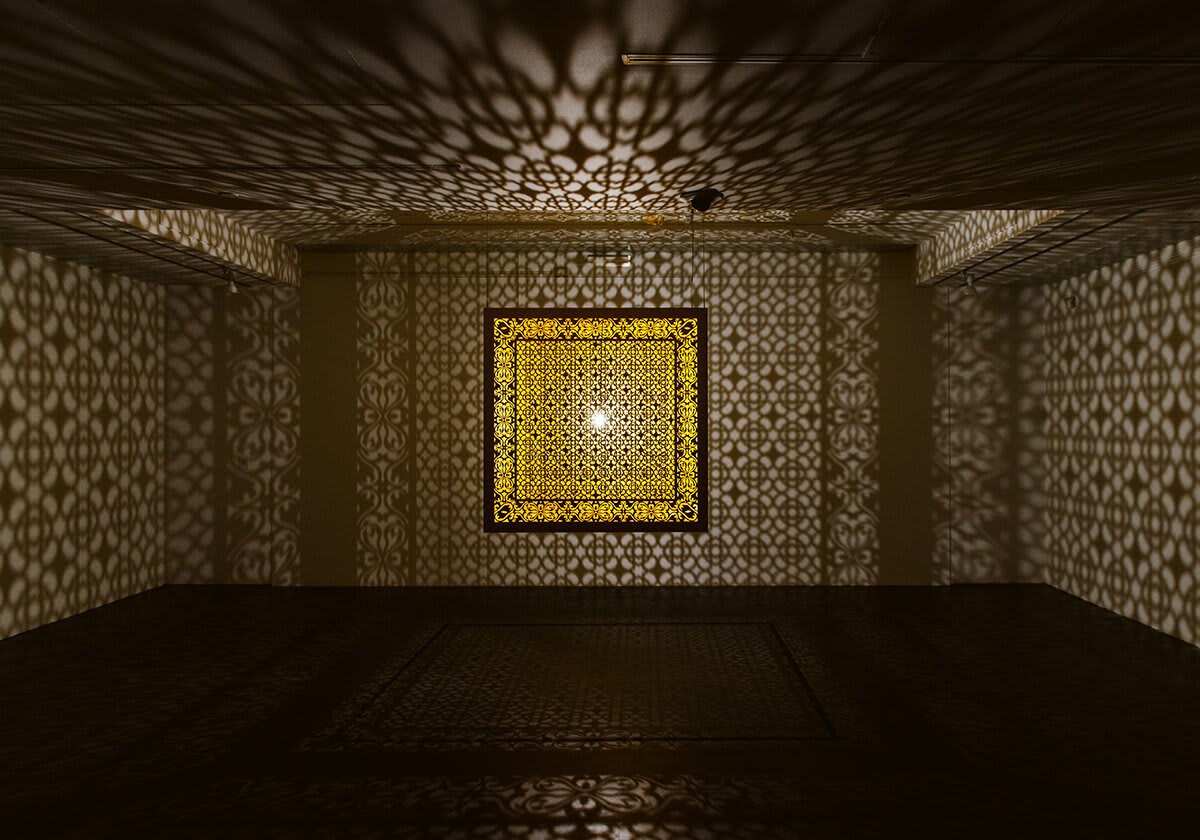
We take that out into the world of experience, where that light is projected on the wall. Patterns of light and shadow are what we see as reality. We must understand reality as the world of shapes and patterns and forms, whereas the source is one source of light.
We have to operate in the world of shapes and patterns. As long as we do that, we have a chance to make it as beautiful as possible to honor the source.
If the world of forms looks disturbing, because it is light and shadow, then it is all the more important to reconnect with the source of light, with the inner light, with the way the source appears through us, through our souls.
Equally important is to seek the source of light in all that we encounter, understanding that all other beings, that everything in the world appears to us as a shape projected from the same source.
If we can make contact with our inner light, our presence of light allows others to experience theirs more clearly. That is, the experience of light reminds us of our inner light. Therefore, the more connected to our inner light we are, the more we become a beacon, not only to shine light but also to activate inner light in others.
Which is why connecting to our inner light is a foundational practice, an act that changes the world. Without any doing it self-organizes the world in beautiful ways. All we have to do is show up. Our presence, all of our doing, is the vehicle for the transmission of this inner light.
So, when the world of shapes, of light and dark, feels distressing, it is not selfish to turn inward, to connect with the source. Rather, it is an act of healing in the realm of the soul, an act of healing that reverberates effortlessly.
That in itself can be seen as our purpose: showing up as the Being we are, a Being that shines through all of our doing.
Every time we embody Love, divine love, capital L Love, is a doing. Whatever we do is then an act of Love, an act of light ministry, if you will.