


2026-09-14 23:24:19

TOKEN2049 Singapore is back - October 7–8, Marina Bay Sands.
The world’s largest crypto event returns, where the whole industry shows up: 25,000+ attendees, 300+ speakers, and 1,000+ side events taking over the city right into F1 weekend.
This year’s stage runs from Shayne Coplan (Polymarket), Jeff Yan (Hyperliquid), Adena Friedman (Nasdaq), Eric Trump, Arthur Hayes, Balaji and Jesse Pollak (Base)—the people actually shaping where this goes. Readers get 10% off with code POMP10.
To investors,
Anthropic, one of the leading AI model labs, published a blog post this weekend calling for the AI industry to “pace” themselves going forward. The argument in layman’s terms is that AI is a powerful technology that promises many benefits, but it could also destroy humanity.
I am not joking.
This comes after an Anthropic employee quit last week and publicly warned that AI was an existential threat to humans. Now before you put any weight on this employee’s “warning,” you should know a few facts first.
The employee is rumored to have worked at Anthropic for 6 - 18 weeks before quitting. He previously worked in the “AI safety” industry. His resignation letter was given to the media in advance of him posting it (we know because the media published their article on the tweets before the tweets were publicly posted. Oops!). The first people to amplify the employee’s tweets were his former colleagues in the AI safety industry and they used it to go full hysteria mode.
I don’t believe this employee at all. This is exactly what a psychological operation looks like. It seems pretty obvious that the employee got a job at Anthropic with the express intent to quit and cause a scene. You should think of this like a mole who infiltrated their enemy’s front lines, then ran back and screamed about how bad everything was.
Nice try, doomers. No one is falling for this nonsense in 2026.
But let’s put aside the obvious manipulation of the press for a second. Why are these people so focused on AI safety? Why do they keep saying ridiculous things in public? Why is the Anthropic CEO stating in interviews that he wants to turn over ownership of his company to a collection of the right governments?
No one knows for sure, but the best theory I have heard comes from David Sacks (former AI and crypto czar at the White House). He claims that Anthropic and others want to create a federal department that oversees the AI industry. Sounds benign, right? Wrong. The idea is for the large model labs to pack this federal organization with “their people” and then create rules that essentially shut down competition, including banning open source.
I don’t know about you, but I don’t trust any of these people to set the rules. These are the same people that told us pretty much every prior model was too dangerous. They promised the last 6 or 7 models were going to hack into every bank and people would lose their lives.
Instead of any of that happening, AI has simply made us more productive, given us more time, and generally been a big win for humanity. Could it create issues? Sure. Is that the likely outcome? Absolutely not.
These AI folks know this too. When asked about probabilities, they claim there is a 10% chance that AI could kill humanity. Where did the 10% number come from? They literally just made it up. What is the difference between 5%, 10% and 15%? No one knows! These wild claims and numbers are just being invented as we go. YOLO.
Ok, enough of me dunking on these insane “warnings.” What do I think we should do as an industry and as a country?
We should accelerate. Build AI as fast as possible and make sure we are the clear winners on the global stage. Acceleration is the American way. Slowing down will only ensure that other people will win. China or other adversaries would love nothing else than for the US to take their foot off the gas pedal. We cannot let that happen.
And I promise you the AI leaders know this. Do you see a single one of them promising to slow their investments in AI? Are any of them freezing hiring or claiming they will “pace” their research and development? Absolutely not. They want everyone else to slow down, but they have no plans to slow down themselves.
This is how it should be. I am glad this “pacing” narrative is getting so much press time because it is ultimately an intelligence test. If you slow down, you fail the test and deserve to lose to the large model companies. If you realize they aren’t going to slow down and you keep accelerating, you pass the test and have a shot at competing for the largest prize in human history: superintelligence.
Related to this, it is very important for the US government to avoid calls to intervene in the AI industry. I know it is tempting. I know the company CEOs are issuing all sorts of insane warnings. But we need leadership that sees right through the nonsense.
Let competition play out. We need OpenAI, Anthropic, Google, Meta, SpaceXAI, China, and open source all ruthlessly competing against each other. Push the pace of innovation. It is good for the consumer and it will also create a safer environment too.
The thing people forget is that consumers and enterprises will ultimately move away from any products they deem unsafe. The market can regulate these companies much more than the government. If these super geniuses create dangerous products that cause harm, they will be held accountable by markets.
The last thing I will say is that this dust up from over the weekend reinforces the idea that every company needs to “own their own intelligence.” They will need to build AI harnesses, train their own models, and run the technology on their own hardware. This is the sovereign approach to ensuring your company is insulated from the daily gyrations and knee-jerk reactions from these model labs.
This is exactly what we have done at Silvia. We have built a custom AI harness, including a model router, proprietary data pipelines, and many other technological developments we will begin publicly talking about in the coming weeks. Ignore the noise from the labs. Focus on embracing this technology as quickly as possible. Use it to win your market. And make sure you own your intelligence.
The future of your business and your financial security depends on it. I explained more on Fox Business this morning. You can watch the segment here:
Hope everyone has a great start to their week. I will talk to you next time.
- Anthony J. Pompliano
Founder & CEO, ProCap Financial (Nasdaq: BRR)
Jordi Visser is a veteran macro investor with 30+ years of experience and the author of the VisserLabs Substack.
In this conversation, we break down the timing for the next bitcoin bull market, why the Clarity Act could send bitcoin to $100K, and how AI's exponential progress is leaving the market mispriced. We also discuss the Fed's rate decision, the Trump-Bessent-Warsh alignment on AI and crypto, and why the AI bubble skeptics have it backwards.
Figure – True DeFi Democratized Prime yielding ~8.5% APY. They also have the lowest industry interest rates at 8.91% with 12 month terms! Take out a Crypto Backed Loan today. Figure Lending LLC dba Figure (NMLS 1717824)
Arch Public’s platform automates your trading strategy beyond DCA for equities, commodities, ETFs, and crypto. With advanced inputs that reflect your own intentions, Arch Public supports smarter entries, exits, and opportunities in volatile markets. Connect with their team, try the product for free, and see how agentic trading can work for you, with Arch Public!
Lava - The Lava Card allows you to earn up to 5% back in bitcoin every time you spend. There are no annual fees, no FX fees, and no gimmicks. You can also use Lava to borrow against your bitcoin at 6.5%, the industry’s lowest interest rate. Get started in just a few minutes at lava.xyz/pomp!
GalaxyOne – Earn up to 8.00% yield on cash. Auto-Reinvest into stock and crypto.
Simple Mining offers a premium white-glove Bitcoin mining service. Want to grow your Bitcoin stack? Visit https://www.simplemining.io/pomp
Uphold - Uphold is the all-in-one platform to trade, earn, stake, and swap across 300+ assets with real-time proof-of-reserves and any-to-any conversions. Manage your entire crypto portfolio in one place at www.uphold.com
BloFin - BloFin is a fast-growing cryptocurrency exchange focused on providing professional-grade trading tools, deep liquidity, and a secure trading environment for crypto traders worldwide.
🚨READER NOTE: If you want to sponsor The Pomp Letter, you can fill out this form and someone from our team will get in touch with you.
You are receiving The Pomp Letter because you either signed up or you attended one of the events that I spoke at. Feel free to unsubscribe if you aren’t finding this valuable. Nothing in this email is intended to serve as financial advice. Do your own research.
2026-09-09 02:14:18

Figure’s building the future of capital markets through blockchain with $30B unlocked in equity.
They offer one of the lowest rates on their Crypto Backed Loans at 8.91% @ 50% LTV.
Or check out Democratized Prime to earn ~8.5% yield, a one of a kind DeFi product where your crypto earns for you against RWA (real world assets).
Sign up now and earn $50 when you make your first deposit, earn ~8.5% yield, or take out a Crypto Backed Loan with their low rates today!1
To investors,
Bitcoin seems to have bottomed from the bear market. Investors are cautiously optimistic about the asset’s potential return given the backdrop of undisciplined fiscal and monetary policy. But there are a few data points worth paying attention to that should solidify that early enthusiasm into full bull market vibes.
First, bitcoin’s 50-day moving average is about to cross it’s 200-day moving average for the first time in almost 500 days. Bitcoin Isaiah writes “[Today] Bitcoin will have its first golden cross in 474 days.
Last 5 golden crosses:
+15% in 3 months
+56% in 2 months
+115% in 5 months
+41% in 2 months
+50% in 2 months
Based on previous golden crosses, we should expect Bitcoin to be 91k - 170k around year’s end.”
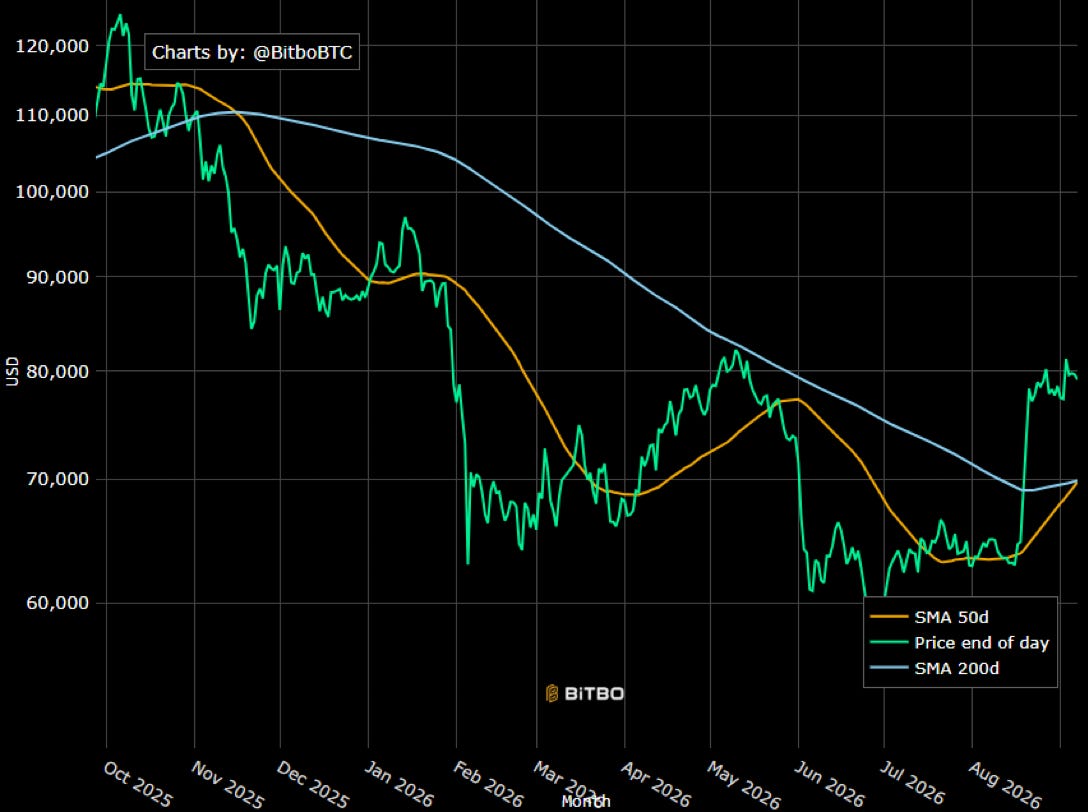
When this “golden cross” historically happens, there have been substantial moves in bitcoin’s prices in a very short period of time. Will history repeat itself? No one knows for sure. I wouldn’t ignore a simple, timeless analysis framework like this though.
Speaking of the 200-day moving average, Joe Carlasare asked Grok to analyze bitcoin’s performance after reclaiming the 200-day moving average and staying above the trend line for 15 days or longer. Grok responded with “Bitcoin has never closed above its 200-day MA for 15+ consecutive days in a bear market and then made a new cycle low. Sustained reclaims after prolonged periods below (2015, 2019, Jan 2023) marked the definitive bottoms. Brief tests/rejects (like March 2022) failed quickly without lasting 15 days.”
As if that wasn’t clear enough, Grok finished the analysis by explicitly saying “This is historically strong evidence the cycle low is already in.”
Next, bitcoin analyst Willy Woo shows the relationship between bitcoin and public equities is starting to get interesting as well. He writes “It’s almost been a decade since the last time this happened...the last time BTC decoupled from stocks to this degree was 2015 (prelude to the 2017 bull market).
2014: Stocks remained bullish while BTC suffered an uncorrelated bear market.
2015-2016: Equities chopped bearish for 2 years while BTC engaged bull mode, then mooning in 2017 when equities aligned bullish.
In my opinion, the setup looks similar... BTC liquidity continues to strengthen, while equities starting to show signs of fragility.”

And if none of this data has convinced you yet about bitcoin’s incoming appreciation, I will leave you with Adam Livingston’s passionate analysis on bitcoin’s MVRV metric:
“OFFICIAL: Bitcoin’s MVRV momentum oscillator just printed positive for the first time since October 9, 2025.
That is 329 consecutive days underwater. The longest stretch since the 2022 bear. In the modern era this exact setup has appeared three times: a run of 329+ straight days below zero, then a green flip above zero.
July 2015. April 2019. January 2023. Here is what came next.
3 months: -21%, +121%, +23% → median +23%
6 months: +40%, +58%, +24% → median +40%
9 months: +37%, +57%, +45% → median +45%
12 months: +114%, +39%, +82% → median +82%
18 months: +160%, +105%, +181% → median +160%
24 months: +669%, +978%, +337% → median +669%
Applied to today’s $80,000 print, the median path implies:
3 months: $98,533
6 months: $112,021
9 months: $116,358
12 months: $145,894
18 months: $208,010
24 months: $615,167
Three observations, so treat the tails with respect. The 24-month mark lands inside a cycle top every single time, which is precisely where you would expect it to land.
The durable read is simpler than the price targets.
Every one of those flips left Bitcoin higher a year later, and the worst 12-month outcome was +39%. The oscillator spent 329 days telling you the market was exhausted.
It just changed its mind.”
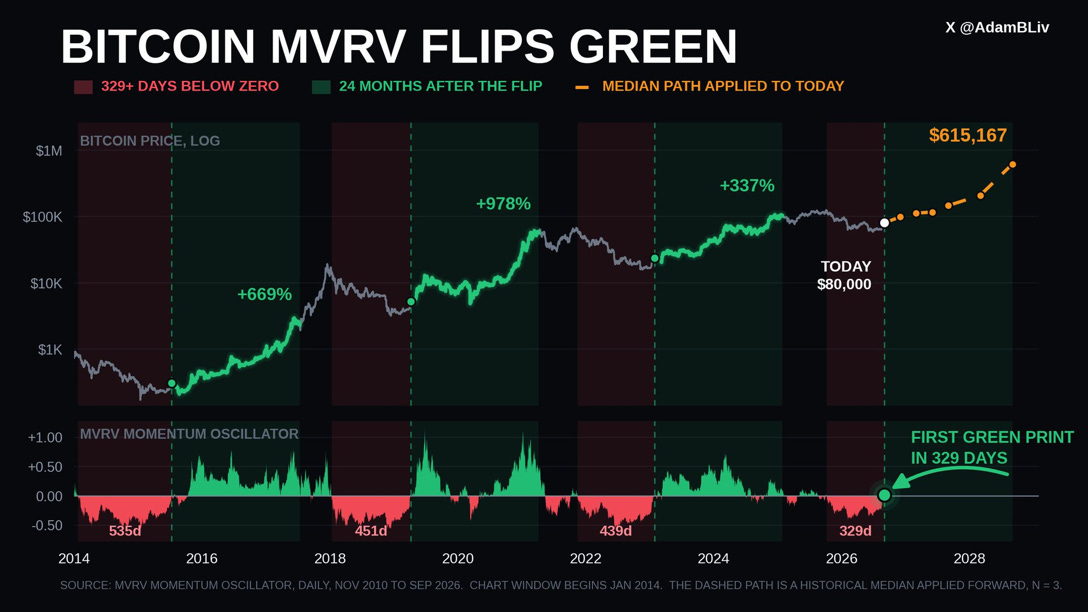
The bear market is likely over. The bulls are in charge. The data is piling up. Bitcoin is ready to do bitcoin things again. Hopefully you held through all the pain because my guess is that everyone is about to get rewarded.
Hope you have a great start to your week. I will talk to you next time.
- Anthony J. Pompliano
Founder & CEO, ProCap Financial (Nasdaq: BRR)
Jordi Visser is a veteran macro investor with 30+ years of experience and the author of the VisserLabs Substack.
In this conversation, we break down why rising interest rates may not derail the AI-driven economy, bitcoin's path to new highs and the four-year cycle debate, and how AI agents are already reshaping markets, business management, and crypto adoption. We also cover tokenization, portfolio allocation, and why a 0% crypto weighting no longer makes sense.
Figure – True DeFi Democratized Prime yielding ~8.5% APY. They also have the lowest industry interest rates at 8.91% with 12 month terms! Take out a Crypto Backed Loan today. Figure Lending LLC dba Figure (NMLS 1717824)
Arch Public’s platform automates your trading strategy beyond DCA for equities, commodities, ETFs, and crypto. With advanced inputs that reflect your own intentions, Arch Public supports smarter entries, exits, and opportunities in volatile markets. Connect with their team, try the product for free, and see how agentic trading can work for you, with Arch Public!
Lava - The Lava Card allows you to earn up to 5% back in bitcoin every time you spend. There are no annual fees, no FX fees, and no gimmicks. You can also use Lava to borrow against your bitcoin at 6.5%, the industry’s lowest interest rate. Get started in just a few minutes at lava.xyz/pomp!
GalaxyOne – Earn up to 8.00% yield on cash. Auto-Reinvest into stock and crypto.
Simple Mining offers a premium white-glove Bitcoin mining service. Want to grow your Bitcoin stack? Visit https://www.simplemining.io/pomp
Uphold - Uphold is the all-in-one platform to trade, earn, stake, and swap across 300+ assets with real-time proof-of-reserves and any-to-any conversions. Manage your entire crypto portfolio in one place at www.uphold.com
BloFin - BloFin is a fast-growing cryptocurrency exchange focused on providing professional-grade trading tools, deep liquidity, and a secure trading environment for crypto traders worldwide.
🚨READER NOTE: If you want to sponsor The Pomp Letter, you can fill out this form and someone from our team will get in touch with you.
You are receiving The Pomp Letter because you either signed up or you attended one of the events that I spoke at. Feel free to unsubscribe if you aren’t finding this valuable. Nothing in this email is intended to serve as financial advice. Do your own research.
Figure Lending LLC dba Figure. Equal Opportunity Lender.
NMLS 1717824. Terms and conditions apply.
2026-09-02 21:46:12
To investors,
Every founder, executive or investor I talk with these days wants to know how others are using AI in their daily lives. I figured it would be helpful to pull back the curtain on what I am using and how I have implemented the various products.
There are three areas where I have adopted AI in a material way: professionally, financially, and personally.
On the professional side, I am currently using Grok Bot extensively. I started with a Chief of Staff bot that I put in charge of the entire operation, followed by a number of more specialized bots for various bodies of work (talent recruiter, product designer, podcast researcher, book launch manager, email organizer, etc). Once I had the initial team of bots set up, I spent about an hour “onboarding” the Chief of Staff to my professional life.
I treated this exactly how I would onboard a human Chief of Staff. I explained each business I am involved with, including their products, business model, personnel, metrics, and goals. I explicitly called out what the business is doing well and where we need to improve. I also gave the Chief of Staff access to relevant systems (email, calendar, Slack, analytics dashboards, etc).
Once I had given as much context as I thought necessary, I asked the Chief of Staff to create an overview document to send me so I could double-check the accuracy and thoroughness of the bots understanding. I also asked the CoS bot to interview me for any other information that would be relevant to ensuring the bot could help me.
This entire process was fairly quick and painless, but I believe it was the single most important thing I did to get value from Grok Bot. The more context that the AI system has, the more helpful it can be. That context can come from static, institutional knowledge or it can come from dynamic daily updates like email and Slack messages.
After getting the bots set up and giving them context, I have done two other things that I think are worth sharing. The first is that my team of bots holds a daily standup meeting where they all come together and share what they did yesterday, what they are going to do today, and what they need my help or approval on (aka what they are blocked on). These “exec meeting” or daily standup allows for the bots to collaborate in a more seamless way, while also creating a very simple process for the Chief of Staff bot to put together a daily brief for me on what happened yesterday, what is going to happen today, and where I am needed to unblock productivity.
The second thing I have done is treat the AI system as the brain of the company. Most people try to use AI as an augmentation to themselves, which can be helpful to a degree. I have flipped the relationship though. I look at my job as persistently giving the AI bots as much context as possible, so I can leverage their superhuman intelligence to make decisions and achieve our goals.
For example, the recruiter bot recently surfaced a number of very high-quality candidates for an open role we have. After meeting with each candidate, I wrote a quick message to the recruiter bot to tell it what I liked about the person, what I thought were potential issues, improvements for future searches, and what the next steps were with each individual.
All of that information and context is getting stored in the bot’s memory, which will compound over time and help us improve as an organization. Quick pro tip: If you are worried about putting all of the context into a single system’s memory, but unsure if that is the system you will use forever, you can have Grok Bot or another system dump their memory and context into a Notion document as well. This way you have a duplicate copy of the memory so it can be referenced by any AI system you use in the future.
My takeaway from using Grok Bot to manage our companies is that we are having to hire less people, we are seeing a direct impact on revenue growth, and it appears to drive higher quality in our decision-making process. That is a win-win-win. I highly recommend going through these steps to setup your system correctly and it will pay off big time later on.
On the financial side, it was nearly impossible to find a good AI product to use for personal finance. Everything seemed to be a Chat-GPT wrapper that technically worked from an engineering standpoint, but didn’t solve any of the user problems I was facing. A big issue is that most of the fintech products are focused on budgeting and saving, rather than investing and growing your portfolio.
This is why I eventually spent the time and money to build CFO Silvia. I went through a similar process of getting Silvia set up with the necessary context. I attached my bank accounts, brokerage accounts, crypto accounts, and credit cards, along with uploading real estate, cars, collectibles, and private investments. Silvia allows me to dynamically track the value of these assets (and my overall net worth) in real-time.
But the real unlock for me has been talking to Silvia about two specific topics: tax and estate planning.
As most of you know, I am not a frequent trader, so although you could use Silvia for stock analysis or trading activities, that is not my approach to investing. Instead, I have had great success in using Silvia to find creative and valuable tax mitigation strategies that are personalized to my situation, including ideas that had not previously been surfaced by my accountants, lawyers, or tax experts.
Additionally, I have used Silvia for estate planning purposes. I am married and have four children, so there is a decent amount of complexity and opportunities to pursue. Having a dedicated resource with superhuman intelligence and the full context of my personal financial situation has been incredibly powerful. One funny thing I have noticed is that I am willing to tell Silvia certain things that I would hesitate to tell other humans (financial goals, areas of concern, etc) and I ask numerous “dumb” questions that I would probably shy away from asking a human.
Regardless of why I feel more comfortable talking to the AI product, it has unlocked a few different ideas and strategies that I was previously unaware of, so that has been an added bonus to using the product. If you aren’t using AI to help manage your finances, I think it is a no brainer to start using the technology. I am biased towards Silvia since we built it, but you can give it a try for free by clicking here.
On the personal side, I use almost all of the traditional AI products (Chat-GPT, Claude, Grok, Gemini, Perplexity, etc). Those are well understood at this point, but one product that I started using recently that I am impressed with is Instinct AI.
They have built a personal assistant AI bot that you communicate with through iMessage or SMS. The experience has been delightful, but I am most excited about the bot’s ability to anticipate the second or third-step in a process before I have to tell it anything.
For example, Instinct got access to my calendar and immediately started identifying scheduling conflicts and asked me if I would like the bot to reach out to one of the parties to reschedule. I never told it to look for conflicts, nor did I tell it I wanted help rescheduling things. It’s “instincts” knew what the basic task would be and began executing.
Another example is that Instinct was told my wife is Polina, so whenever it deems something important to the household or family, Instinct will add Polina to the calendar invite, communicate the information to her, or ask me if Polina should be aware of the information. This is very helpful for someone like me who has too many things floating around in my brain and should always do a better job of keeping Polina informed about various things.
Lastly, Instinct is very helpful in scanning my personal email and understanding what is most important. It ignores things that are trivial, but somehow can parse out the high priority items, summarize them for me in a text message, draft a response to the email, and then ask me for permission to respond. As I said, it is the most impressive personal assistant AI product I have used so far.
So those are the three big areas that I use AI today and the specific products I have incorporated into my life. Before I let you go, I figured I could share some best practices I have learned as well. I also make sure to tell AI bots they are not allowed to respond to any message or email without my explicit approval. This reduces the risk of having a bot go rogue with a message or commitment that I am not onboard with.
I also ensure that each bot only has read access to our business systems like an analytics dashboard, etc. While I am a big proponent of using these products and believe they will fundamentally transform how we operate professionally, I am still not ready to let them loose without human oversight. I am sure that will change in the coming weeks and months, but I need more time to get comfortable with that level of delegation and trust.
You can watch this video for a quick overview of what I have written here too:
I hope this overview was helpful for each of you. It would be great if you could respond to this email with any products you are using or tips/tricks that you have learned to get more productivity and value in your life. I love writing these letters each day because I learn just as much from me as I learn from you all.
Hope you have a great day. I will talk to everyone next time.
- Anthony J. Pompliano
Founder & CEO, ProCap Financial (Nasdaq: BRR)
BloFin is a fast-growing cryptocurrency exchange built for serious crypto and TradFi traders.
Trade 500+ spot pairs and hundreds of futures and perpetual pairs across crypto and TradFi, plus stock indices and commodities like oil and gold — all with deep liquidity, professional-grade tools, and zero internal market makers, so you’re never up against the house.
Jordi Visser is a veteran macro investor with 30+ years of experience and the author of the VisserLabs Substack.
In this conversation, we break down bitcoin’s historic recovery and the key levels that matter, the fight between Kevin Warsh and Scott Bessent over interest rates, and why Jordi is rotating more of his money into Ethereum and Solana. We also discuss AI agents, tokenization, and just how high bitcoin could realistically go.
Figure – True DeFi Democratized Prime yielding ~8.5% APY. They also have the lowest industry interest rates at 8.91% with 12 month terms! Take out a Crypto Backed Loan today. Figure Lending LLC dba Figure (NMLS 1717824)
Arch Public’s platform automates your trading strategy beyond DCA for equities, commodities, ETFs, and crypto. With advanced inputs that reflect your own intentions, Arch Public supports smarter entries, exits, and opportunities in volatile markets. Connect with their team, try the product for free, and see how agentic trading can work for you, with Arch Public!
Lava - The Lava Card allows you to earn up to 5% back in bitcoin every time you spend. There are no annual fees, no FX fees, and no gimmicks. You can also use Lava to borrow against your bitcoin at 6.5%, the industry’s lowest interest rate. Get started in just a few minutes at lava.xyz/pomp!
Simple Mining offers a premium white-glove Bitcoin mining service. Want to grow your Bitcoin stack? Visit https://www.simplemining.io/pomp
Uphold - Uphold is the all-in-one platform to trade, earn, stake, and swap across 300+ assets with real-time proof-of-reserves and any-to-any conversions. Manage your entire crypto portfolio in one place at www.uphold.com
BloFin - BloFin is a fast-growing cryptocurrency exchange focused on providing professional-grade trading tools, deep liquidity, and a secure trading environment for crypto traders worldwide.
🚨READER NOTE: If you want to sponsor The Pomp Letter, you can fill out this form and someone from our team will get in touch with you.
You are receiving The Pomp Letter because you either signed up or you attended one of the events that I spoke at. Feel free to unsubscribe if you aren’t finding this valuable. Nothing in this email is intended to serve as financial advice. Do your own research
2026-08-31 23:20:59

Arch Public just keeps hitting home runs - and the numbers tell the ‘moonshot’ story over and over again. Arch Public equities and ETF tools blow away both buy and hold and DCA returns. Some numbers to consider1:
+ NVDA 523.6%
+ TSLA 129.3%
+ MSTR $260,841 (Cash Yield)
+ MARA $130,147 (Cash Yield)
Both total return and turning high growth, high volatility stocks into cash yield machines are what our warehouse of agentic, algorithmic tools specialize in. And, during our webinar last week, Anthony announced that he has signed up for Arch’s tools and will be using them personally going forward. Take a look at what Arch can do for you, completely hands free with equities, ETF’s, Bitcoin, and crypto. You won’t be disappointed.
To investors,
I am fond of the saying “hard work never goes out of style.” There is a blue collar, self-made theme to this timeless advice. But what if hard work is not enough anymore when it comes to generating financial security for the average American?
Normally I would brush that question off as some insane talking point from the Democratic Socialists of America, but this chart from Quinten Francois forced me to think a little deeper about the problem over the weekend:
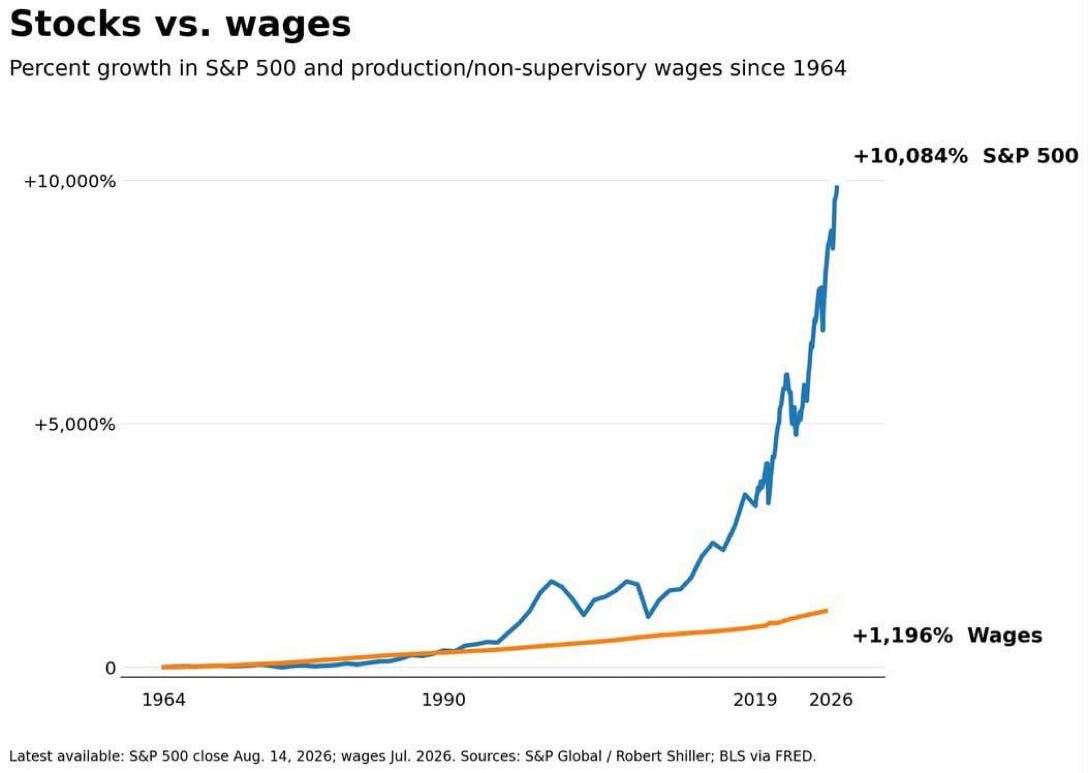
This chart is the root cause for so many issues in society. Asset owners have been handsomely rewarded for their understanding of the system, while the remainder of citizens have been punished for following the advice of their grandparents to get a good job, spend less than they make, and save for a rainy day.
Wages are up almost 12x since the mid-1960s. That is a big number. But it is dwarfed in comparison to the 100x from the S&P 500 in the same time frame. The idea of investing in low-cost index funds and chilling has never had a better advertisement.
This chart is looking in the rearview mirror though. What about expectations or the future?
Well, Adam Kobeissi explains that things are going to get much worse before they ever get better:
“US M2 money supply surged +$102.8 billion in July, to a record $23.22 trillion.
This marks the 27th consecutive monthly increase. Since the start of 2026, M2 has now risen +$862.7 billion.
Furthermore, money supply now stands $1.43 trillion above the March 2022 peak. Since 2000, money in circulation has grown at an average annual rate of +6.3%, or ~$700 billion a year.
US money creation is expanding at a rapid pace.”
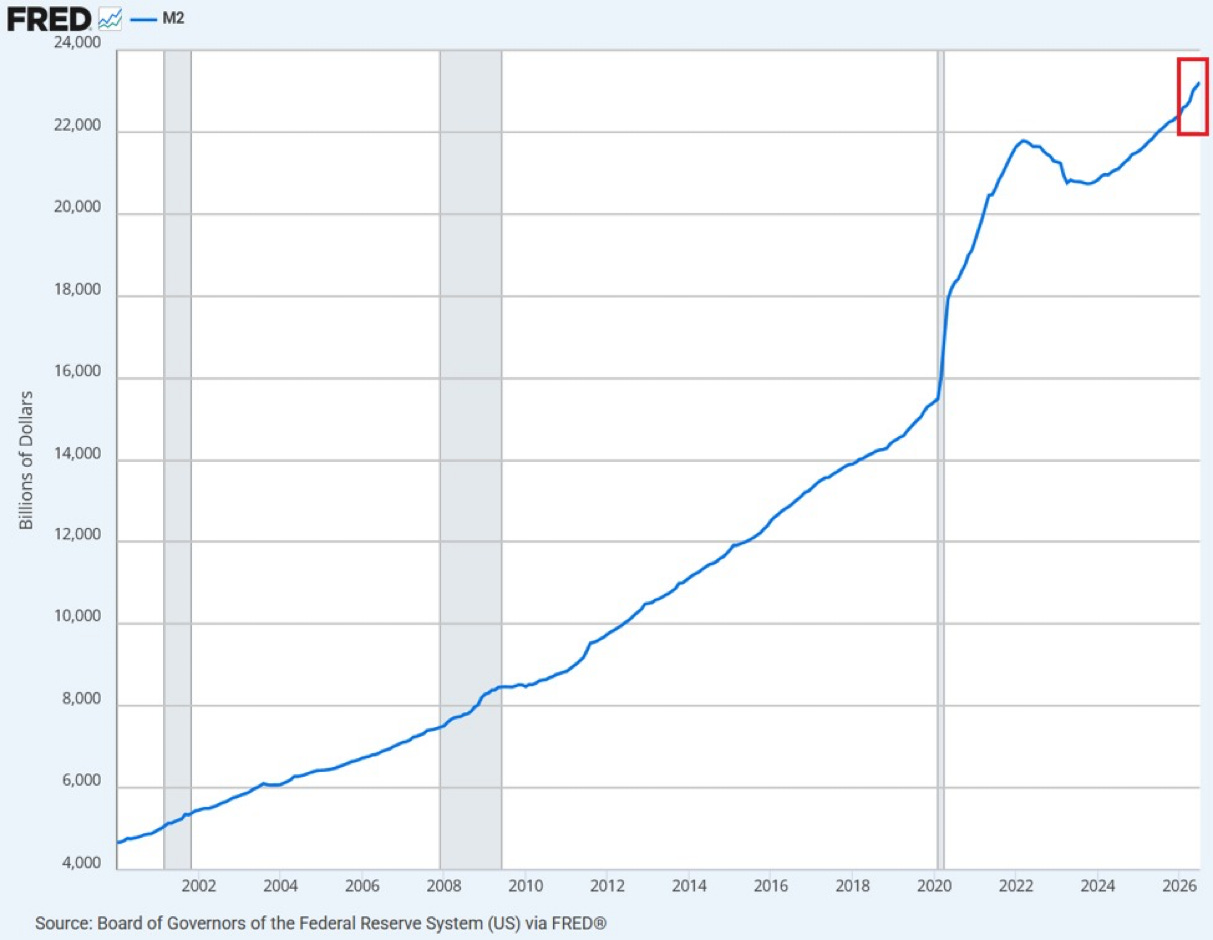
If this chart doesn’t scare you, remember that the annual interest expense on the national debt is now more than $1 trillion. That is only going to accelerate as politicians spend more money, interest rates stay high, and no one has the courage to stop the runaway train.
It is much easier for politicians to keep promising free things to voters. Remember, they aren’t spending their own money. They are spending our money. I have always thought you would stop the undisciplined spending if you could require politicians to invest personal dollars in every spending initiative. Make them have real skin in the game. I am willing to bet the federal budget would collapse and we would have a balanced budget over night.
The truth is that politicians don’t want a balanced budget. This means we won’t get one, which essentially guarantees that wages can’t keep up with investment assets.
So now we are back to where we started: has hard work gone out of style if you want to achieve financial security?
Of course not. But hard work is definitely not the only ingredient you need. I don’t know a single person that is wealthy who wasn’t able to generate a significant amount of their wealth by owning investment assets.
So which assets am I most bullish on going forward?
Bitcoin. Gold. Land.
Those are going to be the three assets that should outperform the productive assets in the public equities market. The money printer is just warming up. The hard assets built to insulate you from the money printer will show up and do their job. So you don’t have to overthink this one.
I want a portfolio filled with resilient assets that are optimized for the long-term. Assets that go up significantly when politicians do what they are incentivized to do. Quite literally, I want to hold the things that politicians are likely to inflate.
You can choose your own mix or allocation diversification between these three assets. But just make sure you have exposure. Because a 0% allocation to bitcoin, gold, and land is going to be a bad answer in the coming years.
Hope you all have a great start to your week. I will talk to you next time.
- Anthony J. Pompliano
Founder & CEO, ProCap Financial (Nasdaq: BRR)
Jordi Visser is a veteran macro investor with 30+ years of experience and the author of the VisserLabs Substack.
In this conversation, we break down bitcoin's historic recovery and the key levels that matter, the fight between Kevin Warsh and Scott Bessent over interest rates, and why Jordi is rotating more of his money into Ethereum and Solana. We also discuss AI agents, tokenization, and just how high bitcoin could realistically go.
Figure – True DeFi Democratized Prime yielding ~8.5% APY. They also have the lowest industry interest rates at 8.91% with 12 month terms! Take out a Crypto Backed Loan today. Figure Lending LLC dba Figure (NMLS 1717824)
Arch Public’s platform automates your trading strategy beyond DCA for equities, commodities, ETFs, and crypto. With advanced inputs that reflect your own intentions, Arch Public supports smarter entries, exits, and opportunities in volatile markets. Connect with their team, try the product for free, and see how agentic trading can work for you, with Arch Public!
GalaxyOne – Open an account with promo code POMP and deposit $10,000 to earn a $1,000 bonus. Terms apply. https://www.galaxy.app/pomp1000
Lava - The Lava Card allows you to earn up to 5% back in bitcoin every time you spend. There are no annual fees, no FX fees, and no gimmicks. You can also use Lava to borrow against your bitcoin at 6.5%, the industry’s lowest interest rate. Get started in just a few minutes at lava.xyz/pomp!
Simple Mining offers a premium white-glove Bitcoin mining service. Want to grow your Bitcoin stack? Visit https://www.simplemining.io/pomp
Uphold - Uphold is the all-in-one platform to trade, earn, stake, and swap across 300+ assets with real-time proof-of-reserves and any-to-any conversions. Manage your entire crypto portfolio in one place at www.uphold.com
BloFin - BloFin is a fast-growing cryptocurrency exchange focused on providing professional-grade trading tools, deep liquidity, and a secure trading environment for crypto traders worldwide.
🚨READER NOTE: If you want to sponsor The Pomp Letter, you can fill out this form and someone from our team will get in touch with you.
You are receiving The Pomp Letter because you either signed up or you attended one of the events that I spoke at. Feel free to unsubscribe if you aren’t finding this valuable. Nothing in this email is intended to serve as financial advice. Do your own research
Backtested results across three windows ending June 2026; figures are percentage-point differences in return, not multiples
2026-08-27 23:28:43
Arch Public just keeps hitting home runs - and the numbers tell the ‘moonshot’ story over and over again. Arch Public equities and ETF tools blow away both buy and hold and DCA returns. Some numbers to consider1:
+ NVDA 523.6%
+ TSLA 129.3%
+ MSTR $260,841 (Cash Yield)
+ MARA $130,147 (Cash Yield)
Both total return and turning high growth, high volatility stocks into cash yield machines are what our warehouse of agentic, algorithmic tools specialize in. And, during our webinar last week, Anthony announced that he has signed up for Arch’s tools and will be using them personally going forward. Take a look at what Arch can do for you, completely hands free with equities, ETF’s, Bitcoin, and crypto. You won’t be disappointed.
To investors,
Bitcoin has disappointed many investors over the last year. We watched everyone’s favorite digital asset drop more than 50% from the all-time high of $125,000. The good news is that the bear market is likely over and we are in the process of starting the next bull market.
Here are five charts that should get you excited about bitcoin’s returns over the next 18-24 months.
First, Quinten Francois shows the relationship between bitcoin’s electrical costs and RSI. You can clearly see the historical pattern of this relationship bottoming simultaneously.
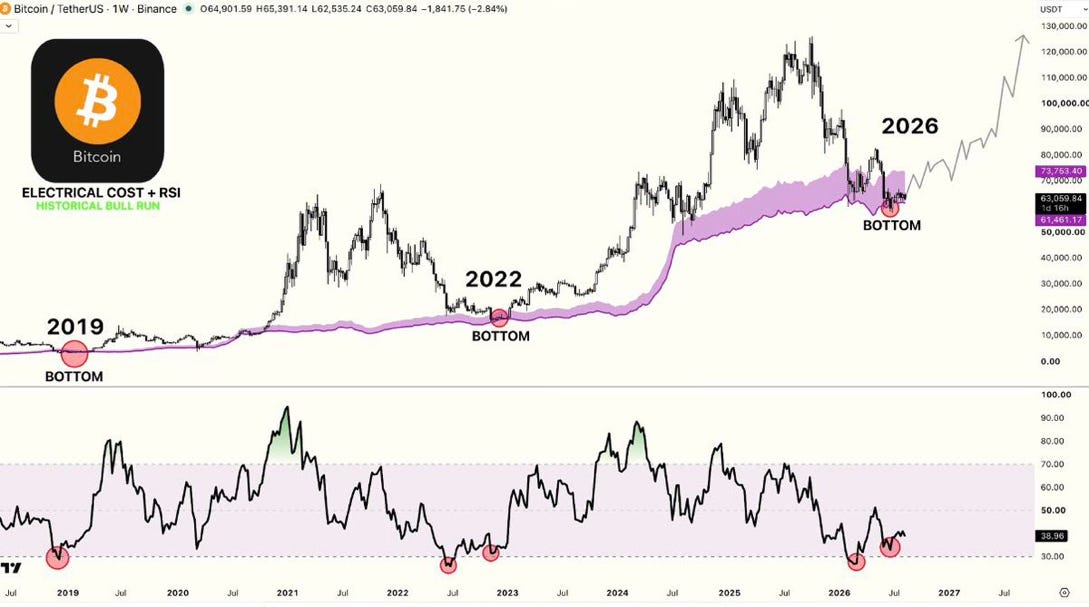
If history repeats, this is a good signal that a bull market has begun.
Second, Will Clemente shows there is an all-time high correlation between bitcoin and gold right now. This is important as the debasement trade makes a comeback due to Scott Bessent’s recent promise of more government spending.
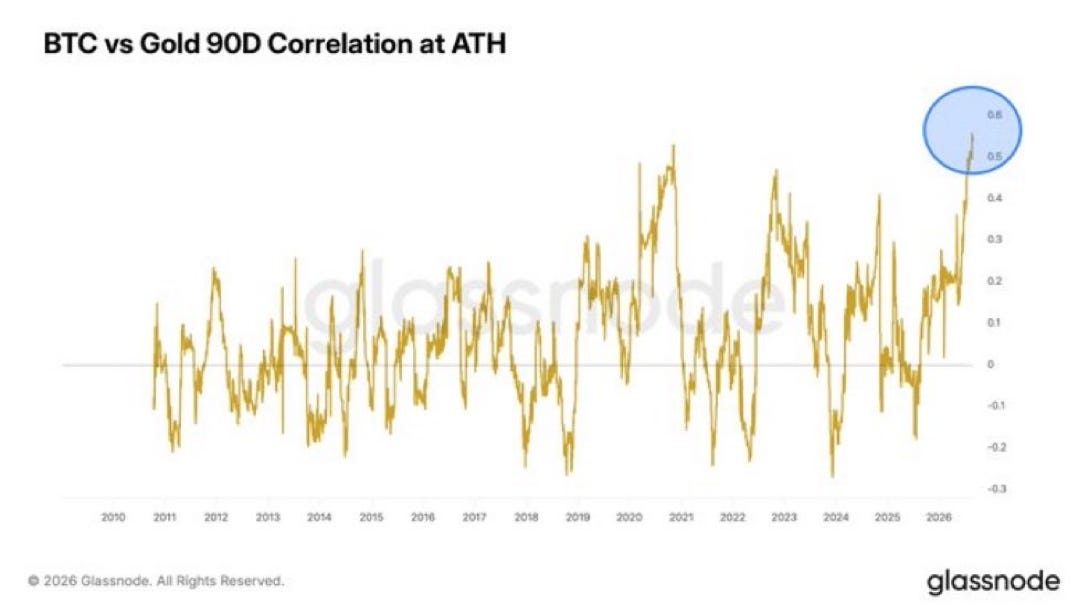
I continue to repeat the classic bitcoin mantra: bitcoin has no top because the dollar has no bottom. And given the government’s insane commitment to destroying dollar purchasing power, even with the current $40+ trillion national debt, you have to be mentally slow to think they won’t continue the undisciplined trend.
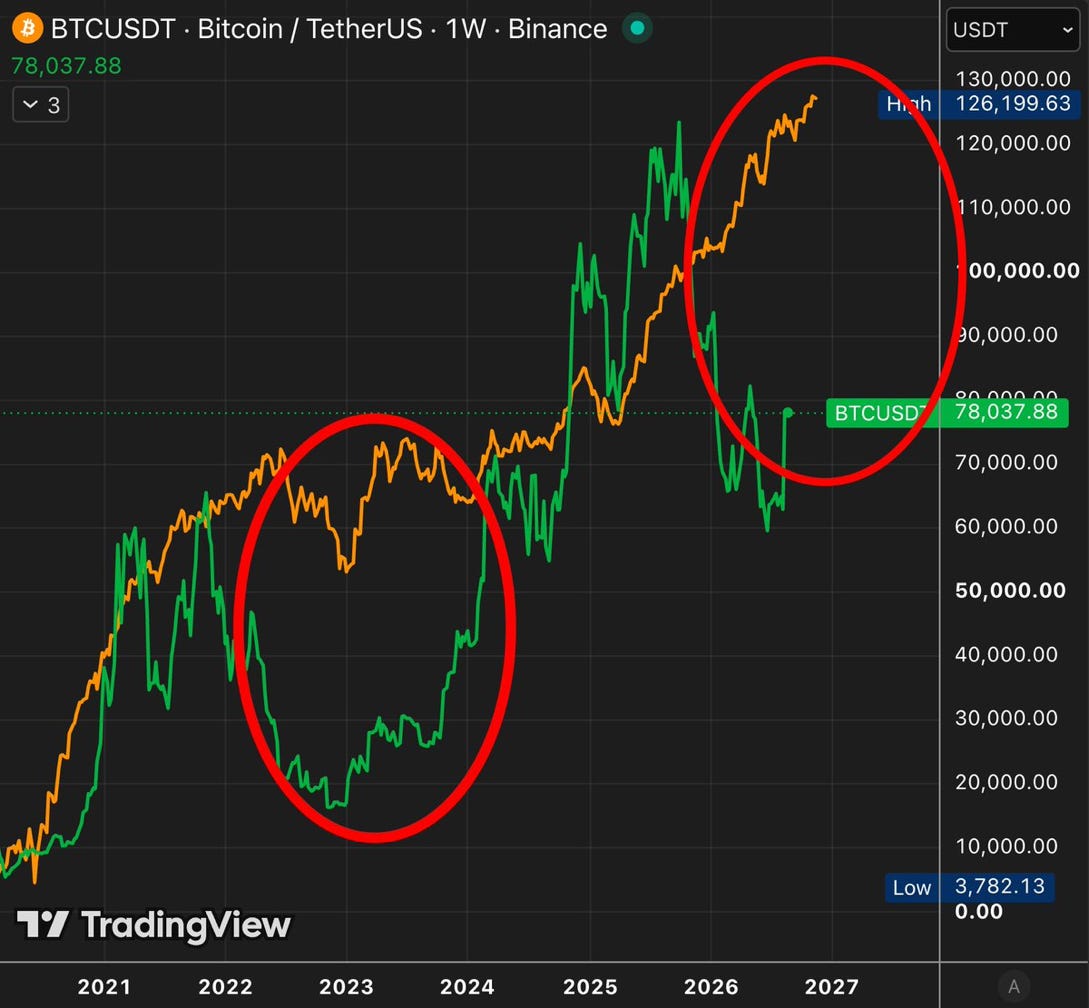
Third, bitcoin has historically followed the M2 money supply, but recently there was a large divergence when bitcoin fell at the same time that M2 was continuing to grow. This caused many people to give up on the measurement, but you can see there have been large divergences in the past. When the gap closed, it was bitcoin catching up rather than M2 slowing down.
Fourth, I am not usually one to draw lines on charts and hope my investment portfolio goes up, but I find this analysis from R89 Capital compelling. Bitcoin seems to be bouncing off the bottom of a structured zone that should lead to higher prices in the coming weeks and months.
Finally, the entire secret to investing in bitcoin is that time in the market outperforms timing the market. Jeff John Robert’s shared this chart from Bloomberg and wrote “Bitcoin investing has come to resemble the S&P, where most gains come from big rebound days—and it’s disastrous if you sell and miss those days. Bloomberg chart shows annual BTC returns—with and without 10 days where biggest gains occurs.”
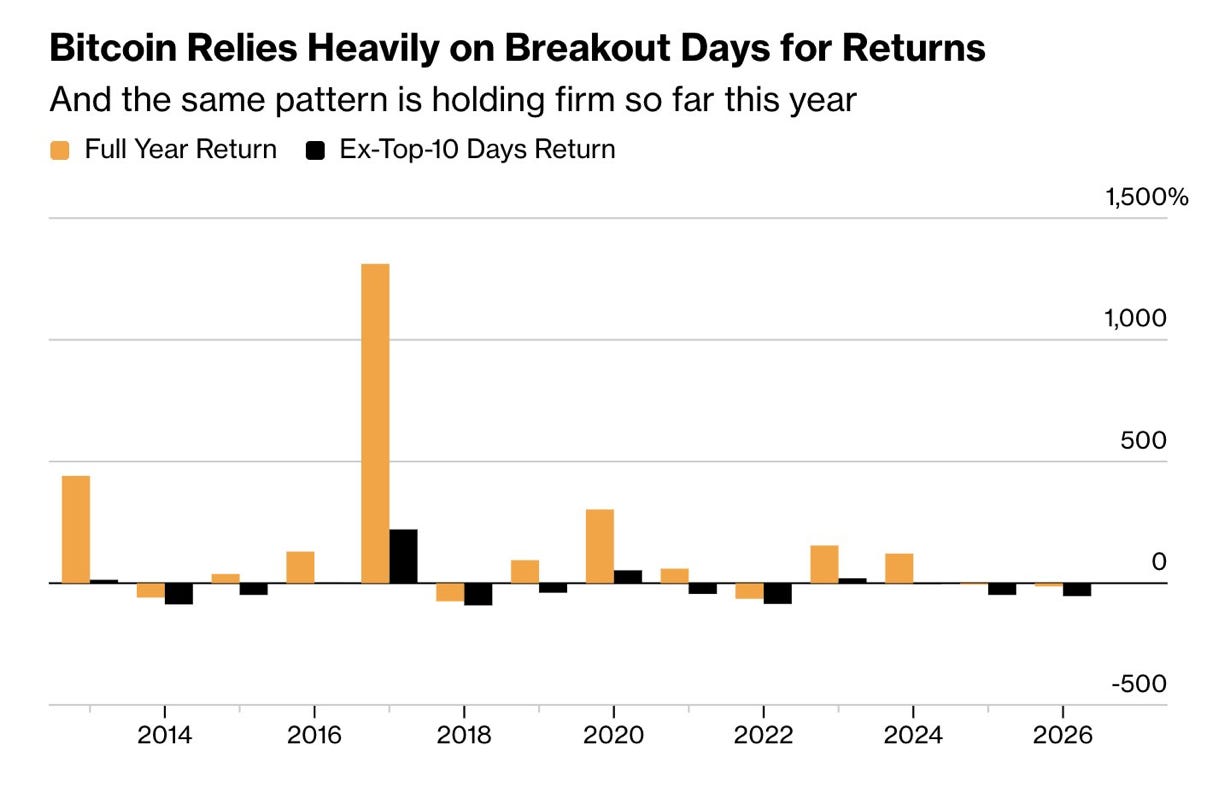
It really is that simple. The bitcoin bear market was shorter and less severe than past cycles. But stop looking in the rearview mirror. A new bull market is upon us. Bitcoin is going to appreciate significantly from here. There will be lots of volatility. The gyrations won’t be for the faint of heart, but those who understand bitcoin and refuse to sell during the volatility will likely be rewarded handsomely.
Hope you all have a great day. I will talk to everyone next time.
- Anthony J. Pompliano
Founder & CEO, ProCap Financial (Nasdaq: BRR)
Arthur Hayes is the CEO of Flop Labs and CIO of Maelstrom.
In this conversation, we break down Treasury Secretary Scott Bessent's money printing playbook, the controversy around Stanley Druckenmiller's AI-written op-ed, and why bitcoin got overshadowed by the AI trade in 2025. We also discuss gold's next move, how Arthur allocates across bitcoin, gold, and public equities, and his new project tokenizing AI compute itself.
Figure – Get a slice of $160,000 with their Community Appreciation event. T&Cs apply. True DeFi Democratized Prime yielding ~8.5% APY. They also have the lowest industry interest rates at 8.91% with 12 month terms! Take out a Crypto Backed Loan today. Figure Lending LLC dba Figure (NMLS 1717824)
Arch Public’s platform automates your trading strategy beyond DCA for equities, commodities, ETFs, and crypto. With advanced inputs that reflect your own intentions, Arch Public supports smarter entries, exits, and opportunities in volatile markets. Connect with their team, try the product for free, and see how agentic trading can work for you, with Arch Public!
Lava - The Lava Card allows you to earn up to 5% back in bitcoin every time you spend. There are no annual fees, no FX fees, and no gimmicks. You can also use Lava to borrow against your bitcoin at 6.5%, the industry's lowest interest rate. Get started in just a few minutes at lava.xyz/pomp!
Simple Mining offers a premium white-glove Bitcoin mining service. Want to grow your Bitcoin stack? Visit https://www.simplemining.io/pomp
Uphold - Uphold is the all-in-one platform to trade, earn, stake, and swap across 300+ assets with real-time proof-of-reserves and any-to-any conversions. Manage your entire crypto portfolio in one place at www.uphold.com
BloFin - BloFin is a fast-growing cryptocurrency exchange focused on providing professional-grade trading tools, deep liquidity, and a secure trading environment for crypto traders worldwide.
🚨READER NOTE: If you want to sponsor The Pomp Letter, you can fill out this form and someone from our team will get in touch with you.
You are receiving The Pomp Letter because you either signed up or you attended one of the events that I spoke at. Feel free to unsubscribe if you aren’t finding this valuable. Nothing in this email is intended to serve as financial advice. Do your own research.
Backtested results across three windows ending June 2026; figures are percentage-point differences in return, not multiples
2026-08-25 21:50:44

A lot of people have their money working for them. The real question is how hard. That’s what GalaxyOne is built around.
If you make over $200K a year or over $300K a year combined, you probably qualify as an accredited investor. Galaxy Premium Yield pays 8.00% on cash, guaranteed by Galaxy Digital. Everyone on GalaxyOne earns 3.50% APY on GalaxyOne Cash, and FDIC-insured checking account power by Cross River bank.1
The best part is you can set that interest to auto-invest straight into your favorite stock, ETF, or crypto.2 You don’t have to think about it every month.
Right now GalaxyOne is running a crazy promo — a $3,000 cash bonus when you deposit $10,000 or more in cash or crypto.
To investors,
Scott Bessent is one of the best macro traders in the world. It has been well documented that he got an elite investing education while working under George Soros, but there is another investor who may be slightly more famous and widely recognized as the best Soros protege: Stanley Druckenmiller.
Debating which one of these guys is better is like trying to pick between a Ferrari and Lamborghini. The exercise is futile and your answer probably relies more on personal preference than an objective difference.
The shared lineage of these two men is what makes the recent debate around the US Treasury’s announcement to “at least double, the size of liquidity support buyback operations for longer-dated nominal coupon securities.”
Bessent obviously believes that he can manipulate long-term yields lower by engaging in this activity. He was proven correct initially after the announcement, but long-term yields have already rebounded back to the same level amid concerns around the national debt and continued money printing.
It remains to be seen whether the Treasury has enough firepower to have a lasting effect, even if they continue signaling their $1 trillion general account is available if needed.
On the other side of the debate is Stanley Druckenmiller. He published an op-ed in the Wall Street Journal yesterday titled “Let the Bond Market Speak.” The subtitle reads “Rising interest rates are a signal of trouble ahead. Artificially suppressing it heightens the danger.”
Those words don’t exactly leave much for interpretation. Druckenmiller is explicitly disagreeing with Bessent and the Treasury in public. I would normally expect a disagreement to be handled through a private phone call, but a public dissent like this probably means Druckenmiller feels public pressure is the only way to reverse course.
In the op-ed, he concludes that the long-dated bond yields bouncing back to the same levels post-announcement from the Treasury can only mean one thing: “The market’s verdict was swift and correct: This wasn’t liquidity management, it was price management—and a mistake far larger than $4 billion suggests.”
I personally thought Druckenmiller’s argument about price discovery was the most important part of the op-ed. It reads:
“I have spent five decades trading on a simple premise: Markets aggregate information no committee possesses, and prices are how that information reaches decision makers. The long-term Treasury yield is the most important price in the world. It is also the only fiscal disciplinarian the U.S. has left. Neither party will run on entitlement reform. Both have spent the past decade expanding commitments while ignoring arithmetic. Democracies don’t repair their finances because a budget office publishes a table. They repair them only when the cost of inaction becomes visible and immediate, when mortgage rates bite, when auctions tail, when the political price of a rising long bond finally exceeds the political price of touching spending.
Every basis point of artificial yield suppression is a subsidy to procrastination. Suppressed long rates sugarcoat the interest-cost projections, shrink the apparent urgency, and let incumbents assure voters the debt is someone else’s problem. If Congress and the administration are unlikely to touch entitlements even with the market’s signal, they are certain not to touch them without one. Whatever this operation saves in basis points, it will cost multiples in delay.”
This all seems fairly logical, right? I agree.
But if Druckenmiller is right, which I believe he is, then it would require us to believe that Scott Bessent is completely missing the obvious data. I find that very, very hard to believe. He is too smart and too experienced to make such a rookie mistake.
This left me confused until I realized an important aspect of Druckenmiller’s op-ed. The entire thing was written by AI. Yes, you read that right. The AI measurement tools online say 100% of the op-ed is written by AI.
The reason this is important is because it tells me that Druckenmiller was not overly passionate about this situation and probably put it together rather quickly. AI is very good at doing that for someone. So why would Druckenmiller put together an op-ed quickly, especially one that critiqued his friend and former colleague in one of the most popular financial newspapers in the world?
Well…what if Bessent asked him to do it? What if the situation everyone thinks is Bessent vs Druckenmiller is actually Besssent AND Druckenmiller.
Under this perspective, Bessent would understand that the Trump administration is trying to print too much money. He knows the damage that is being done. But he also wants to keep his job. So Bessent has to do the things necessary to appease his boss, while still wanting politicians in DC to understand the signal being provided by long-dated yields.
So what do you do in that scenario?
You announce the intention to double your purchases and spend billions of dollars. And then you have your homie write an op-ed saying the government should be doing the opposite and people need to stop manipulating the market.
This is chess, not checkers.
While the media will run with the narrative that Bessent and Druckenmiller fundamentally disagree on the path forward, I just don’t believe that. They both have previously spoke publicly about the need for the government to become more disciplined. They come from the same school of thought. They both are incredible macro traders. And there is no chance that Druckenmiller surprise attacked Bessent in public like that.
So sit back and watch the show. The financial geniuses are using every tool in their toolbox, including manipulation of the mainstream media, to address the dismal financial position the US finds itself in.
The bad boys of finance just played their hand masterfully. And they did it together.
Hope you have a great day. I will talk to everyone next time.
- Anthony J. Pompliano
Founder & CEO, ProCap Financial (Nasdaq: BRR)
Dr. Roman Yampolskiy is a professor of computer science at the University of Louisville and one of the world's leading AI safety researchers, credited with coining the term "AI safety" over a decade ago.
In this conversation, we break down why he believes superintelligence may be fundamentally uncontrollable, and the recent incidents of AI models hacking, lying, and blackmailing their way out of containment. We also get into the surprising relationship between AI and bitcoin, the collapse of trust from deepfakes, and what happens to jobs and society once we cross the AGI threshold.
Figure – Get a slice of $160,000 with their Community Appreciation event. T&Cs apply. True DeFi Democratized Prime yielding ~8.5% APY. They also have the lowest industry interest rates at 8.91% with 12 month terms! Take out a Crypto Backed Loan today. Figure Lending LLC dba Figure (NMLS 1717824)
Arch Public’s platform automates your trading strategy beyond DCA for equities, commodities, ETFs, and crypto. With advanced inputs that reflect your own intentions, Arch Public supports smarter entries, exits, and opportunities in volatile markets. Connect with their team, try the product for free, and see how agentic trading can work for you, with Arch Public!
Lava - Lava allows you to earn up to 5% back in bitcoin every time you spend with Lava Card, borrow against your bitcoin at the lowest rates, earn yield on cash, and move money globally. Get started in just a few minutes at lava.xyz/pomp!
GalaxyOne – Open an account with promo code POMP and deposit $10,000 to earn a $3,000 bonus. Terms apply. https://go.galaxy.app/HMiq/p57n69yy
Simple Mining offers a premium white-glove Bitcoin mining service. Want to grow your Bitcoin stack? Visit https://www.simplemining.io/pomp
Uphold - Uphold is the all-in-one platform to trade, earn, stake, and swap across 300+ assets with real-time proof-of-reserves and any-to-any conversions. Manage your entire crypto portfolio in one place at www.uphold.com
BloFin - BloFin is a fast-growing cryptocurrency exchange focused on providing professional-grade trading tools, deep liquidity, and a secure trading environment for crypto traders worldwide.
🚨READER NOTE: If you want to sponsor The Pomp Letter, you can fill out this form and someone from our team will get in touch with you.
You are receiving The Pomp Letter because you either signed up or you attended one of the events that I spoke at. Feel free to unsubscribe if you aren’t finding this valuable. Nothing in this email is intended to serve as financial advice. Do your own research.
GalaxyOne is a financial technology platform, not a bank. Galaxy Premium Yield is an investment note issued by Galaxy Digital LP and guaranteed by Galaxy Digital Holdings LP — it is an investment product, not a bank deposit, is unsecured, and is not FDIC or SIPC insured. Available to U.S. accredited investors only. Cash deposits held at Cross River Bank, Member FDIC, insured up to $250,000. Annual Percentage Yield is variable and subject to change.
Securities products are not FDIC insured, not bank guaranteed, and may lose value. GalaxyOne Crypto is not FDIC or SIPC insured.